 Back
BackRenal System: Structure, Function, and Regulation
Study Guide - Smart Notes
 Tailored notes based on your materials, expanded with key definitions, examples, and context.
Renal System Overview
Main Organs and Functions
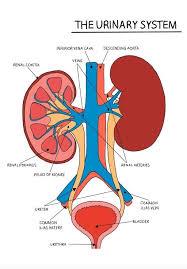
The renal system, also known as the urinary system, is essential for maintaining internal balance and removing waste products from the body. It consists of the kidneys, ureters, bladder, and urethra, each playing a distinct role in filtration, storage, and excretion of urine.
Kidneys: Filter blood and produce urine.
Ureters: Transport urine from kidneys to bladder.
Bladder: Stores urine until excretion.
Urethra: Releases urine from the body.
Renal artery: Brings unfiltered blood to kidneys.
Renal vein: Returns filtered blood to circulation.
Kidney Structure and Function
Internal Anatomy
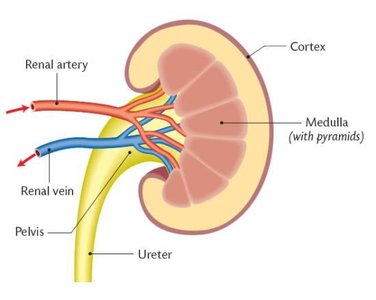
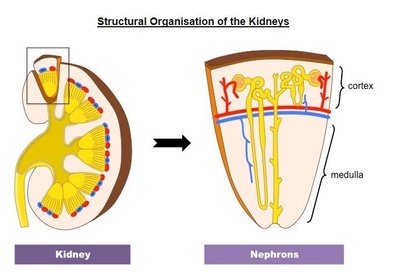
Each kidney contains approximately one million nephrons, which are the functional units responsible for filtration and osmoregulation. The kidney is divided into two main regions:
Cortex: The outer section where ultrafiltration occurs.
Medulla: The inner region involved in osmoregulation and urine concentration.
Nephron Structure
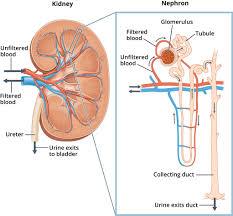
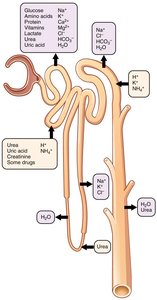
The nephron consists of several key structures:
Glomerulus: Site of ultrafiltration.
Bowman's capsule: Collects filtered products.
Proximal convoluted tubule: Site of selective reabsorption.
Loop of Henle: Establishes concentration gradients for osmoregulation.
Distal convoluted tubule: Further reabsorption.
Collecting duct: Transfers urine to renal pelvis.
Excretion and Osmoregulation
Role in Excretion
Excretion is the removal of metabolic waste products from the body. The kidneys filter out substances such as urea, creatinine, and excess ions, which are then excreted in urine.
Urea: Produced from amino acid breakdown.
Creatinine: From muscle metabolism.
Excess ions: Including sodium, potassium, and chloride.
Role in Osmoregulation
Osmoregulation is the process by which the kidneys maintain water and salt balance. The nephron adjusts water reabsorption, influenced by hormones such as antidiuretic hormone (ADH).
Loop of Henle: Creates a concentration gradient for efficient water reabsorption.
Collecting duct: Adjusts urine concentration based on hormonal signals.
Nephron Function and Filtration Process
Ultrafiltration and Selective Reabsorption
Blood enters the kidney via the renal artery and travels through afferent arterioles to the glomerulus. Here, ultrafiltration occurs, forcing small molecules into the Bowman's capsule. The filtrate then passes through the nephron, where selective reabsorption and osmoregulation take place.
Ultrafiltration: Small molecules (glucose, salt, water, urea) are filtered out; large proteins remain in blood.
Selective reabsorption: Nutrients (glucose, amino acids, vitamins) re-enter the blood in the convoluted tubules.
Osmoregulation: Water and salt are reabsorbed in the loop of Henle and distal tubule.
Summary Table: Parts of the Nephron and Their Functions
Part | Function |
|---|---|
Afferent arterioles | Transport blood to the glomerulus |
Efferent arterioles | Transport blood away from the glomerulus |
Proximal convoluted tubule | Selective reabsorption |
Distal convoluted tubule | Selective reabsorption |
Loop of Henle | Creates water and salt gradient for osmoregulation |
Glomerulus | Ultrafiltration |
Bowman's capsule | Collects products removed from blood |
Collecting duct | Transfers urine to renal pelvis |
Regulation of Water Levels
Hormonal Control
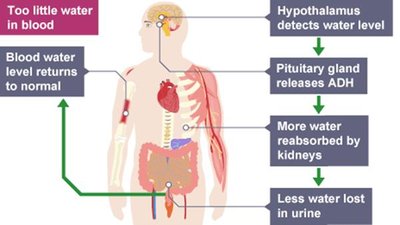
The kidneys regulate water levels in the blood through hormonal control. When water levels are low, the hypothalamus detects this and stimulates the pituitary gland to release ADH, increasing water reabsorption in the collecting duct.
Hypothalamus: Detects changes in blood water levels.
Pituitary gland: Releases ADH (antidiuretic hormone).
ADH: Increases permeability of collecting duct to water.
Summary Table: Kidney Parts and Functions
Part | Function |
|---|---|
Renal Artery | Carries blood from the aorta (heart) to the kidney |
Renal Vein | Carries blood from kidneys to the vena cava (heart) |
Cortex | Contains glomerulus and convoluted tubules; responsible for ultrafiltration and selective reabsorption |
Medulla | Inner part responsible for osmoregulation |
Calyx | Where urine collection begins; collection ducts pass urine to ureters |
Ureters | Carry urine from kidneys to bladder |
Bladder | Stores urine until removal |
Urethra | Tube allowing urine to exit the body |
Key Terms and Definitions
Ultrafiltration: Process where small molecules are forced out of capillaries in the glomerulus; large proteins remain in blood.
Selective reabsorption: Nutrients re-enter the blood in convoluted tubules.
Osmoregulation: Regulation of water and salt levels in the body; excess is removed in urine.
Summary
The renal system is vital for removing waste and maintaining internal balance. The kidneys, through their nephron structure, support both excretion and osmoregulation, ensuring the body retains essential nutrients and water while eliminating metabolic waste.
Relevant Equations
Filtration rate in the glomerulus can be described by:
GFR: Glomerular Filtration Rate
Kf: Filtration coefficient
PGC: Glomerular capillary pressure
PBS: Bowman's space pressure
πGC: Oncotic pressure in glomerular capillaries
Additional info: The above equation is a standard representation of the forces driving filtration in the nephron.
