 Back
Reproduction and Continuity of Life: A Mini-Textbook Study Guide
Study Guide - Smart Notes
 Tailored notes based on your materials, expanded with key definitions, examples, and context.
Reproduction and Continuity of Life
Introduction to Reproduction
Reproduction is the biological process by which organisms produce offspring, ensuring the continuity of genetic information (DNA) from one generation to the next. This process is fundamental for the survival and evolution of species.
Cell theory: All cells arise from pre-existing cells through cell division.
Hereditary continuity: DNA carries genetic information passed from parent to offspring.
Common ancestry: All living organisms share a common ancestor, with evidence of life on Earth dating back at least 3.5 billion years.
Mechanisms Maintaining Continuity
DNA replication: DNA copies itself so genetic information can be passed to new cells or offspring.
Cell division: Mitosis produces genetically similar daughter cells for growth and repair; Meiosis produces haploid cells for sexual reproduction.
Reproduction: Can be asexual (one parent, genetically identical offspring) or sexual (fusion of gametes, genetically varied offspring).
Types of Reproduction
Asexual vs Sexual Reproduction
Asexual reproduction involves a single parent and produces offspring genetically identical to the parent. Sexual reproduction involves the fusion of gametes from two parents, resulting in genetically varied offspring.
Asexual reproduction: Fast, energy-efficient, common in bacteria, protists, fungi, plants, and some animals. Useful in stable environments but produces little genetic variation.
Sexual reproduction: Requires more time and energy, produces genetic variation, increases adaptability to environmental changes.
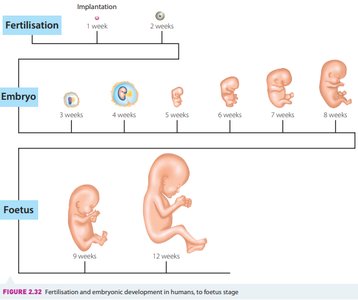
Example: Human sexual reproduction involves the formation of a zygote, which divides by mitosis to form a blastocyst that implants in the uterus.
Genetic Variation in Sexual Reproduction
Crossing over: Homologous chromosomes exchange DNA during meiosis.
Independent assortment: Chromosome pairs separate into different combinations.
Random fertilisation: Different sperm and eggs combine, increasing variation.
Alternation of Generations
Some organisms alternate between sexual and asexual reproductive stages during their life cycle, known as alternation of generations.
Asexual Reproduction in Plants
Vegetative Propagation
Vegetative propagation is a type of asexual reproduction in plants where stems, roots, or leaves produce new plants without fertilisation. The new plants are usually genetically identical to the parent.
Advantages: Rapid growth, no need for seeds or mates, desirable traits maintained, useful in agriculture and horticulture.
Examples: Seedless grapes (cuttings), mangoes (grafting).
Types of Vegetative Propagation
Runners/Stolons: Horizontal stems that grow above ground, forming new plants at nodes. Example: Strawberries.
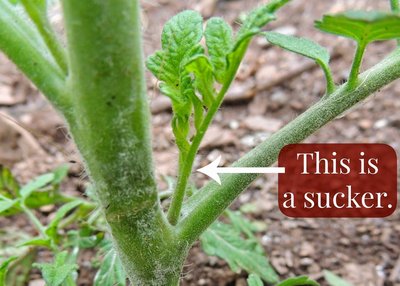
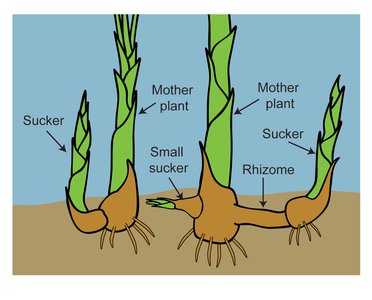
Suckers: New shoots develop from roots or plant base, can become independent plants. Example: Wattles, blackberries.
Rhizomes: Underground horizontal stems, nodes produce roots and shoots. Example: Ginger, grasses, ferns.
Cuttings/Fragmentation: Parts of plants are cut or break off and grow into new individuals. Example: Dragon fruit, willows.
Apomixis: Seeds form without fertilisation, offspring often genetically identical to parent.
Asexual and Sexual Reproduction in Fungi
Fungal Structure and Nutrition
Fungi are eukaryotic organisms that can be unicellular (yeast) or multicellular (moulds, mushrooms). They lack chloroplasts and are heterotrophs, obtaining nutrients from other sources.
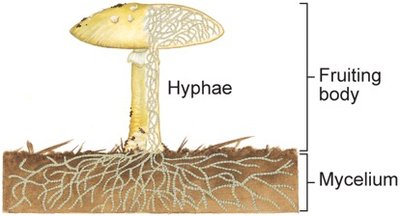
Hyphae: Microscopic threads forming a network called mycelium.
Mycelium: Absorbs nutrients and spreads through the food source.
Asexual Reproduction: Spores
Many fungi reproduce asexually by producing spores, which are reproductive cells that can develop into new organisms without gamete fusion.
Advantages: Rapid reproduction, no mate needed, preserves successful traits.
Disadvantage: Genetically similar offspring may be vulnerable to disease or environmental change.
Sexual Reproduction in Fungi
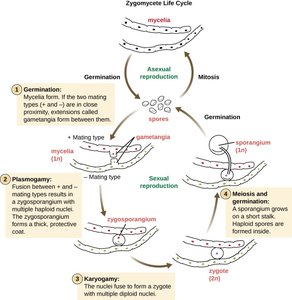
Sexual reproduction involves the fusion of compatible hyphae, followed by nuclear fusion and meiosis, producing genetically varied spores.
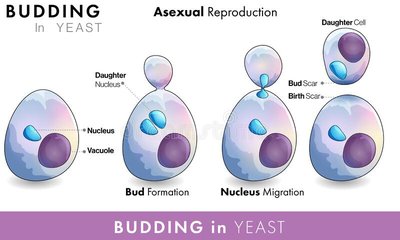
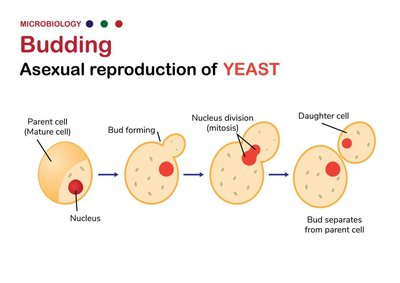
Budding in Yeast
Budding is a form of asexual reproduction in unicellular fungi like yeast. A small bud forms on the parent cell, receives a nucleus, grows, and separates as a new cell.
Offspring: Usually genetically identical to the parent.
Asexual Reproduction in Bacteria and Protists
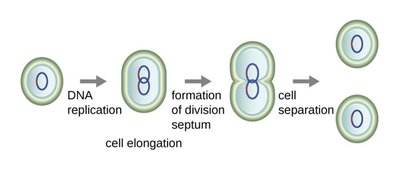
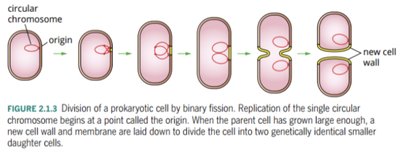
Binary Fission
Binary fission is a type of asexual reproduction where one cell divides to form two daughter cells. It occurs in bacteria and many unicellular protists.
Bacteria: Prokaryotes, reproduce by binary fission (not mitosis).
Protists: Eukaryotes, reproduce by mitosis followed by cytokinesis.
Sexual Reproduction in Flowering Plants
Flower Structure and Function
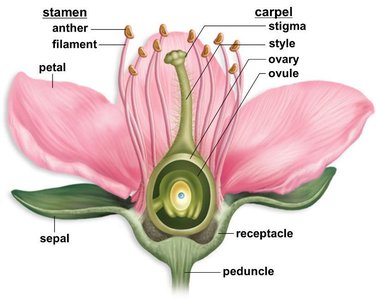
Flowers are the reproductive structures of angiosperms. The carpel (female) and stamen (male) are the main reproductive organs.
Carpel: Stigma (receives pollen), style (connects stigma to ovary), ovary (contains ovules), ovule (contains egg cell).
Stamen: Anther (produces pollen), filament (supports anther).
Pollination
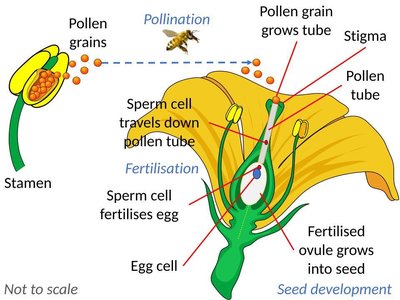
Pollination is the transfer of pollen from the anther to the stigma. It can be cross-pollination (between different plants) or self-pollination (same plant).
Agents: Biotic (animals), abiotic (wind, water).
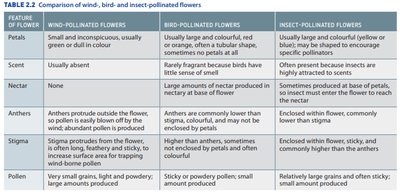
Adaptations: Animal-pollinated flowers have bright petals, scent, nectar; wind-pollinated flowers produce large quantities of lightweight pollen.
Comparison of Pollination Types
Feature | Wind-pollinated | Bird-pollinated | Insect-pollinated |
|---|---|---|---|
Petals | Small, dull | Large, colourful | Large, colourful |
Scent | Absent | Rare | Present |
Nectar | Absent | Large amount | Small amount |
Anthers | Exposed | Enclosed | Enclosed |
Stigma | Exposed, feathery | Enclosed | Enclosed, sticky |
Pollen | Small, light, abundant | Sticky, powdery | Large, sticky |
Fertilisation in Flowering Plants
Fertilisation is the fusion of male and female gametes to form a diploid zygote. The pollen tube grows from the stigma to the ovule, delivering sperm cells for fertilisation.
Seed and Fruit Formation
After fertilisation, the ovule develops into a seed and the ovary develops into a fruit. The seed contains the embryo, seed coat, and food supply.
Seed Dispersal and Germination
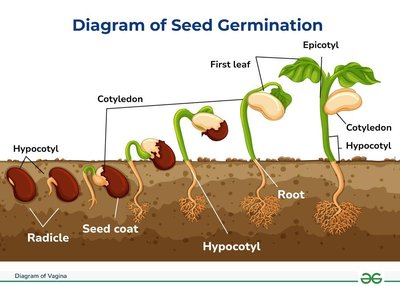
Seed dispersal moves seeds away from the parent plant, reducing competition and increasing colonisation of new habitats. Germination is the resumption of growth of a dormant seed embryo under suitable conditions.
Sexual Reproduction in Mammals
Overview and Adaptations
Sexual reproduction in mammals involves internal fertilisation, implantation, pregnancy, and parental care. Adaptations maximise reproductive success and offspring survival.
Hormonal Control of Reproduction
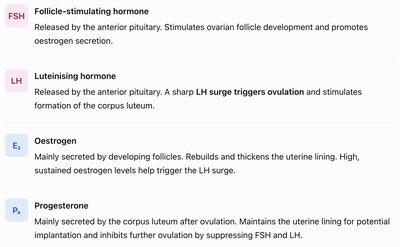
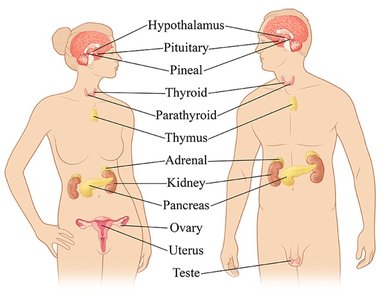
The endocrine system regulates reproductive processes through hormones such as FSH, LH, oestrogen, and progesterone.
Key Reproductive Hormones
Hormone | Source | Main Function |
|---|---|---|
FSH | Anterior pituitary | Stimulates follicle development |
LH | Anterior pituitary | Triggers ovulation |
Oestrogen | Follicles, corpus luteum, placenta | Repairs and thickens endometrium |
Progesterone | Corpus luteum, placenta | Maintains endometrium |
Female Reproductive Cycles
Mammalian reproductive cycles are controlled by hormones and prepare the female for fertilisation and pregnancy. Humans are continuous breeders with a menstrual cycle averaging 28 days.
Ovarian and Menstrual Cycle Phases
Menstruation: Shedding of uterine lining.
Follicular phase: Follicle develops, oestrogen rebuilds lining.
Ovulation: LH surge releases oocyte.
Luteal phase: Corpus luteum secretes progesterone, maintains lining.
Oogenesis and Spermatogenesis
Oogenesis is the formation of female gametes (ova), while spermatogenesis is the production of sperm. Both involve meiosis to produce haploid gametes.
Fertilisation and Early Development
Fertilisation occurs in the fallopian tube, forming a zygote. The zygote undergoes cleavage, forming a morula and then a blastocyst, which implants in the uterus.
Manipulation of Reproduction in Agriculture
Artificial Insemination and Pollination
Scientific knowledge allows manipulation of reproduction to improve agricultural productivity. Artificial insemination and pollination are used to produce offspring with desirable traits.
Comparison of Artificial Insemination and Pollination
Feature | Artificial Insemination | Artificial Pollination |
|---|---|---|
Organisms | Animals | Plants |
Gamete transferred | Sperm | Pollen |
Structures involved | Female reproductive tract | Anther and stigma |
Main purpose | Control animal breeding | Control plant breeding |
Outcome | Offspring with desirable traits | Hybrid plants with desirable traits |
Selective Breeding
Selective breeding involves choosing organisms with desirable traits to reproduce, increasing the likelihood of offspring inheriting those traits. This improves productivity but can reduce genetic diversity.
Summary
Reproduction ensures continuity of life by passing DNA from one generation to the next. Asexual reproduction is generally faster and produces little variation, while sexual reproduction creates genetic variation that helps populations survive changing environments. Scientific knowledge has enabled manipulation of reproduction in agriculture, improving yield and quality but also raising concerns about genetic diversity and animal welfare.
