Back
BackReproduction and Domestication of Flowering Plants
Study Guide - Smart Notes
 Tailored notes based on your materials, expanded with key definitions, examples, and context.
Reproduction and Domestication of Flowering Plants
Flowers of Deceit and Pollinator Interactions
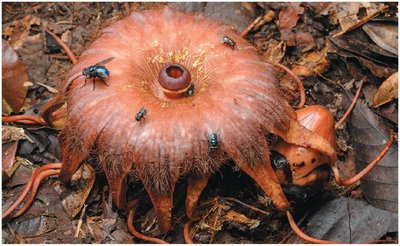
Angiosperms (flowering plants) often rely on animals, especially insects, for sexual reproduction. While most plant-pollinator relationships are mutually beneficial, some plants use deceptive strategies to attract pollinators without offering rewards.
Mutualism: Many angiosperms provide nectar or pollen to pollinators, benefiting both organisms.
Deception: Some species, such as Rhizanthes lowii, emit odors resembling decaying flesh to attract flies, which are tricked into pollinating the flower.
Ecological Importance: Angiosperms are crucial in terrestrial ecosystems and agriculture due to their reproductive success and diversity.
Unique Features of the Angiosperm Life Cycle
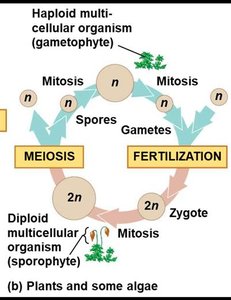
The angiosperm life cycle is defined by alternation of generations, with a dominant sporophyte and reduced gametophytes. Three unique features are flowers, double fertilization, and fruits.
Alternation of Generations: Life cycle alternates between multicellular haploid (n) gametophyte and multicellular diploid (2n) sporophyte.
Sporophyte: The visible, dominant generation in angiosperms.
Gametophyte: Reduced in size, dependent on the sporophyte for nutrients.
Three Fs: Flowers, double fertilization, and fruits are hallmarks of angiosperm reproduction.
Flower Structure and Function
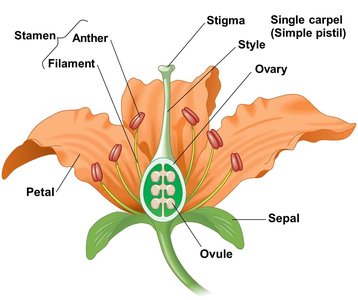
Flowers are the reproductive organs of angiosperms, consisting of four main types of floral organs attached to the receptacle.
Carpels: Female reproductive organs, each with a stigma, style, and ovary containing ovules. A single carpel or fused group is called a pistil.
Stamens: Male reproductive organs, each with a filament and anther (pollen sacs).
Petals and Sepals: Sterile organs; petals attract pollinators, sepals protect the flower bud.
Complete vs. Incomplete Flowers: Complete flowers have all four organs; incomplete flowers lack one or more.
Inflorescences: Clusters of flowers.
Flower Formation and Regulation
Flowering is synchronized within a species and regulated by environmental cues and genetic signals. Floral identity genes determine the organization of floral organs.
Transition: From vegetative to reproductive growth, triggered by cues such as light and temperature.
Genetic Control: Floral identity genes regulate organ development.
Overview of the Angiosperm Life Cycle
The angiosperm life cycle includes gametophyte development, pollination, double fertilization, and seed development.
Gametophyte Development: Male and female gametophytes develop within the protective tissues of the sporophyte.
Pollination: Transfer of pollen to the stigma.
Double Fertilization: Unique process where one sperm fertilizes the egg and another fuses with polar nuclei to form endosperm.
Seed Development: Fertilized ovules develop into seeds, and the ovary becomes a fruit.
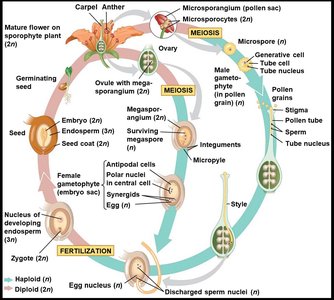
Development of Female Gametophytes (Embryo Sacs)
The female gametophyte, or embryo sac, develops within the ovule. The megasporangium undergoes meiosis to produce four megaspores, only one of which survives and divides to form the embryo sac with eight nuclei.
Megasporangium: Surrounded by integuments with a micropyle opening.
Embryo Sac: Contains egg cell, synergids, antipodal cells, and polar nuclei.
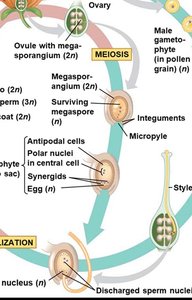
Development of Male Gametophytes in Pollen Grains
Male gametophytes develop in the anther's microsporangia. Diploid cells undergo meiosis to form microspores, which divide to produce the generative cell and tube cell, forming the pollen grain.
Pollen Grain: Contains two cells (generative and tube cell) and a protective spore wall.
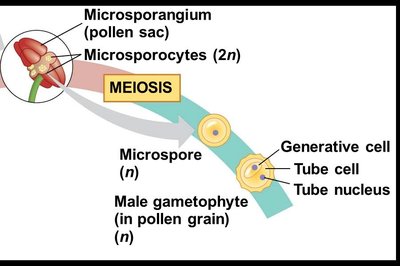
Pollination and Double Fertilization
Pollination is the transfer of pollen to the stigma. If successful, the pollen tube grows down the style, delivering two sperm cells to the embryo sac. Double fertilization results in a diploid zygote and a triploid endosperm.
Pollen Tube: Grows through the style to the ovary.
Double Fertilization: One sperm fertilizes the egg (zygote), the other fuses with polar nuclei (endosperm).
Significance: Ensures endosperm develops only in fertilized ovules.
Seed Development and Structure
After fertilization, the ovule becomes a seed and the ovary develops into a fruit. Seeds contain a dormant embryo, stored food, and a protective seed coat. Seed dormancy ensures germination occurs under favorable conditions.
Endosperm: Triploid tissue that stores nutrients for the embryo.
Embryo: Develops from the zygote; consists of cotyledons, hypocotyl, epicotyl, and radicle.
Seed Coat: Protective outer layer.
Dormancy: Adaptation to survive unfavorable conditions.
Seed Germination
Germination begins with imbibition (water uptake), causing the seed to swell and break dormancy. The radicle emerges first, followed by the shoot tip. In eudicots, the hypocotyl forms a hook; in monocots, the coleoptile pushes through the soil.
Imbibition: Water uptake due to low water potential.
Radicle: Embryonic root, first to emerge.
Hypocotyl Hook: Protects shoot tip in eudicots.
Coleoptile: Protective sheath in monocots.
Fruit Structure and Function
Fruits develop from the ovary and aid in seed protection and dispersal. They are classified by texture (dry or fleshy) and developmental origin (simple, aggregate, multiple, accessory).
Dry Fruits: Ovary dries at maturity (e.g., legumes).
Fleshy Fruits: Ovary becomes thick and sweet (e.g., berries).
Dispersal Mechanisms: Wind, water, and animals.
Seed Dispersal Mechanisms
Seed dispersal increases the chances of survival by spreading offspring away from the parent plant. Mechanisms include:
Water: Buoyant seeds (e.g., coconut) can travel long distances.
Wind: Seeds with wings or parachutes (e.g., dandelion).
Animals: Edible fruits or seeds with hooks for attachment to fur.
Domestication of Flowering Plants
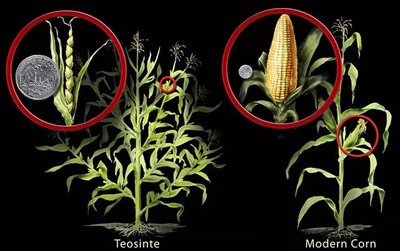
Domestication has dramatically altered the morphology and reproductive strategies of flowering plants, especially in crops such as maize (corn). Selective breeding has led to larger, more productive plants compared to their wild ancestors.
Teosinte vs. Modern Corn: Teosinte is the wild ancestor of modern corn, which has been selected for larger, more accessible kernels and cobs.
Genetic Changes: Domestication involves changes in genes controlling plant architecture, seed dispersal, and reproductive timing.