 Back
BackResource Acquisition and Transport in Vascular Plants
Study Guide - Smart Notes
 Tailored notes based on your materials, expanded with key definitions, examples, and context.
Resource Acquisition and Transport in Vascular Plants
Adaptations for Resource Acquisition
Vascular plants have evolved numerous adaptations to efficiently acquire essential resources such as water, minerals, carbon dioxide, and light. These adaptations are crucial for their survival and productivity in diverse environments.
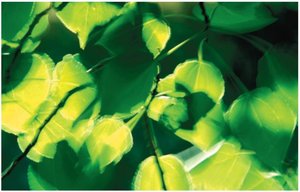
Leaf Adaptations: Some plants, like Aspen, have leaves that tremble in light wind, which may help with light capture and gas exchange.
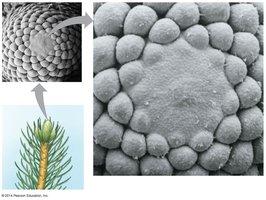
Phyllotaxy: The arrangement of leaves on a stem, known as phyllotaxy, is species-specific. Most angiosperms display alternate phyllotaxy with leaves arranged in a spiral, minimizing shading and maximizing light absorption.
Canopy Depth: The productivity of a plant is influenced by the depth of its canopy. Self-pruning occurs when lower leaves, shaded and respiring more than photosynthesizing, are shed.
Leaf Orientation: Horizontal leaves capture more sunlight in low-light conditions, while vertical leaves reduce sun damage and allow light to reach lower leaves in sunny environments.
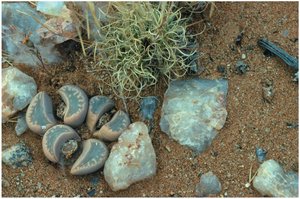
Underground Adaptations: Stone plants (Lithops) expose only succulent leaf tips above ground, with the rest of the plant below ground to minimize water loss.
Root Architecture and Resource Acquisition
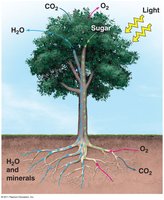
Roots play a vital role in acquiring water and minerals from the soil. Their growth and branching patterns are responsive to local soil conditions, enhancing resource uptake.
Root Branching: Roots branch more in areas with high nitrate concentration, optimizing nutrient acquisition.
Root Hairs: Increase surface area for absorption.
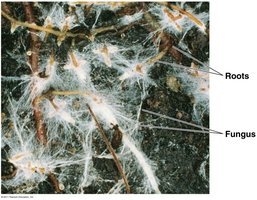
Mycorrhizae: Symbiotic associations with fungi further enhance water and mineral uptake, aiding plant colonization of land.
Transport Mechanisms in Plants
Plants utilize diffusion, active transport, and bulk flow to move water, minerals, and sugars throughout their bodies. The evolution of xylem and phloem enabled efficient long-distance transport.
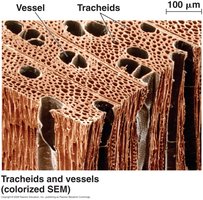
Xylem: Transports water and minerals from roots to leaves via negative pressure generated by transpiration.
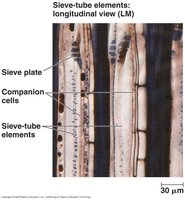
Phloem: Transports sugars from sources (e.g., leaves) to sinks (e.g., roots, fruits) via positive pressure.
Cellular Transport: Proton Pumps and Gradients
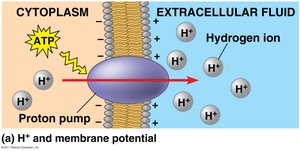
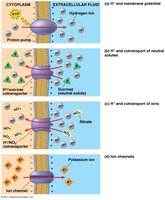
Proton pumps in plant cells create hydrogen ion gradients, which serve as potential energy for transporting nutrients against their concentration gradients.
Active Transport: Plants expend energy (ATP) to move nutrients against gradients.
Cotransport: Proton gradients drive the transport of solutes and ions through membrane channels.
Water Potential and Osmosis
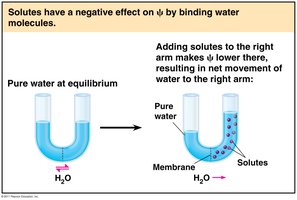
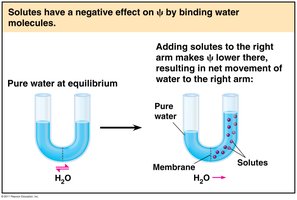
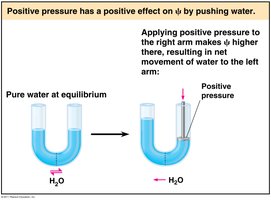
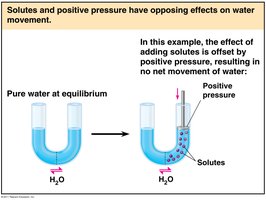
Osmosis is the diffusion of free water across a cell membrane. Water potential (Ψ) predicts the direction of water flow and is influenced by solute concentration and physical pressure.
Water Potential Equation: where is water potential, is solute potential, and is pressure potential.
Direction of Flow: Water moves from regions of higher to lower water potential.
Plasmolysis: Occurs when a cell loses water in a hypertonic environment, causing the protoplast to shrink away from the cell wall.
Turgor Pressure: The pressure exerted by the plasma membrane against the cell wall, essential for maintaining cell rigidity.
Routes of Water and Mineral Transport
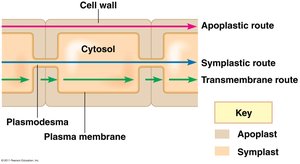
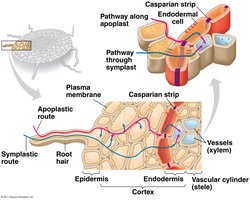
Water and minerals can travel through plants via three main routes: apoplastic, symplastic, and transmembrane.
Apoplast: Movement through cell walls and intercellular spaces.
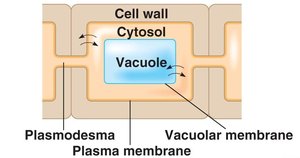
Symplast: Movement through cytoplasm connected by plasmodesmata.
Transmembrane: Movement across cell membranes.
Root Endodermis and Casparian Strip
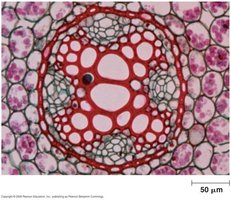
The endodermis is the innermost layer of cells in the root cortex, acting as a selective barrier for mineral passage into the vascular tissue. The Casparian strip blocks the apoplastic route, ensuring materials must pass through endodermal cells.
Selective Passage: Only certain minerals and water can enter the xylem after passing through the endodermis.
Casparian Strip: A band of suberin in the cell walls that blocks apoplastic flow.
Xylem Transport: Bulk Flow and Transpiration
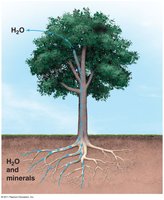
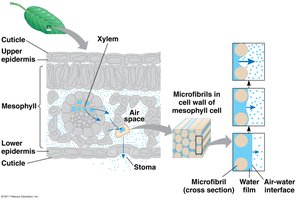
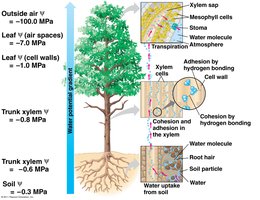
Water is pulled upward through xylem by negative pressure generated by transpiration. Cohesion and adhesion of water molecules facilitate this process.
Transpiration: Evaporation of water from leaf surfaces creates negative pressure, pulling water up from roots.
Cohesion and Adhesion: Water molecules stick to each other (cohesion) and to xylem walls (adhesion), enabling continuous flow.
Bulk Flow: Movement of water and minerals (xylem sap) from roots to leaves.
Preventing Water Loss: Stomata and Cuticle
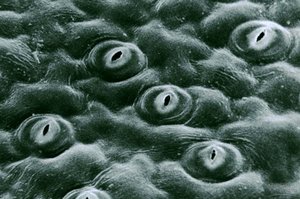
Plants face the challenge of preventing excessive water loss while allowing gas exchange for photosynthesis. The waxy cuticle reduces evaporation, but stomata enable gas exchange and water loss regulation.
Stomata: Pores in the epidermis controlled by guard cells, regulate gas exchange and water loss.
Guard Cells: Change shape in response to turgor pressure, opening or closing stomata.
Cuticle: Waxy layer that prevents water loss but also limits gas exchange.
Phloem Transport: Translocation and Pressure Flow
Phloem transports the products of photosynthesis (mainly sucrose) from sources to sinks. The pressure flow hypothesis explains this movement.
Source: Organ that produces or stores sugar (e.g., mature leaves).
Sink: Organ that consumes or stores sugar (e.g., roots, fruits).
Pressure Flow Hypothesis: Sugars are actively loaded into phloem at the source, water follows by osmosis, creating pressure that pushes sap toward the sink.
Phloem Loading: Often requires active transport and cotransport mechanisms.
Phloem as an Information Superhighway
Phloem not only transports sugars but also macromolecules, viruses, and electrical signals, integrating plant functions and defense responses.
Systemic Communication: Chemical signals travel through phloem to activate defense genes in distant tissues.
Electrical Signaling: Rapid communication between organs, such as in Mimosa pudica.
Summary Table: Comparison of Xylem and Phloem Transport
Feature | Xylem | Phloem |
|---|---|---|
Transport Direction | Root to shoot (upward) | Source to sink (any direction) |
Main Contents | Water, minerals | Sugars (sucrose), signaling molecules |
Driving Force | Negative pressure (transpiration) | Positive pressure (pressure flow) |
Cell Types | Tracheids, vessel elements | Sieve-tube elements, companion cells |
Key Equations
Water Potential:
Additional info: Some explanations and context were expanded for clarity and completeness, including definitions and examples of phyllotaxy, root adaptations, and the pressure flow hypothesis.
