 Back
BackRespiration: Mechanisms and Adaptations in Animals
Study Guide - Smart Notes
 Tailored notes based on your materials, expanded with key definitions, examples, and context.
Chapter 34: Respiration
Introduction to Respiration
Respiration is a fundamental biological process that enables organisms to exchange gases with their environment, supporting cellular respiration and energy production. This chapter explores the mechanisms, adaptations, and structures involved in animal respiration, with a focus on minimizing diffusion distances and maximizing efficiency.
34.1 Why Exchange Gases and What Are the Requirements for Gas Exchange?
Gas Exchange and Cellular Respiration
Cellular respiration is the process by which cells convert the energy in nutrients (such as glucose) into ATP, the energy currency of the cell. This process requires a continuous supply of oxygen (O2) and produces carbon dioxide (CO2) as a waste product.
Organismal respiration (simply called respiration) refers to the exchange of gases (O2 in, CO2 out) between an organism and its environment to support cellular respiration.
Requirements for Efficient Gas Exchange
Gas exchange relies on diffusion, the movement of molecules from areas of higher concentration to lower concentration.
Three key adaptations facilitate diffusion in animals:
Respiratory surfaces must remain moist (only dissolved gases can diffuse across cell membranes).
Respiratory surfaces must be thin to minimize diffusion distances.
Respiratory surfaces must have a large surface area to meet the organism's gas exchange needs.
To maintain concentration gradients, the environment (air or water) must flow past the respiratory surface, a process called bulk flow.
34.2 How Do Respiratory Adaptations Minimize Diffusion Distances?
Diffusion Limitations and Evolutionary Solutions
Diffusion is effective only over short distances (usually less than 1 mm). Evolution has produced a variety of adaptations to keep diffusion distances short and maximize gas exchange efficiency.
Animals Without Specialized Respiratory Structures
Relatively inactive animals may lack specialized respiratory organs and rely solely on diffusion.
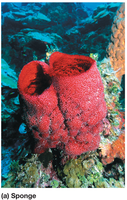
Sponges (Porifera) use ciliated cells to create water currents, moving water by bulk flow through pores into a central chamber for gas exchange.
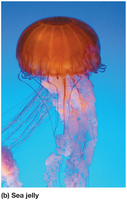
Cnidarians (e.g., sea jellies, corals, anemones) have thin outer skins and a central gastrovascular cavity that brings water close to internal cells, facilitating diffusion.
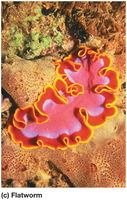
Flatworms (Platyhelminthes) have flattened bodies and extensive gas-permeable skin surfaces, ensuring all cells are close to the surface for diffusion.
Animals with Combined Diffusion and Circulatory Systems
Some animals, such as earthworms, combine a large skin surface for diffusion with a circulatory system that transports gases in the blood by bulk flow.
Moist skin is essential for gas exchange; if the skin dries out, the animal suffocates.
Respiratory and Circulatory System Interactions
Most large, active animals have specialized respiratory organs (e.g., gills, tracheae, lungs) that work with circulatory systems to transport gases throughout the body.
Major respiratory organs include:
Gills in aquatic animals
Tracheae in insects
Lungs in terrestrial vertebrates
Stages of Gas Exchange in Animals with Circulatory and Respiratory Systems
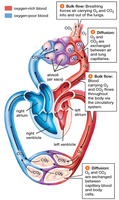
Bulk flow carries air or water (high in O2, low in CO2) past the respiratory surface, usually propelled by muscular movements.
Diffusion moves O2 from the environment into capillaries and CO2 out to the environment.
Bulk flow of blood transports gases between the respiratory system and tissues, powered by the heart.
Diffusion transfers O2 from capillaries to tissues and CO2 from tissues to capillaries.
Gills: Gas Exchange in Aquatic Environments
Gills are thin, branched, or folded structures with a large surface area and dense capillary networks, facilitating efficient gas exchange in water.
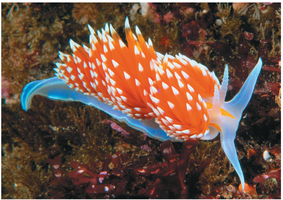
Some aquatic animals, such as nudibranch mollusks, have external gills that protrude into the water.
Fish protect their gills with a bony flap called the operculum and use pumping movements or swimming to create water currents over the gills.
Fish use countercurrent exchange to maximize O2 extraction from water.
Respiratory Adaptations in Terrestrial Animals
Gills are ineffective in air due to drying and collapse; terrestrial animals evolved internal respiratory structures.
Insects use a system of tracheae—branched, air-filled tubes that conduct air directly to tissues through openings called spiracles.
Tracheae branch into microscopic tracheoles that deliver air close to each cell.
Large insects may use abdominal pumping to increase air movement.
Tracheae compensate for the relatively inefficient open circulatory system of insects.
Lungs: Gas Exchange in Terrestrial Vertebrates
Lungs are internal chambers with moist respiratory surfaces, protected from drying and mechanical damage.
The first vertebrate lungs likely evolved in freshwater fish to survive in low-oxygen environments.
Amphibians use gills as larvae and develop simple lungs as adults; many also use cutaneous respiration (gas exchange through the skin).
Reptiles and mammals have waterproof skin (scales, feathers, fur) that prevents cutaneous respiration, so their lungs have a much larger surface area for gas exchange.
Birds have highly efficient respiratory systems with rigid lungs and multiple air sacs, allowing unidirectional airflow and continuous gas exchange even during exhalation.
34.3 How Is Air Conducted Through the Human Respiratory System?
Structure of the Human Respiratory System
The human respiratory system is divided into:
Conducting portion: Passageways that carry air into and out of the lungs (nose/mouth → pharynx → larynx → trachea → bronchi → bronchioles).
Gas-exchange portion: Structures within the lungs (alveoli) where O2 and CO2 are exchanged with blood in lung capillaries.
Air enters through the nose or mouth, passes through the nasal/oral cavity, pharynx, and larynx (where sounds are produced). The epiglottis guards the opening to the larynx.
