 Back
Respiratory and Circulatory Systems: Gas Exchange and Transport in Animals
Study Guide - Smart Notes
 Tailored notes based on your materials, expanded with key definitions, examples, and context.
Respiratory and Circulatory Systems
Overview and Relationship
The respiratory and circulatory systems work together to facilitate gas exchange and transport essential molecules throughout the body. These systems are crucial for delivering oxygen to tissues and removing carbon dioxide, a waste product of cellular respiration.
Respiratory system: Responsible for the intake of oxygen and removal of carbon dioxide.
Circulatory system: Transports gases, nutrients, and waste products between cells and the external environment.
Cellular respiration: Occurs in mitochondria, using oxygen to produce ATP and releasing carbon dioxide.
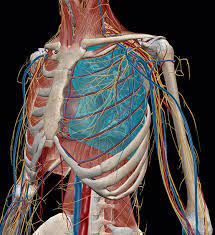
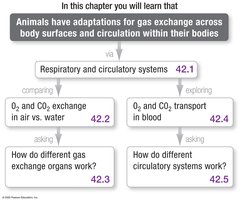
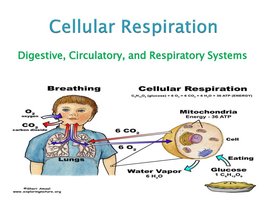
Steps of Gas Exchange
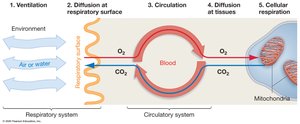
Gas exchange in animals involves five major steps:
Ventilation: Movement of air or water through specialized gas-exchange organs (lungs, gills).
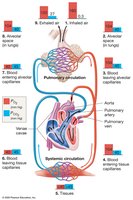
Diffusion at the respiratory surface: Oxygen moves from air/water into blood; carbon dioxide moves from blood into air/water.
Circulation: Transport of dissolved gases throughout the body via the circulatory system.
Diffusion at tissues: Oxygen moves from blood into tissues; carbon dioxide moves from tissues into blood.
Cellular respiration: Cells use oxygen and produce carbon dioxide, creating gradients for gas movement.
Gas Exchange in Air and Water
Behavior of Oxygen and Carbon Dioxide in Air
Gas exchange relies on diffusion, driven by partial pressure gradients. Oxygen is high in the environment and low in tissues, while carbon dioxide is high in tissues and low in the environment.
Partial pressure: The pressure exerted by a single gas in a mixture, calculated using Dalton’s law:
Elevation effects: The percentage of oxygen in air remains constant (21%), but partial pressure decreases with elevation, making breathing more difficult at high altitudes.
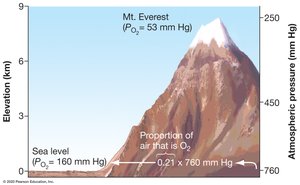
Behavior of Oxygen and Carbon Dioxide in Water
Aquatic environments contain much less oxygen than air, requiring aquatic animals to process more water and expend more energy for ventilation.
Factors affecting gas solubility: Solubility, temperature, presence of solutes, and partial pressure.
Oxygen availability: Higher in habitats with photosynthetic organisms and near the water surface; lower in stagnant or deep water.
Organs of Gas Exchange
Gas Exchange in Small and Large Animals
Small animals rely on diffusion across moist body surfaces, while larger or terrestrial animals require specialized organs with increased surface area for gas exchange.
Fick’s Law of Diffusion
The rate of diffusion of a gas across a membrane is described by Fick’s law:
Parameters: Solubility, temperature, surface area, partial pressure difference, and thickness of the barrier.
Fick's Law equation: where is the diffusion constant, is surface area, is the partial pressure difference, and is the thickness of the barrier.
Gills in Aquatic Animals
Gills are outgrowths used for gas exchange and osmoregulation. They provide a large surface area and thin epithelium for efficient oxygen diffusion.
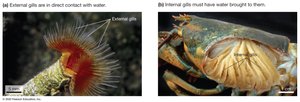
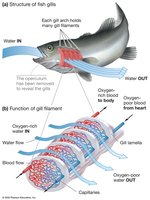
Tracheal Systems in Insects
Insects use air-filled tubes called tracheae, which open to the outside via spiracles. Spiracles can close to minimize water loss, and the branched tracheae deliver air directly to cells.
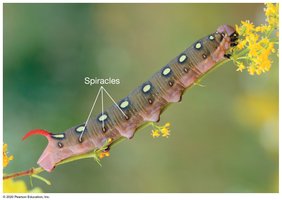
Lungs in Vertebrates
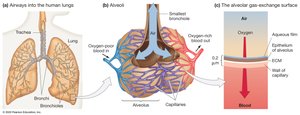
Vertebrate lungs are internal organs with a large surface area for gas exchange. Air enters through the mouth/nose, travels down the trachea, bronchi, and bronchioles, and reaches alveoli where gas exchange occurs.
Alveoli: Tiny sacs with thin membranes, facilitating rapid gas exchange between air and blood.
Ventilation Mechanisms
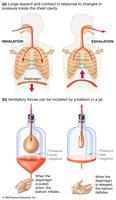
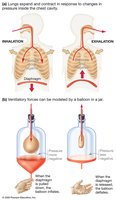
Vertebrates actively ventilate lungs using muscular contractions. Humans use negative pressure ventilation, driven by the diaphragm.
Inhalation: Diaphragm contracts and moves down, lowering chest cavity pressure and expanding lungs.
Exhalation: Diaphragm relaxes, chest cavity decreases, and air is expelled.
Gas Transport in Blood
Blood Components
Blood consists of plasma and cellular components:
Platelets: Minimize blood loss.
White blood cells: Immune defense.
Red blood cells: Transport oxygen and carbon dioxide.
Hemoglobin Structure and Function
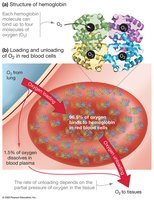
Hemoglobin is a tetramer with four polypeptide chains, each containing a heme group with an iron ion (Fe2+) that binds oxygen. Most oxygen in blood is bound to hemoglobin.
Cooperative Binding and Oxygen-Hemoglobin Equilibrium
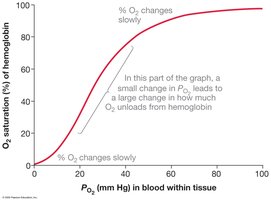
Hemoglobin exhibits cooperative binding: binding of one oxygen molecule increases the affinity for subsequent molecules. The oxygen-hemoglobin equilibrium curve is sigmoidal (S-shaped).
Bohr Shift and pH Effects
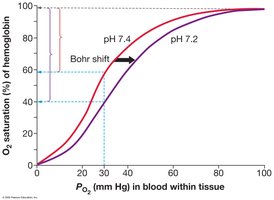
Hemoglobin releases more oxygen in tissues with low pH (high CO2), a phenomenon known as the Bohr shift. This adaptation ensures efficient oxygen delivery where it is most needed.
Carbonic Anhydrase and CO2 Transport
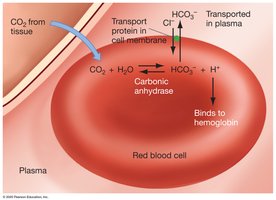
Carbonic anhydrase in red blood cells catalyzes the conversion of CO2 to bicarbonate, maintaining partial pressure gradients and facilitating CO2 transport.
Circulatory System Structure and Function
Types of Circulatory Systems
Open circulatory system: Hemolymph is pumped through open vessels.
Closed circulatory system: Blood flows in a continuous circuit of closed vessels.
Blood Vessel Types
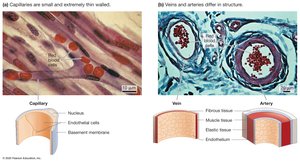
Arteries: Carry blood away from the heart under high pressure.
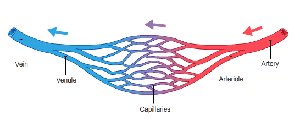
Capillaries: Thin-walled vessels for gas and molecule exchange.
Veins: Return blood to the heart under lower pressure.
Capillary Function and Regulation
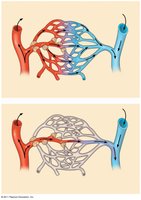
Blood flow through capillary beds is regulated by constriction/dilation of arterioles and precapillary sphincters, controlled by nerve impulses, hormones, and chemicals.
Lymphatic System
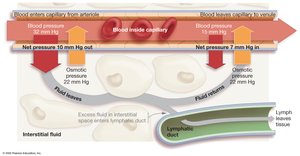
The lymphatic system drains excess interstitial fluid, returning it to the circulatory system. Blockage can cause tissue swelling.
Heart Structure and Function
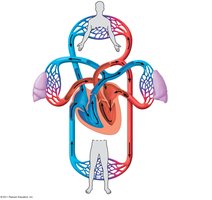
Separation of Oxygenated and Deoxygenated Blood
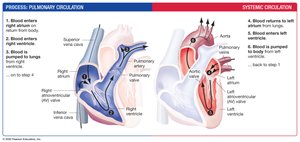
The human heart maintains separation of oxygenated and deoxygenated blood, ensuring efficient gas exchange and transport.
Partial Pressures in Circulatory System
Cardiac Cycle and Blood Pressure
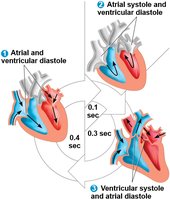
The heart contracts (systole) and relaxes (diastole) in a rhythmic cycle. Heart rate, stroke volume, and cardiac output are key measures of heart function.
Electrical Activation of the Heart
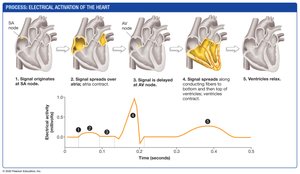
The sinoatrial (SA) node acts as the pacemaker, initiating electrical impulses that coordinate heart contractions. These impulses can be recorded as an electrocardiogram (ECG/EKG).
Patterns in Blood Pressure and Blood Flow
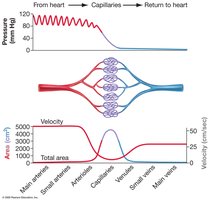
Blood pressure drops as blood moves through capillaries due to increased cross-sectional area. Velocity and total area of blood vessels change throughout the circulatory system.
Measurement and Regulation of Blood Pressure
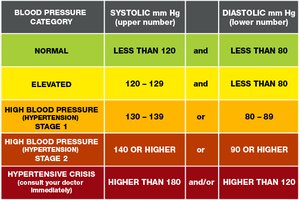
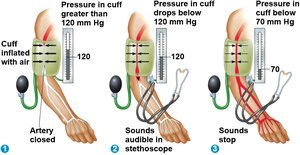
Systolic pressure: Highest pressure during ventricular contraction.
Diastolic pressure: Lowest pressure during relaxation.
Pulse: Rhythmic bulging of artery walls.
Vasoconstriction: Increases blood pressure.
Vasodilation: Decreases blood pressure.
Cardiovascular Disease
Causes and Effects
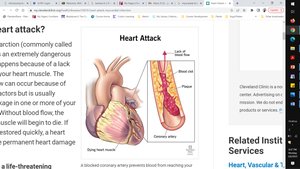
Cardiovascular disease affects the heart and blood vessels, and is the leading cause of death worldwide. Risk factors include age, tobacco use, poor diet, obesity, inactivity, and genetics. Arteriosclerosis and plaque buildup can reduce vessel diameter and lead to heart attacks.
Summary Table: Types of Blood Vessels
Type | Structure | Function |
|---|---|---|
Artery | Thick, muscular walls | Carry blood away from heart |
Capillary | Thin, one-cell thick walls | Exchange gases and molecules |
Vein | Thin walls, valves | Return blood to heart |
Summary Table: Blood Pressure Categories
Category | Systolic (mm Hg) | Diastolic (mm Hg) |
|---|---|---|
Normal | Less than 120 | Less than 80 |
Elevated | 120-129 | Less than 80 |
High Blood Pressure (Stage 1) | 130-139 | 80-89 |
High Blood Pressure (Stage 2) | 140 or higher | 90 or higher |
Hypertensive Crisis | Higher than 180 | Higher than 120 |
Additional info: Academic context was added to clarify Fick's law, blood pressure measurement, and the relationship between gas exchange and cellular respiration.
