 Back
RNA Processing and mRNA Maturation in Eukaryotes
Study Guide - Smart Notes
 Tailored notes based on your materials, expanded with key definitions, examples, and context.
RNA Processing in Eukaryotic Cells
Overview of RNA Processing
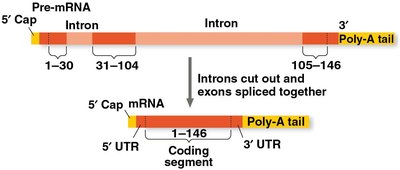
In eukaryotic cells, the initial RNA transcript (pre-mRNA) produced by transcription undergoes several modifications before becoming mature mRNA capable of being translated into protein. These modifications include the addition of a 5' cap, splicing to remove introns, and the addition of a poly-A tail at the 3' end. These steps are essential for mRNA stability, export from the nucleus, and efficient translation.
Pre-mRNA contains both coding (exons) and non-coding (introns) sequences.
RNA processing occurs in the nucleus before the mRNA is exported to the cytoplasm.
RNA Splicing
Mechanism and Significance of RNA Splicing
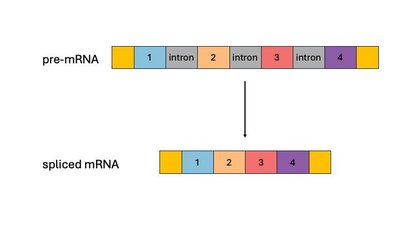
RNA splicing is the process by which non-coding regions (introns) are removed from the pre-mRNA, and coding regions (exons) are joined together to form a continuous coding sequence. This process is catalyzed by a complex called the spliceosome.
Introns are intervening sequences that do not code for protein and are removed during splicing.
Exons are expressed sequences that remain in the mature mRNA and code for protein.
The spliceosome recognizes specific sequences at the intron-exon boundaries (donor and acceptor sites) to accurately remove introns.
Splicing errors can lead to altered or nonfunctional proteins.
Consequences of Splicing Mutations
Mutations at splice sites can result in the retention of introns or the loss of exons, producing abnormal mRNA and potentially nonfunctional proteins.
Example: A mutation in the acceptor splice site may prevent the removal of an intron, leading to an altered mRNA sequence.
Alternative Splicing and Protein Diversity
Mechanisms of Alternative Splicing
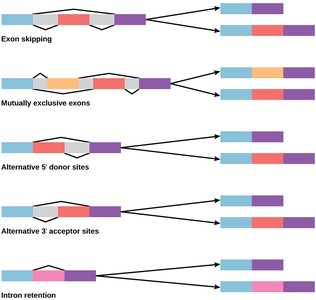
Alternative splicing allows a single gene to produce multiple protein isoforms by varying the combination of exons included in the final mRNA. This process greatly increases the diversity of proteins that can be generated from a single gene.
Exon skipping: Certain exons are excluded from the mature mRNA.
Mutually exclusive exons: Only one of several possible exons is included in the mRNA.
Alternative donor/acceptor sites: Different splice sites are used, changing the boundaries of exons.
Intron retention: An intron is retained in the mature mRNA.
Biological Significance
Alternative splicing enables the production of protein isoforms with different, sometimes tissue-specific, functions.
It plays a critical role in development, cellular differentiation, and adaptation to environmental changes.
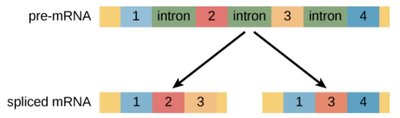
Example: The same pre-mRNA can be spliced to produce two isoforms, one containing exons 1, 2, 3, 4 and another containing exons 1, 3, 4.
mRNA 5' Cap and Poly-A Tail
Addition and Function of the 5' Cap
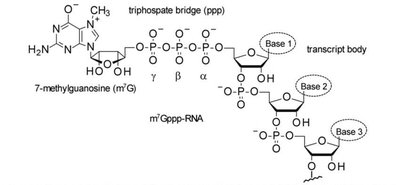
The 5' end of the pre-mRNA is modified by the addition of a 7-methylguanosine cap. This cap is added in a unique 5'-5' linkage and serves several important functions:
Facilitates export of mRNA from the nucleus to the cytoplasm.
Protects mRNA from degradation by exonucleases.
Helps ribosomes recognize and bind to the mRNA for translation initiation.
Addition and Function of the Poly-A Tail
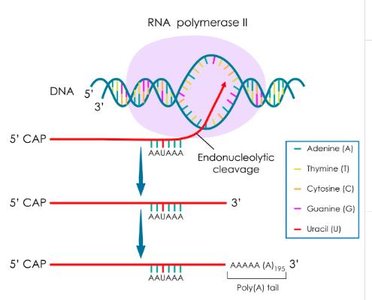
The 3' end of the pre-mRNA is cleaved downstream of an AAUAAA consensus sequence, and a poly-A tail (a stretch of ~200 adenine nucleotides) is added by the enzyme poly-A polymerase.
Enhances mRNA stability by protecting against degradation.
Facilitates export of mRNA from the nucleus.
Promotes efficient translation by ribosomes.
Structure of Eukaryotic mRNA
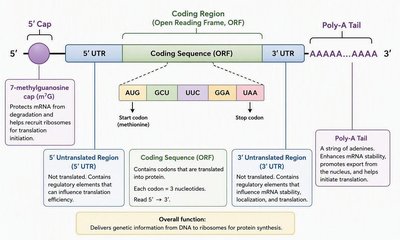
Mature eukaryotic mRNA consists of a 5' cap, 5' untranslated region (UTR), coding sequence, 3' UTR, and a poly-A tail. Each region has specific roles in mRNA stability, translation, and regulation.
5' UTR: Regulates translation efficiency.
Coding sequence (ORF): Encodes the protein.
3' UTR: Influences mRNA stability and localization.
mRNA Stability and Protein Production
Regulation of mRNA Stability
The stability of mRNA molecules determines how long they are available for translation and thus influences the amount of protein produced. Both the 5' cap and poly-A tail are critical for protecting mRNA from degradation.
Loss of the 5' cap or shortening of the poly-A tail leads to rapid mRNA degradation and reduced protein synthesis.
Regulatory proteins and sequences in the 3' UTR can also affect mRNA stability.
Case Study: Heat Shock Protein HSP70 in C. elegans
Role of mRNA Processing in Stress Response
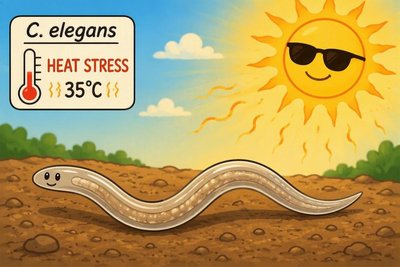
Heat shock proteins like HSP70 help cells survive high temperatures by preventing protein misfolding. Proper mRNA processing is essential for the production of functional HSP70 protein.
Mutations that disrupt the 5' cap or poly-A tail of HSP70 mRNA result in decreased mRNA stability and lower protein levels, making organisms more sensitive to heat stress.
Alternative splicing can produce different HSP70 isoforms, with some isoforms being more effective at protecting cells from heat damage.
Exon 3 of HSP70 may contain a binding site for the regulatory protein HSF-1, which is necessary for mRNA stability during heat stress.
Summary Table: Key Steps in Eukaryotic mRNA Processing
Step | Description | Function |
|---|---|---|
5' Capping | Addition of 7-methylguanosine to 5' end | Protects mRNA, aids export, promotes translation |
Splicing | Removal of introns, joining of exons | Creates continuous coding sequence |
Alternative Splicing | Variable inclusion of exons | Increases protein diversity |
Polyadenylation | Addition of poly-A tail to 3' end | Stabilizes mRNA, aids export, promotes translation |
