 Back
Same Genes, Different Bodies: Heritability, Development, and Environmental Effects on Phenotype
Study Guide - Smart Notes
 Tailored notes based on your materials, expanded with key definitions, examples, and context.
Heritability and the Environment
Heritability: What Does It Measure?
Heritability quantifies the proportion of variation in a trait among individuals in a population that is attributable to genetic differences. It does not measure how much of a single individual's trait is due to genes versus environment, nor does it predict how a trait will change if the environment changes.
Heritability (h2): Fraction of trait variation due to genetic differences in a population and environment.
Example: Height in Dutch men is about 80% heritable, but the population average increased by 20 cm in 150 years due to improved nutrition and health.
Key Point: Heritability describes differences, not fixed shares; environmental changes can shift the mean trait value for everyone.
Norm of Reaction and Phenotypic Plasticity
The norm of reaction is the range of phenotypes a single genotype can produce across different environments. Phenotypic plasticity refers to the ability of one genotype to yield different phenotypes depending on environmental conditions.
Norm of Reaction: Visualized as a line showing how a genotype responds to environmental variation.
Phenotypic Plasticity: Example: Daphnia develop neckteeth only when exposed to predator scent.
Multifactorial Traits: Traits influenced by many genes and environmental factors (e.g., height, skin color).
Development: How Cells Decide Their Fate
Sources of Developmental Information
Cells use two main sources of information to determine their fate during development: cytoplasmic determinants and induction from neighboring cells.
Cytoplasmic Determinants: Molecules unevenly distributed in the egg, inherited at cell division, direct early gene expression.
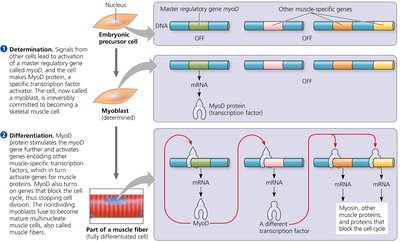
Induction: Signals from neighboring cells trigger changes in gene expression, leading to new cell fates.
Determination: Commitment to a cell fate, often marked by activation of master regulatory genes (e.g., myoD for muscle).
Differentiation: Production of tissue-specific proteins and acquisition of specialized structure and function.
Example: In frog embryos, a cell moved next to neural tissue becomes a neuron due to induction, not a change in its genome.
The Environment as a Signal
Environmental Effects on Gene Expression
The environment can directly influence gene expression, sometimes leading to lasting changes in phenotype.
Temperature-dependent Sex Determination: In some turtles, nest temperature during incubation determines sex by regulating chromatin modifiers and gene expression.
Epigenetics: Environmental signals can cause lasting changes in gene expression through DNA methylation and chromatin modification, without altering the DNA sequence.
Example: The Dutch Hunger Winter led to reduced methylation at the IGF2 gene in individuals exposed in utero, affecting metabolism decades later.
Gene Expression: From DNA to Protein
Central Dogma and Regulation
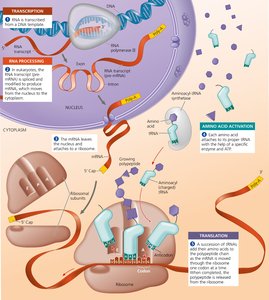
The flow of genetic information follows the central dogma: DNA → RNA → Protein. Regulation occurs at multiple levels, including transcription, RNA processing, and translation.
Transcription: RNA polymerase synthesizes RNA from a DNA template.
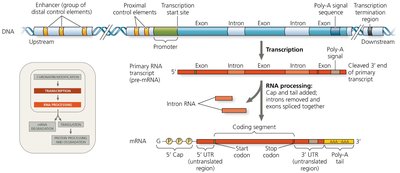
RNA Processing: Addition of 5' cap, poly-A tail, removal of introns, joining of exons.
Translation: Ribosomes read mRNA codons to assemble amino acids into proteins.
Regulation: Chromatin modifications, enhancers, activators, and repressors control which genes are expressed.
The Genetic Code
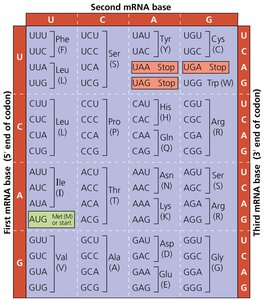
The genetic code is a set of rules by which information encoded in mRNA is translated into proteins. Each codon (three bases) specifies an amino acid or a stop signal.
Start Codon: AUG (Methionine)
Stop Codons: UAA, UAG, UGA
Redundancy: Multiple codons can code for the same amino acid.
RNA Processing and Alternative Splicing
RNA transcripts are processed before translation. Alternative splicing allows one gene to produce multiple protein variants.
Introns: Non-coding regions removed from pre-mRNA.
Exons: Coding regions joined together.
Alternative Splicing: Generates different proteins from the same gene.
Gene Regulation in Different Cell Types
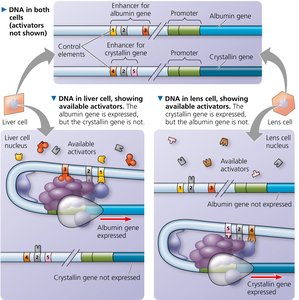
Gene expression is regulated by cell-specific activators and enhancers, allowing different cell types to express different sets of genes despite having the same DNA.
Example: Liver cells express albumin, lens cells express crystallin, depending on available activators.
Operons and Gene Regulation in Prokaryotes
The Lac Operon
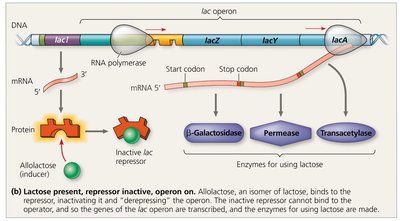
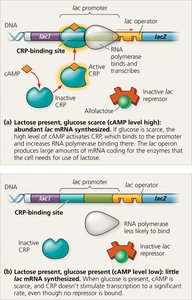
The lac operon is a classic example of gene regulation in bacteria. It allows cells to use lactose only when it is available and glucose is scarce.
Repressor: Binds operator to block transcription; inactivated by allolactose (inducer).
CRP (CAP): Activates transcription when cAMP is high (glucose is low).
Enzymes: β-galactosidase, permease, transacetylase.
Cell Signaling and Division
Signal Transduction Pathways
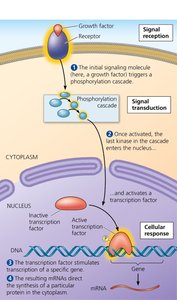
Cells respond to external signals through signal transduction pathways, which often involve phosphorylation cascades and activation of transcription factors.
Reception: Signal molecule binds receptor.
Transduction: Cascade of protein modifications relays the signal.
Response: Activation of gene expression or other cellular activities.
Cell Cycle Regulation and Cancer
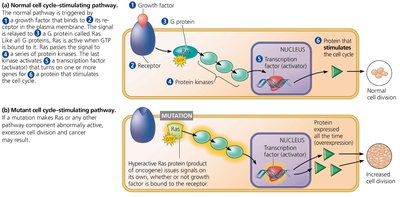
Growth factors stimulate cell division via signaling pathways. Mutations in pathway components (e.g., Ras protein) can lead to uncontrolled cell division and cancer.
Normal Pathway: Growth factor → receptor → G protein → kinases → transcription factor → cell division genes.
Mutant Pathway: Hyperactive Ras leads to excessive cell division.
Key Terms and Concepts
Multifactorial Character: Trait shaped by many genes and environment.
Polygenic Inheritance: Multiple genes contribute to one trait.
Norm of Reaction: Range of phenotypes for one genotype across environments.
Phenotypic Plasticity: One genotype, different phenotypes in different environments.
Heritability: Fraction of variation due to genetics in a population and environment.
Common Garden: Experimental design to separate genetic and environmental effects.
Cytoplasmic Determinant: Molecule in egg directing early gene expression.
Induction: Signal from nearby cells changing gene expression.
Determination: Commitment to cell fate.
Differentiation: Becoming a specialized cell.
Epigenetics: Lasting changes in gene expression without DNA sequence change.
DNA Methylation: Methyl groups added to DNA, usually reducing transcription.
Summary: Five Key Ideas
A genotype is a line, not a point: multifactorial traits and norm of reaction.
Heritability is about differences, not shares; environmental changes can move the mean.
Cells tell each other what to become: cytoplasmic determinants and induction.
The environment can be the signal: temperature-dependent sex, Daphnia neckteeth.
The environment can leave a mark: epigenetic changes such as DNA methylation.
