 Back
BackScientific Method and Chemistry of Living Things: Study Notes for Human Biology
Study Guide - Smart Notes
 Tailored notes based on your materials, expanded with key definitions, examples, and context.
The Scientific Method in Human Biology
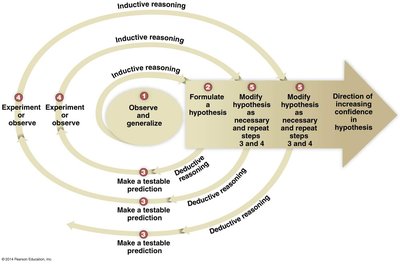
Overview of the Scientific Method
The Scientific Method is a systematic process used to acquire knowledge about the natural world. It is fundamental to human biology and all scientific disciplines, ensuring that findings are reliable and unbiased.
Observation & Generalization: Scientists observe phenomena and use inductive reasoning to make generalizations from specific cases.
Formulate a Hypothesis: A hypothesis is an educated guess based on observations, which can be tested.
Make a Testable Prediction: Predictions are made using deductive reasoning and are often structured as "if...then" statements.
Experiment or Observe: Experiments are carefully designed to test predictions, manipulating variables to gather data.
Modify & Repeat: If results do not support the hypothesis, it is modified and retested, increasing confidence in the findings.
Experimental Design and Controlled Experiments
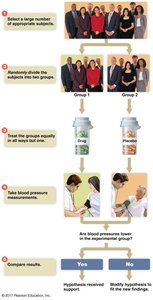
Controlled experiments are essential for testing hypotheses in human biology. They involve manipulating one variable (independent variable) while keeping others constant, and measuring the effect on the dependent variable.
Independent Variable: The factor intentionally changed (e.g., drug dose).
Dependent Variable: The outcome measured (e.g., blood pressure).
Control Group: Receives a placebo or no treatment, used for comparison.
Blind Study: Participants do not know which group they are in, reducing bias.
Reporting and Evaluating Scientific Results
Results from scientific experiments are reported in peer-reviewed journals, which are the most reliable sources. Critical thinking is required to evaluate the credibility of information, distinguish facts from conclusions, and understand the difference between correlation and causation.
Peer-Reviewed Journals: Most reliable, provide detailed methods and results.
Other Sources: Science magazines, books, news articles, and websites (preferably .edu, .gov, .org).
Critical Thinking: Question sources, seek evidence, and verify information.
Data Interpretation: Learn to read graphs and appreciate statistics.
Correlation vs. Causation: Correlation does not imply causation; further studies are needed to establish cause-effect relationships.
Scientific Theory
In science, a theory is not just a guess. It is a broad hypothesis that has been extensively tested and supported, explaining a range of facts with high reliability.
Highest status a hypothesis can achieve.
Examples: Theory of Evolution, Cell Theory.
The Chemistry of Living Things
Importance of Water to Life
Water is the most essential molecule for life, making up about 60% of human body weight. It is involved in numerous biological processes and is critical for survival.
Biological Reactions: Water is used in many chemical reactions, including metabolism.
Solvent Properties: Water dissolves many substances, facilitating transport and reactions.
Temperature Regulation: Water absorbs and holds heat, helping regulate body temperature.
Clean Water Access: Essential for health; lack of access can lead to disease.
Chemical Structure and Properties of Water
Water is a polar molecule, with a slightly positive hydrogen side and a slightly negative oxygen side. This polarity allows water molecules to form weak hydrogen bonds, making water an excellent solvent.
Polarity: Unequal sharing of electrons creates charged ends.
Hydrogen Bonds: Attraction between opposite charges on separate water molecules.
Water as a Biological Solvent
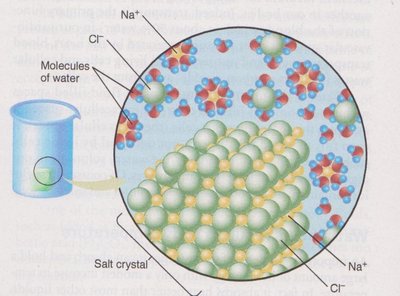
Water dissolves substances called solutes. Polar solutes (hydrophilic) dissolve easily, while non-polar solutes (hydrophobic) do not.
Example: Table salt (NaCl) dissolves in water as Na+ and Cl- ions are separated and surrounded by water molecules.
Hydrophilic: Water-loving, polar substances.
Hydrophobic: Water-fearing, non-polar substances.
Water in Transport and Temperature Regulation
Water's liquid state at body temperature allows it to transport solutes throughout the body and regulate temperature by absorbing excess heat and enabling cooling through evaporation.
Intracellular and Intercellular Spaces: Water is the main constituent of fluid-filled spaces in the body.
Heat Regulation: Excess heat is lost via sweat evaporation.
Water in Chemical Reactions
Water participates in metabolic reactions such as dehydration synthesis (formation of macromolecules) and hydrolysis (breaking down macromolecules).
Dehydration Synthesis: Formation of carbohydrates, lipids, proteins.
Hydrolysis: Breakdown of these molecules.
Hydrogen Ions and pH
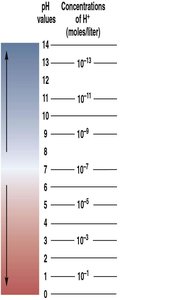
The concentration of hydrogen ions (H+) in a solution determines its pH. Water can dissociate into H+ and OH- ions. Acids donate H+, bases accept H+. The pH scale measures hydrogen ion concentration, affecting many biological processes.
pH Scale: Ranges from 0 (acidic) to 14 (basic), with 7 being neutral.
Blood pH: Must remain close to 7.4 for proper function.
Buffers: Substances that help maintain pH stability, such as bicarbonate ions and carbonic acid in blood.
Biological Importance of pH
Changes in pH can affect molecule transport, reaction speed, protein shape, and threaten homeostasis. The body uses buffer systems to regulate pH and maintain health.
Bicarbonate Buffer System: Bicarbonate ions (HCO3-) accept H+ when blood is too acidic; carbonic acid (H2CO3) donates H+ when blood is too alkaline.
Key Equations
pH Calculation:
Water Dissociation:
Bicarbonate Buffer:
Table: Properties of Water Relevant to Human Biology
Property | Biological Importance |
|---|---|
Polarity | Allows water to dissolve many substances |
Hydrogen Bonding | Enables water to absorb heat and maintain temperature |
Solvent Ability | Facilitates transport and reactions in cells |
Liquid State | Supports fluid movement and metabolic processes |
Table: pH Values and Biological Examples
pH Value | Example |
|---|---|
1-2 | Stomach acid |
7 | Pure water |
7.4 | Human blood |
8-9 | Soapy water |
13-14 | Bleach, drain opener |
Additional info: Academic context was added to clarify the scientific method, water chemistry, and pH regulation, ensuring completeness and self-contained study notes.
