 Back
Scientific Method and Metric System: Foundations for General Biology
Study Guide - Smart Notes
 Tailored notes based on your materials, expanded with key definitions, examples, and context.
Levels of Organization in Biology
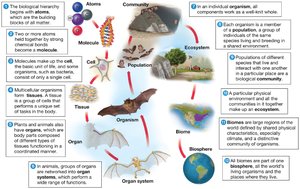
Biological Hierarchy
The study of life encompasses a range of organizational levels, from the smallest chemical units to the entire biosphere. Understanding these levels is fundamental to General Biology.
Atoms: The basic units of matter, forming molecules.
Molecules: Groups of atoms bonded together, such as water (H2O).
Cells: The smallest unit of life; all living organisms are composed of cells.
Tissues: Groups of similar cells performing a specific function.
Organs: Structures composed of different tissues working together.
Organ Systems: Groups of organs that perform complex functions.
Organism: An individual living entity.
Population: A group of organisms of the same species in a given area.
Community: All populations of different species living and interacting in an area.
Ecosystem: The community plus the physical environment.
Biome: Large regions characterized by specific climate and communities.
Biosphere: The global sum of all ecosystems.
The Scientific Method
Steps of Scientific Inquiry
The scientific method is a systematic approach used by scientists to investigate natural phenomena. It ensures objectivity and reproducibility in research.
Observation: Gathering information about phenomena.
Question: Formulating a question based on observations.
Hypothesis: Proposing a testable explanation.
Prediction: Making a logical statement about the outcome.
Experiment: Testing the hypothesis under controlled conditions.
Analysis: Interpreting data from the experiment.
Conclusion: Drawing conclusions based on the analysis.
Example:
A biologist observes plant growth, asks why some plants grow faster, hypothesizes that sunlight affects growth, predicts that plants in more sunlight will grow taller, tests this by placing plants in different light conditions, analyzes the results, and concludes whether the hypothesis is supported. 
The Metric System
Standardized Measurement in Science
Scientists use the metric system for consistency and ease of communication. The metric system is based on units of ten, making calculations straightforward.
Length: Measured in meters (m).
Mass: Measured in grams (g).
Volume: Measured in liters (L).
Temperature: Measured in degrees Celsius (°C).
Examples:
Length: A meter is slightly longer than a yard.
Mass: A large paperclip weighs about 1 gram.

Volume: A liter is about the volume of a large soda bottle.
Temperature: Water freezes at 0°C.

Metric System Prefixes
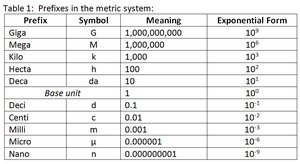
The metric system uses prefixes to indicate multiples or fractions of base units. These prefixes are essential for expressing measurements at different scales.
Prefix | Symbol | Meaning | Exponential Form |
|---|---|---|---|
Giga | G | 1,000,000,000 | |
Mega | M | 1,000,000 | |
Kilo | k | 1,000 | |
Hecta | h | 100 | |
Deca | da | 10 | |
Base unit | 1 | ||
Deci | d | 0.1 | |
Centi | c | 0.01 | |
Milli | m | 0.001 | |
Micro | \mu | 0.000001 | |
Nano | n | 0.000000001 |
Summary
The scientific method provides a logical framework for inquiry.
The metric system ensures standardized measurement in biology.
Understanding levels of biological organization is foundational for studying life.
Additional info:
The metric system is used globally in scientific research to avoid confusion and facilitate data sharing. Prefixes allow scientists to express very large or very small quantities efficiently. The scientific method is iterative; hypotheses may be revised based on new evidence. The levels of organization help biologists understand how complex systems arise from simpler components.
