 Back
BackSecondary Growth and Transport in Plants: Structure and Function
Study Guide - Smart Notes
 Tailored notes based on your materials, expanded with key definitions, examples, and context.
Secondary Growth in Plants
Types and Location of Meristems
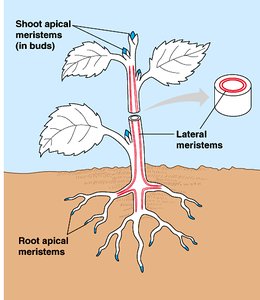
Meristems are regions of undifferentiated cells in plants that are responsible for growth. There are two main types: apical meristems and lateral meristems. Apical meristems are found at the tips of roots and shoots and are responsible for primary growth (lengthening). Lateral meristems, including the vascular cambium and cork cambium, are responsible for secondary growth (increase in diameter), which occurs in conifers and woody eudicots.
Apical meristems: Root and shoot tips; all vascular plants
Lateral meristems: Vascular cambium & cork cambium; only in conifers & woody eudicots
Secondary growth: Produces wood and bark
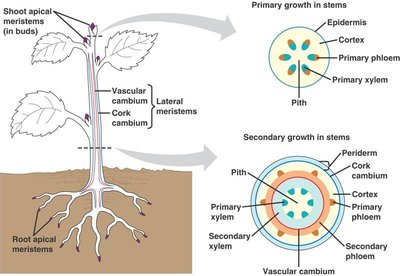
Primary vs. Secondary Growth in Stems
Primary growth increases the length of stems and roots, while secondary growth increases their thickness. The vascular cambium and cork cambium are lateral meristems that produce secondary tissues.
Primary growth: All vascular plants (ferns, seed plants)
Secondary growth: Woody species (conifers, woody eudicots)
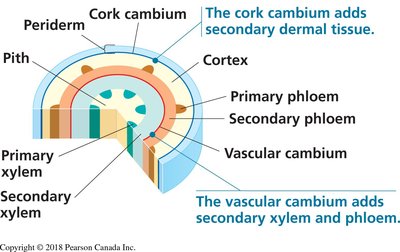
Structure of Secondary Growth
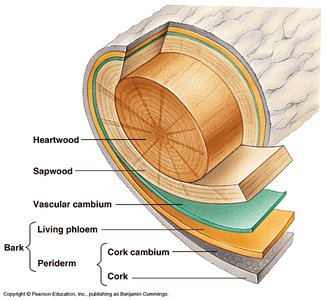
The vascular cambium produces secondary xylem (wood) to the inside and secondary phloem to the outside. The cork cambium produces the periderm, which replaces the epidermis in woody plants.
Vascular cambium: Adds secondary xylem and phloem
Cork cambium: Adds secondary dermal tissue (periderm)
Development of Secondary Tissues Over Time
Secondary growth results in the outward expansion of the stem as new layers of xylem, phloem, and periderm are added each year.
Growth occurs outward from the vascular cambium
Annual growth rings are formed by the periodic addition of secondary xylem
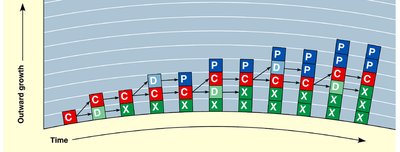
Vascular Cambium Activity
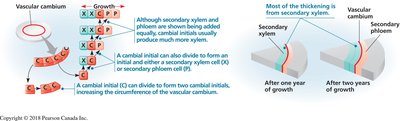
The vascular cambium produces more secondary xylem than phloem, contributing to the thickening of stems. Cambial initials can divide to form new cambial cells, increasing the circumference of the cambium.
Most thickening is from secondary xylem
Cambial initials divide to form new initials and secondary tissues
Wood Anatomy and Growth Rings
Wood Structure: Rays and Growth Rings
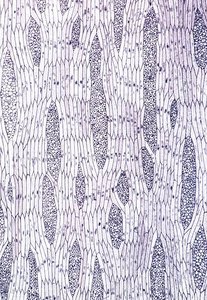
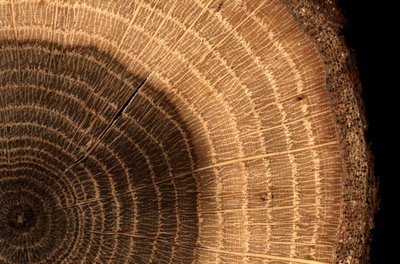
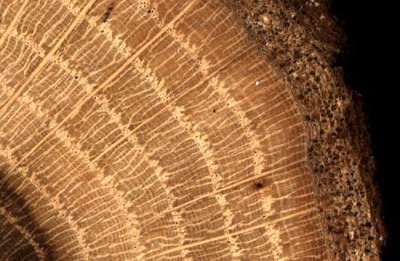
Wood consists of secondary xylem, with rays of parenchyma cells for lateral transport. Growth rings are visible in cross-sections and represent annual cycles of growth.
Rays: Parenchyma cells for lateral transport
Growth rings: Caused by seasonal changes in xylem cell size and wall thickness
Lignin: Structure and Function
Lignin is a complex organic polymer deposited in cell walls, providing strength and rigidity to wood and bark. It is the second-most abundant natural polymer after cellulose.
Fills spaces and binds cellulose, hemicellulose, and pectin
Gives strength to wood and bark
Used in human products: rope, clothing, paper (lignin removed), artificial vanillin

Bark and Cork Cambium
Bark Structure
Bark includes all tissues outside the vascular cambium: secondary phloem and periderm (cork cambium, cork, phelloderm). The cork cambium produces cork, which protects the plant after the epidermis is lost.
Cork cambium (phellogen): Arises from cortex cells, produces periderm
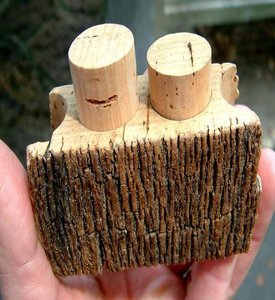
Periderm: Phelloderm (living cells), cork cambium, cork (suberized, dead cells)
Function: Protection of woody plants
Transport in Plants
Overview of Transport Mechanisms
Transport in plants involves the movement of water, minerals, and sugars through specialized tissues. The movement follows the laws of thermodynamics, with water moving from regions of higher to lower potential energy.
Xylem: Transports water and minerals upward
Phloem: Transports sugars and other compounds in any direction
Mechanisms: Transpiration-cohesion-tension (xylem), pressure-flow (phloem)
Water Potential (Ψ) and Its Components
Water potential (Ψ) determines the direction of water movement. It is measured in megapascals (MPa) and combines solute potential (Ψs) and pressure potential (Ψp).
Water flows from higher to lower water potential
Ψ = 0 MPa for pure water at sea level and room temperature
Equation:
Pathways of Water Movement
Water moves through plants via three main pathways: apoplast (cell walls and extracellular spaces), symplast (cytosol connected by plasmodesmata), and transmembrane (across cell membranes).
Apoplast: Nonliving continuum outside cytosol
Symplast: Living continuum of cytosol
Transmembrane: Across cell membranes
Water Potential in Plant Cells
Water movement in plant cells is driven by differences in water potential. Plasmolysis occurs when cells lose water in hypertonic solutions, while turgor pressure develops in hypotonic solutions.
Water moves from higher to lower Ψ
Plasmolysis: cell membrane separates from cell wall
Turgid cell: membrane pushes against cell wall
Xylem Structure and Function
Xylem consists of tracheids and vessel elements, which are dead at maturity and conduct water and minerals upward. The ascent of sap is driven by the transpiration-cohesion-tension mechanism.
Tracheids: Found in all vascular plants
Vessel elements: Found in flowering plants
Mechanism: Water is pulled up by negative pressure (tension) created by transpiration
Phloem Structure and Function
Phloem consists of sieve-tube elements and companion cells. It transports sugars and other organic compounds from sources (e.g., leaves) to sinks (e.g., roots, fruits) via the pressure-flow hypothesis.
Sieve-tube elements: Main transport cells
Companion cells: Support sieve-tube elements
Pressure-flow hypothesis: Movement from source to sink driven by pressure differences
Summary Table: Xylem vs. Phloem
Tissue | Transport Cell Types | What is Transported? | Direction | Mechanism |
|---|---|---|---|---|
Xylem | Tracheids, vessel elements | Water & minerals | Upward | Transpiration-cohesion-tension |
Phloem | Sieve-tube elements | Sugar water, other compounds | Any | Pressure flow |
Additional Info
Cell walls provide strength due to a complex mixture of polysaccharides
Tracheids are an example of cells that are dead at maturity but fully functional
The increase in diameter of woody plants is mostly due to the production of xylem
