 Back
Seed Plants: Gymnosperms and Angiosperms – Structure, Life Cycles, and Diversity
Study Guide - Smart Notes
 Tailored notes based on your materials, expanded with key definitions, examples, and context.
Seed Plants: Overview
Evolutionary Origins of Seed Plants
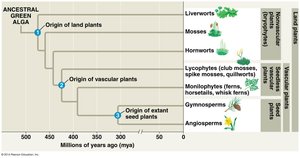
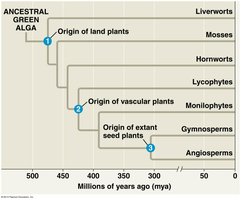
Seed plants are a major group of land plants that evolved specialized reproductive structures, including seeds and pollen. Their evolutionary history is marked by the origin of extant seed plants and the divergence of gymnosperms and angiosperms.
Seed plants originated approximately 360 million years ago.
Gymnosperms and angiosperms diverged around 305 million years ago.
Angiosperms first appeared in the fossil record about 140 million years ago.
Seed Plant Traits
Key Traits of Seed Plants
Seed plants possess several defining features that distinguish them from other land plants:
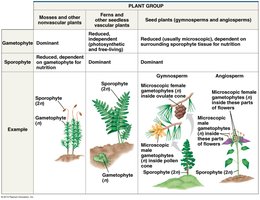
Very reduced gametophytes: Gametophytes are microscopic and develop within the tissues of the sporophyte.
Heterospory: Seed plants produce two types of spores: microspores (male) and megaspores (female).
Ovules: The megasporangium and megaspore are protected by one (gymnosperms) or two (angiosperms) layers of sporophyte tissue called the integument.
Pollen: Microspores develop into microgametophytes (pollen grains) covered in sporopollenin, facilitating pollination without water.
Seeds: Seeds are multicellular structures containing an embryo, nutrient supply, and protective coat.
Gymnosperms
Gymnosperm Characteristics
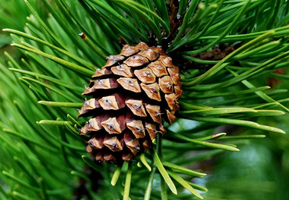
Gymnosperms are seed plants that do not form flowers. Their ovules and seeds are exposed on sporophylls, usually arranged in cones.
Four main clades: Conifers, Gnetophytes, Cycads, Ginkgos.
Conifers are the most species-rich group, bearing cones.
Gymnosperm seeds have tissues from three generations: seed coat (sporophyte), nutrient supply (female gametophyte), and embryo (new sporophyte).
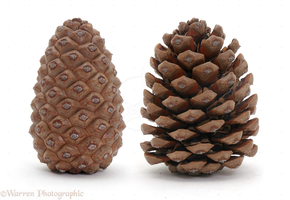
Gymnosperm Ovule Structure
The gymnosperm ovule consists of several layers and cell types, each with a specific function in reproduction.
Integument: Diploid sporophyte tissue surrounding the megasporangium.
Megasporangium: Produces the megaspore.
Megaspore: Develops into the female gametophyte.
Pollen grain: Delivers sperm to the egg via a pollen tube.
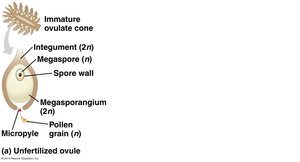
Angiosperms
Key Features of Angiosperms
Angiosperms, or flowering plants, are the most diverse group of seed plants. They are defined by several unique traits:
Flowers: Specialized reproductive structures composed of floral organs.
Double fertilization: Two sperm fertilize the egg and central cell, forming embryo and endosperm.
Endosperm: Triploid tissue that nourishes the developing embryo.
Fruits: Mature ovary walls that protect seeds and aid in dispersal.
Flower Structure and Diversity
Flowers are built from four types of floral organs, arranged in concentric rings on the receptacle:
Sepals: Usually green, protect the developing flower (collectively called the calyx).
Petals: Often brightly colored, attract pollinators (collectively called the corolla).
Stamens: Bear microsporangia; consist of filament and anther.
Carpels: Enclose ovules; consist of stigma, style, and ovary.
Flower Diversity
Perfect flowers: Have both stamens and carpels.
Imperfect flowers: Have either stamens or carpels, but not both.
Monoecious plants: Single plant has both male and female imperfect flowers.
Dioecious plants: Single plant has only male or only female imperfect flowers.
Inflorescences: Groups of flowers arranged together (e.g., bird of paradise, daisies).
Radial vs. bilateral symmetry: Radial flowers can be divided into equal halves by multiple cuts; bilateral flowers only by one cut.
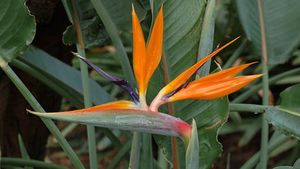
Angiosperm Life Cycle: Double Fertilization and Seed Structure
Double Fertilization
Angiosperms undergo double fertilization, a process unique to this group:
The megagametophyte contains seven cells: one egg, a central cell with two haploid nuclei, and five others.
The microgametophyte (pollen grain) delivers two sperm via a pollen tube.
One sperm fertilizes the egg, forming a diploid zygote (embryo).
The other sperm fuses with the two nuclei in the central cell, forming a triploid cell (endosperm).
The resulting seed contains:
Seed coat: From two layers of integument.
Endosperm: Triploid tissue nourishing the embryo.
Embryo: New sporophyte generation.
Cotyledons: Seed leaves; monocots have one, eudicots have two.
Angiosperm Fruits and Seed Dispersal
Fruit Structure and Types
After fertilization, the ovary wall develops into a fruit, which protects seeds and aids in dispersal.
Simple fruits: Develop from one carpel (e.g., wheat, corn, peach, avocado).
Aggregate fruits: Develop from a single flower with multiple carpels (e.g., raspberry).
Multiple fruits: Form from clusters of separate flowers (e.g., pineapple).
Accessory fruits: Include other flower parts besides carpels (e.g., apple, strawberry).
Seed Dispersal Mechanisms
Fruits facilitate seed dispersal by wind, water, and animals:
Wind: Fruits/seeds have structures for wind dispersal (e.g., maple, dandelion).
Water: Buoyant fruits/seeds can travel long distances (e.g., coconut).
Animals: Fruits may stick to animals, be eaten, or stored, aiding dispersal (e.g., cocklebur, nuts, berries).
Angiosperm Diversity
Major Clades of Angiosperms
Most angiosperms belong to two main clades:
Monocots: One cotyledon; includes grasses, orchids, palms, lilies.
Eudicots: Two cotyledons; includes most herbs, vines, trees, shrubs.
Other groups include Amborella, water lilies, star anise (basal angiosperms), and magnoliids.
Importance of Seed Plants
Ecological and Human Significance
Seed plants provide essential ecosystem services and resources:
Primary producers: Form the base of terrestrial food chains.
Ecosystem services: Produce oxygen, remove CO2, prevent erosion, moderate climate.
Food: Angiosperms are the primary food source for humans; six species provide 80% of human calories.
Other products: Wood, medicines, paper, and more.
Essential Vocabulary
Monoecious/Dioecious
Inflorescence
Radial/Bilateral Symmetry
Double Fertilization
Central Cell
Endosperm Tissue
Cotyledon
Fruit
Pericarp (Exo-, Meso-, Endo-)
Simple Fruit
Flower
Floral Organs
Receptacle
Sepals (Calyx)
Petals (Corolla)
Stamen (Filament, Anther)
Carpel (Stigma, Style, Ovary)
Perfect/Imperfect Flower
Aggregate Fruit
Multiple Fruit
Accessory Fruit
Amborella, Water Lilies, Star Anise
Magnoliids
Monocots
Eudicots
Example Table: Comparison of Plant Groups
Plant Group | Gametophyte | Sporophyte | Example |
|---|---|---|---|
Mosses and other nonvascular plants | Dominant | Reduced, dependent | Sporophyte (small), Gametophyte (large) |
Ferns and other seedless vascular plants | Reduced, independent | Dominant | Sporophyte (large), Gametophyte (small) |
Seed plants (gymnosperms and angiosperms) | Reduced, microscopic, dependent | Dominant | Microscopic female gametophyte inside ovule, Sporophyte (large) |
Key Equations and Concepts
Double Fertilization:
Study Questions
What is the basic structure of a flower? What sets of floral organs make them up? What is the relationship of those floral organs to leaves?
Which parts of a flower typically play a role in attracting pollinators to the flower?
What are perfect and imperfect flowers? What are monoecious and dioecious plants?
How does an inflorescence differ from a single flower? Why do we call the "flower" of a daisy or sunflower plant an inflorescence?
Describe an angiosperm life cycle in detail, explaining the process of double fertilization, endosperm formation, and seed structure, and explaining how the angiosperm life cycle and seed structure is different from that of gymnosperms.
What are fruits for?
When you eat a peach, what part of the flower are you eating? When you eat an apple, what part of the flower are you eating? How do the different types of fruits form?
Is a corn kernel a seed or a fruit?
What living angiosperm group is the sister taxon to the rest of the living angiosperms?
What are some key differences between eudicots and monocots that allow you to tell them apart?
Why are angiosperms important for humans and for terrestrial ecosystems and communities in general?
