 Back
BackSensory and Motor Mechanisms: Pathways, Receptors, and Animal Senses
Study Guide - Smart Notes
 Tailored notes based on your materials, expanded with key definitions, examples, and context.
Sensory and Motor Mechanisms
Big Ideas to Understand
Sensory Pathways
Sensory Receptors
Hearing and Equilibrium
Vision
Taste and Smell
Muscle Function
Skeletal Systems
Locomotion
Sensory Pathways
Overview of Sensory Pathways
Sensory pathways are essential for organisms to detect and respond to environmental changes. These pathways involve a sequence of steps that convert external or internal stimuli into meaningful perceptions and appropriate motor responses.
Sensory Reception: Detection of stimuli by sensory receptors, which may be internal or external.
Transduction: Conversion of stimulus energy into a change in membrane potential, known as the receptor potential.
Transmission: Sensory information is transmitted as action potentials through the nervous system.
Perception: The brain interprets and organizes sensory information, resulting in conscious perception of the stimulus.
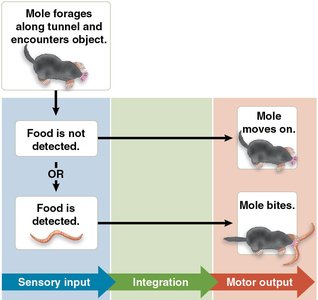
Example: A mole foraging in a tunnel detects an object. If food is detected, the mole bites; if not, it moves on. This illustrates sensory input, integration, and motor output.
Key Functions of Sensory Pathways
Reception: Sensory receptors open or close ion channels in response to stimuli.
Transduction: Stimulus energy is converted into electrical signals.
Transmission: Action potentials carry information to the brain.
Perception: The brain selects, interprets, and organizes sensory input into meaningful perceptions.
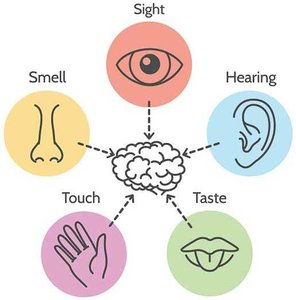
Example: The five senses (sight, hearing, smell, taste, touch) all send information to the brain for processing.
Sensory Receptors
Classification of Sensory Receptors
Sensory receptors are specialized cells or structures that detect specific types of energy from the environment. They are classified based on the type of energy they transduce:
Mechanoreceptors: Detect mechanical energy such as pressure, touch, vibration, and stretch.
Chemoreceptors: Detect chemical stimuli, including taste and smell.
Electromagnetic Receptors: Detect light, electricity, and magnetism.
Thermoreceptors: Detect changes in temperature.
Pain Receptors (Nociceptors): Detect harmful conditions such as excess heat, pressure, or chemicals.
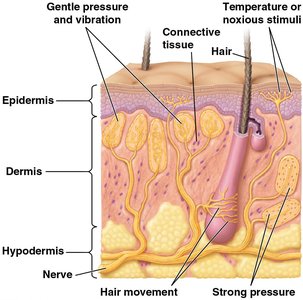
Example: Mechanoreceptors in the skin detect gentle pressure, vibration, and hair movement.
Specialized Receptors
Thermoreceptors: Some animals, such as rattlesnakes, have specialized organs to detect infrared radiation (heat).
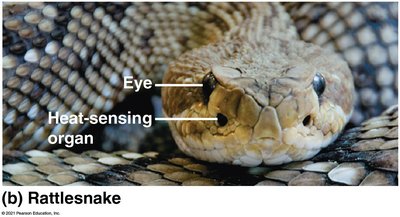
Example: The heat-sensing organ in rattlesnakes allows them to detect warm-blooded prey.
Hearing and Equilibrium
Hearing in Invertebrates and Vertebrates
Hearing involves the detection of sound waves (mechanical energy) and their conversion into nerve impulses. Equilibrium refers to the sense of balance and spatial orientation.
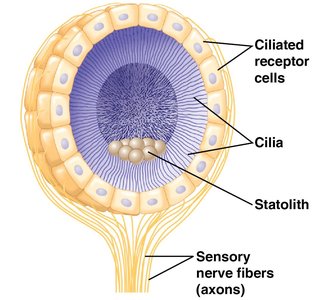
Invertebrates: Use statocysts (containing statoliths) to detect gravity and body position.
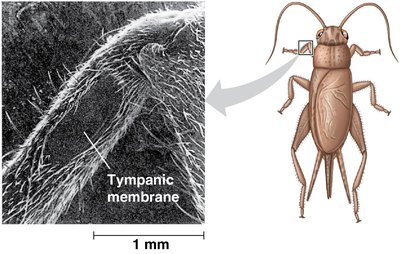
Insects: Detect sound via body hairs or tympanic membranes.
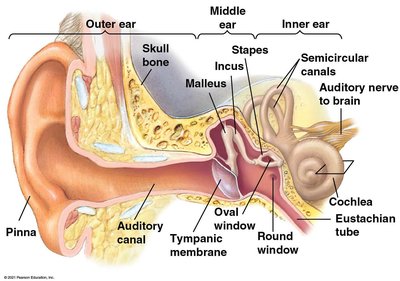
Mammals: The ear is divided into outer, middle, and inner regions, each with specialized structures for hearing and balance.
Sequence of Events in Mammalian Hearing
Sound waves enter the outer ear and cause the tympanic membrane (eardrum) to vibrate.
Vibrations are transmitted and amplified by the three middle ear bones (malleus, incus, stapes).
The stapes transmits vibrations to the oval window, creating pressure waves in the cochlear fluid.
Pressure waves cause the basilar membrane to vibrate, stimulating hair cells in the Organ of Corti.
Hair cells depolarize and generate action potentials in the auditory nerve, which are sent to the brain.
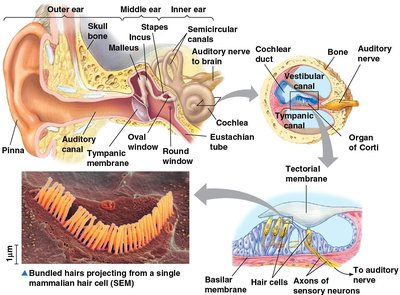
Equilibrium in Vertebrates
Utricle and Saccule: Detect linear acceleration and head position relative to gravity.
Semicircular Canals: Detect rotational movements of the head.

Vision
Types of Eyes and Photoreceptors
Vision is based on the detection of light by photoreceptors. Different animals have evolved various eye structures:
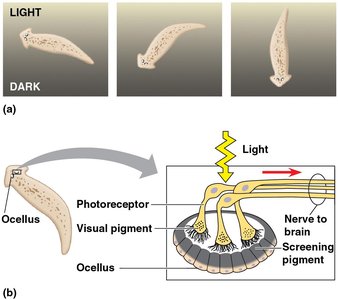
Ocelli (Eyespots): Simple light detectors that do not form images (e.g., in planarians).
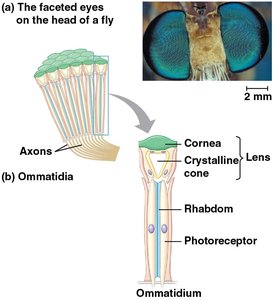
Compound Eyes: Found in insects and crustaceans; consist of many ommatidia, each with its own lens and photoreceptor cells.
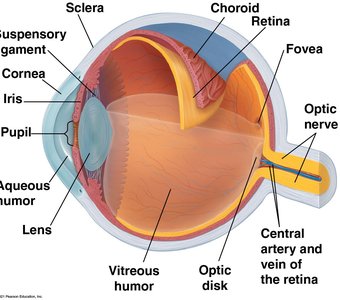
Single-lens Eyes: Found in vertebrates and some invertebrates; focus light onto a retina containing rods and cones.
The Visual Pathway in Humans
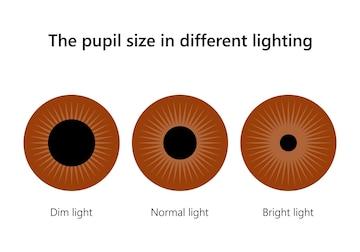
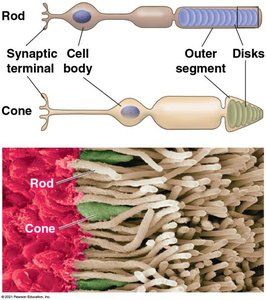
Light passes through the cornea and lens, which focus it onto the retina. The retina contains two main types of photoreceptors:
Rods: Sensitive to light intensity, enable vision in dim light but do not detect color.
Cones: Detect color and function best in bright light.
Neurons in the retina relay visual information to the optic nerve, which transmits signals to the brain.
Steps of the Visual Pathway
Light enters the cornea.
The lens focuses light onto the retina's photoreceptors.
Photoreceptors signal bipolar cells.
Bipolar cells signal ganglion cells.
Ganglion cells form the optic nerve.
The optic nerve transmits signals to the thalamus and visual cortex.
Taste and Smell
Chemoreception: Gustation and Olfaction
Taste (gustation) and smell (olfaction) are chemical senses that depend on chemoreceptors. These senses are crucial for detecting food, environmental chemicals, and pheromones.
Taste: Humans perceive five basic tastes (sweet, sour, salty, bitter, umami). Each taste cell has a single receptor type and is organized into taste buds.
Smell: Olfactory receptors in the nasal cavity detect airborne chemicals.
Muscle Function
Muscle Contraction
Muscle activity is a response to nervous system input and is essential for movement and locomotion. Muscle contraction relies on the interaction of two types of protein filaments:
Thin Filaments: Composed of actin.
Thick Filaments: Composed of myosin.
Example: The sliding filament model explains how actin and myosin interact to produce muscle contraction.
