 Back
BackLec 39s
Study Guide - Smart Notes
 Tailored notes based on your materials, expanded with key definitions, examples, and context.
Speciation and the Role of Organismal Traits
Organismal Traits and Fitness
Organismal traits influence relative fitness by affecting both survival and fecundity (natural selection), as well as mating and fertilization success (sexual selection). These traits can drive divergence between populations, leading to speciation, especially when populations adapt to different environments or develop distinct mating preferences.
Natural Selection: Traits that improve survival and reproductive output in a given environment are favored.
Sexual Selection: Traits that enhance mating success, such as elaborate displays or behaviors, can diverge rapidly between populations.
Speciation: Divergence in traits affecting resource use or mating can lead to reproductive isolation and the formation of new species.
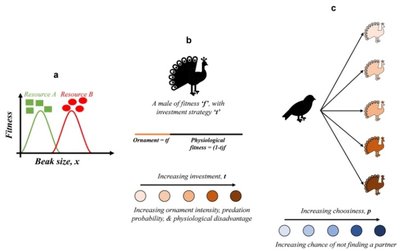
Sexual Selection and Speciation
Mechanisms of Sexual Selection
Sexual selection operates through two main mechanisms: female choice and male-male competition. Both can promote divergence in mating traits and preferences, accelerating speciation.
Female Choice: Females may prefer males with specific traits, leading to assortative mating and reproductive isolation.
Male-Male Competition: Males compete for access to females, often resulting in the evolution of secondary sexual characteristics.
Sexual Conflict: Conflicts between male and female reproductive interests can further drive divergence.
Empirical Evidence: Case Studies
Studies in birds, fish, and insects provide evidence that sexual selection can drive rapid divergence in mating traits, leading to speciation. For example, in cichlid fish and crossbills, both ecological adaptation and sexual selection contribute to diversification.
Haldane’s Rule and Hybrid Sterility
Patterns of Hybrid Inviability and Infertility
Haldane’s rule states that if one sex of hybrids between two species is inviable or infertile, it is usually the heterogametic sex (e.g., XY males in mammals, ZW females in birds). This pattern is observed in Drosophila, mammals, butterflies, and birds.
Genetic Basis: Genes related to spermatogenesis often evolve rapidly, leading to incompatibilities in hybrids.
Theory: The 'faster male' hypothesis predicts that male sterility is more common due to rapid evolution of male-specific genes.
Adaptive Radiation and Speciation in Cichlid Fish
Stages of Adaptive Radiation
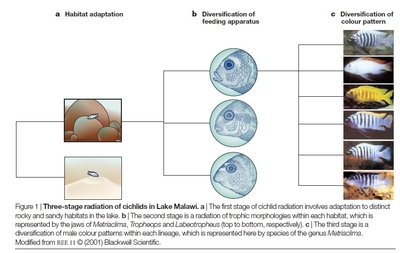
Adaptive radiation is the rapid diversification of a lineage into multiple species, often following the colonization of new environments. In cichlid fish, this process involves adaptation to new niches, morphological diversification, and the evolution of mating signals.
Stage 1: Adaptation to empty ecological niches.
Stage 2: Radiation of morphology in response to key innovations (e.g., jaw structure).
Stage 3: Diversification of male color patterns driven by sexual selection.
Factors Influencing Adaptive Radiation
Both extrinsic environmental factors (e.g., resource availability, climate) and intrinsic lineage-specific traits (e.g., behavior, morphology, genetic architecture) influence the likelihood and extent of adaptive radiation.
Ecological Opportunity: Availability of unoccupied niches promotes diversification.
Sexual Selection: Drives divergence in mating traits, reinforcing reproductive isolation.
Mechanisms of Reproductive Isolation
Prezygotic and Postzygotic Barriers
Barriers to gene flow can be classified as prezygotic (before fertilization) or postzygotic (after fertilization). These barriers prevent or reduce gene flow between diverging populations, facilitating speciation.
Premating Barriers: Ecological isolation (different habitats or breeding times), behavioral isolation (differences in mating signals or preferences).
Postmating, Prezygotic Barriers: Mechanical incompatibility, copulatory behavioral isolation, gametic isolation.
Postzygotic Barriers: Hybrid inviability or infertility.
Reinforcement and Hybrid Zones
Reinforcement is the process by which natural selection increases reproductive isolation between populations in sympatry, especially when hybrids have reduced fitness. Hybrid zones are regions where diverging populations meet and interbreed, providing insight into the dynamics of speciation.
Ecological Speciation
Definition and Process
Ecological speciation is the evolution of reproductive barriers between populations as a result of adaptation to different ecological environments. Divergent selection pressures in different habitats drive the evolution of traits that reduce gene flow.
Example: Crossbills and cichlid fish show how ecological adaptation and sexual selection interact to promote speciation.
Tables and Data Interpretation
Components of Reproductive Isolation in Crossbills
The following table summarizes the contributions of different barriers to reproductive isolation in crossbills:
Isolating barrier | Individual components of reproductive isolation (RI) | Absolute contribution to total reproductive isolation (AC) |
|---|---|---|
Habitat isolation | 0.8469 (South Hills vs. type 2), 0.9725 (South Hills vs. type 5) | 0.8469, 0.9725 |
Immigrant infecundity | 0.1988, 0.2736 | 0.1004, 0.0595 |
Behavioral isolation | 0.9800, 0.9888 | 0.1202, 0.0154 |
Total isolation | 0.9975, 0.9998 | 0.9975, 0.9998 |
Additional info: The table demonstrates that behavioral isolation and habitat isolation are the strongest contributors to reproductive isolation in these populations.
Summary of Key Concepts
Speciation is driven by divergence in traits affecting resource use and mating preferences.
Sexual selection can rapidly promote reproductive isolation, especially when combined with ecological adaptation.
Hybrid sterility and inviability often affect the heterogametic sex first (Haldane’s rule).
Adaptive radiation is facilitated by ecological opportunity and sexual selection, as seen in cichlid fish.
Reproductive isolation is achieved through a combination of prezygotic and postzygotic barriers.
