Back
L11Signal Transduction and Plant Hormones: Plant Responses to Internal and External Signals
Study Guide - Smart Notes
 Tailored notes based on your materials, expanded with key definitions, examples, and context.
Plant Responses to Internal and External Signals
Overview of Plant Sensory and Response Mechanisms
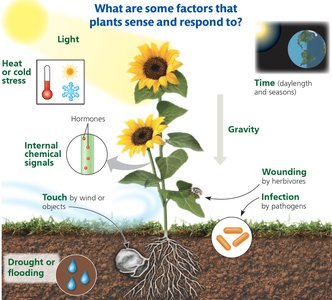
Plants are able to sense and respond to a wide variety of environmental and internal signals. These responses are crucial for survival, growth, and reproduction. Key factors that plants sense include light, gravity, temperature, water availability, mechanical stimuli, and chemical signals.
Light: Influences processes such as photosynthesis, phototropism, and flowering.
Gravity: Directs root and shoot growth (gravitropism).
Temperature: Affects metabolic rates and stress responses.
Water Availability: Regulates stomatal opening and drought responses.
Mechanical Stimuli: Includes touch, wind, and wounding.
Chemical Signals: Both internal (hormones) and external (pathogen signals) cues.
Signal Transduction in Plants
The General Model of Signal Transduction
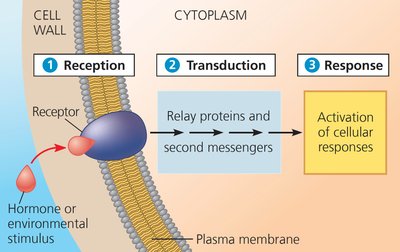
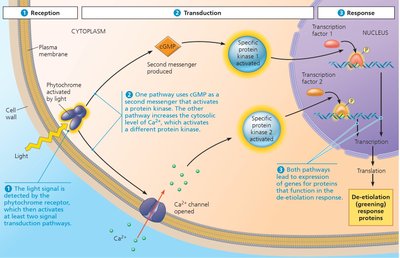
Plant cells convert external and internal signals into physiological responses through a process called signal transduction. This process typically involves three main steps: reception, transduction, and response.
Reception: A signal (such as a hormone or environmental stimulus) is detected by a receptor protein, usually located on the cell surface or within the cell.
Transduction: The receptor activates relay proteins and second messengers, which amplify and transmit the signal within the cell.
Response: The signal ultimately leads to changes in cellular activity, such as gene expression, enzyme activity, or ion channel opening.
Etiolation and De-Etiolation: Plant Development in Darkness and Light
Etiolation vs. De-Etiolation
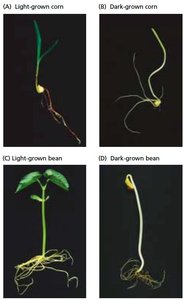
Etiolation is the growth pattern observed in seedlings grown in darkness, characterized by elongated stems, undeveloped leaves, and lack of chlorophyll. De-etiolation, or the greening response, occurs when seedlings are exposed to light, leading to expanded leaves, chlorophyll production, and robust root growth.
Etiolation: Adaptation for rapid stem elongation to reach light.
De-Etiolation: Initiated by light, resulting in photosynthetic development and normal morphology.
Mechanisms of De-Etiolation (Greening Response)
De-etiolation is triggered by light perception, primarily through the phytochrome receptor. This initiates a signal transduction cascade involving second messengers such as cyclic GMP (cGMP) and calcium ions (Ca2+), leading to changes in gene expression and the production of proteins necessary for photosynthesis and normal growth.
Phytochrome: Acts as the light receptor.
Second Messengers: cGMP and Ca2+ coordinate the signal transduction.
Gene Expression: Activation of transcription factors leads to synthesis of greening proteins.
Plant Hormones: Chemical Communication in Plants
Overview of Major Plant Hormones
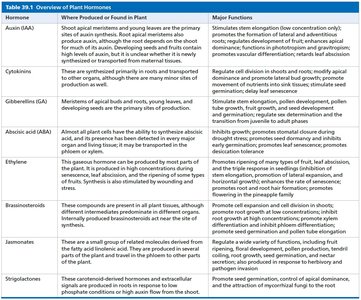
Plant hormones, or phytohormones, are chemical messengers that regulate growth, development, and responses to stimuli. They act at very low concentrations and often interact with each other to produce complex outcomes. Each hormone can have multiple effects, and most processes are regulated by several hormones working together.
Hormone | Where Produced or Found in Plant | Major Functions |
|---|---|---|
Auxin (IAA) | Shoot apical meristems and young leaves; developing seeds | Stimulates stem elongation, root growth, and differentiation; regulates phototropism and gravitropism |
Cytokinins | Roots, transported to other organs | Stimulate cell division, promote lateral bud growth, delay leaf senescence |
Gibberellins (GA) | Meristems of apical buds, roots, young leaves, seeds | Stimulate stem elongation, seed germination, fruit growth |
Abscisic Acid (ABA) | All plant cells can synthesize ABA | Promotes stomatal closure during drought, induces seed dormancy |
Ethylene | Produced in response to stress, during fruit ripening | Promotes fruit ripening, leaf abscission, and response to mechanical stress |
Brassinosteroids | Present in all plant tissues | Promote cell expansion and division, vascular differentiation |
Jasmonates | Derived from fatty acids, produced in response to wounding | Regulate plant defenses against herbivores and pathogens |
Strigolactones | Produced in roots, transported upward | Inhibit axillary bud growth, stimulate mycorrhizal associations |
Auxin and Phototropism: Classic Experiments
Discovery of Auxin's Role in Phototropism
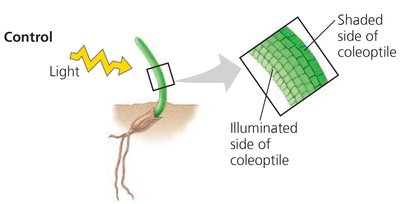
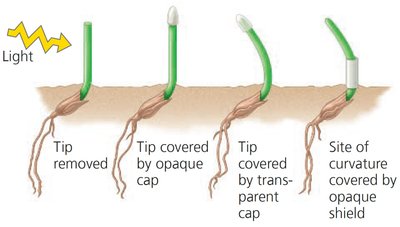
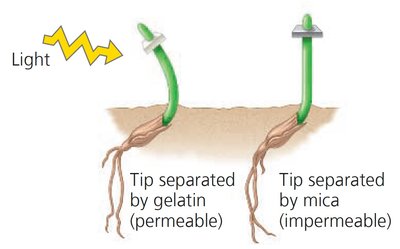
Phototropism is the growth of plant organs toward or away from light. Classic experiments with coleoptiles (sheath protecting young shoots) demonstrated that the tip senses light and a mobile signal (auxin) moves downward, causing differential growth and curvature toward the light.
Light Perception: The tip of the coleoptile detects light direction.
Signal Transmission: Auxin redistributes toward the shaded side, promoting cell elongation there.
Curvature: Differential growth causes the shoot to bend toward the light.
Auxin Mechanism: Acid Growth Hypothesis
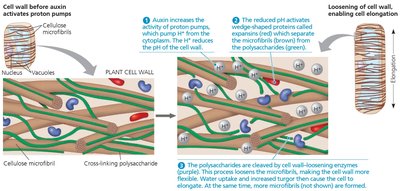
The acid growth hypothesis explains how auxin stimulates cell elongation. Auxin activates proton pumps in the plasma membrane, lowering the pH of the cell wall. This acidic environment activates enzymes called expansins, which loosen the cell wall, allowing water uptake and turgor-driven cell expansion.
Proton Pumps: Auxin increases activity, pumping H+ into the cell wall.
Cell Wall Loosening: Expansins break bonds between cellulose microfibrils and polysaccharides.
Cell Elongation: Water uptake increases turgor pressure, stretching the loosened wall.
Hormonal Interactions: Apical Dominance and Branching
Auxin, Cytokinins, and Strigolactones in Apical Dominance
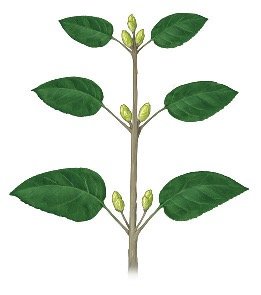
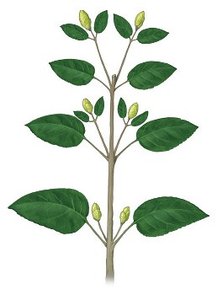
Apical dominance is the phenomenon where the main, central stem of the plant is dominant over (i.e., grows more strongly than) other side stems. Auxin produced by the apical bud suppresses the growth of axillary buds. Strigolactones reinforce this suppression, while cytokinins promote axillary bud growth and branching by counteracting auxin and strigolactone effects.
Auxin: Moves downward from the apical bud, maintaining dominance.
Strigolactones: Inhibit axillary bud outgrowth.
Cytokinins: Promote branching by stimulating axillary bud growth.
Gibberellins and Seed Germination
Mobilization of Nutrients by Gibberellins
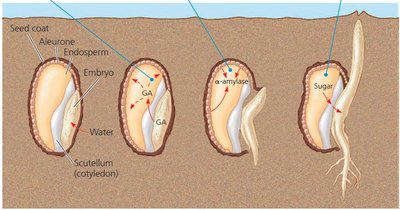
During seed germination, gibberellins (GA) play a key role in mobilizing stored nutrients. Water uptake triggers the embryo to release GA, which signals the aleurone layer to produce hydrolytic enzymes such as alpha-amylase. These enzymes break down endosperm starch into sugars, which are then transported to the growing embryo. The balance between GA and abscisic acid (ABA) determines whether the seed remains dormant or germinates.
Water Uptake: Initiates metabolic activity in the seed.
GA Release: Embryo releases gibberellins to signal the aleurone layer.
Enzyme Production: Aleurone produces alpha-amylase to digest starch.
Nutrient Transfer: Sugars are transported to the embryo for growth.
Hormonal Balance: GA promotes germination; ABA promotes dormancy.