 Back
Sleep and Its Biological Functions: Brain Regions, Stages, and Effects
Study Guide - Smart Notes
 Tailored notes based on your materials, expanded with key definitions, examples, and context.
Sleep: Biological Basis and Importance
Brain Regions Involved in Sleep
Sleep is regulated by specific areas of the brain, which coordinate the sleep-wake cycle and the physiological changes associated with sleep. The brain is divided into three main regions: the hindbrain, midbrain, and forebrain. Groups of neurons in the midbrain play a crucial role in controlling our daily cycle of sleep and wakefulness.
Midbrain neurons send action potentials to the cerebrum, keeping us awake and alert.
Another group of neurons stimulates the release of serotonin, which inhibits the wake-promoting neurons and induces sleepiness.
Example: The midbrain acts as a switch, alternating between wakefulness and sleep by modulating neurotransmitter release.
Why Do We Sleep?
Sleep is essential for the restoration and maintenance of the body and mind. During the deepest parts of sleep, several physiological processes occur:
Muscles relax, heart rate and respiration slow, and body temperature decreases.
Cells and tissues undergo repair.
Long-term memory formation is enhanced.
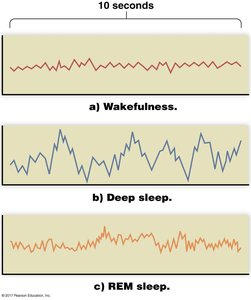
Despite physical rest, the brain remains highly active, as shown by electroencephalograms (EEG).
Example: EEGs reveal that brain activity during sleep can be greater than during wakefulness, especially in certain sleep stages.
Stages of Sleep
Non-REM (NREM) Sleep
Sleep is divided into several stages, each with distinct physiological characteristics. NREM sleep consists of three stages:
Stage 1: Lightest sleep; eyes are closed but the person is easily awakened. Typically lasts 5-10 minutes.
Stage 2: Light sleep; heart rate slows, body temperature drops, and the body prepares for deeper sleep.
Stage 3: Deep sleep; difficult to wake, and if awakened, the person may feel disoriented. This stage is crucial for tissue repair, bone and muscle building, and immune system strengthening. The amount of deep sleep declines with age.
REM (Rapid Eye Movement) Sleep
REM sleep is characterized by rapid eye movements, vivid dreaming, and increased brain activity. Physiological changes during REM include:
Increased heart rate, respiration, and blood flow to the brain.
Muscles become limp, preventing physical responses to dreams.
Throughout the night, individuals cycle through 3-5 periods of deep sleep and REM sleep.
The first REM stage lasts about 10 minutes, with subsequent stages becoming progressively longer, up to an hour.
Example: REM sleep is essential for cognitive functions such as memory consolidation and emotional regulation.
Sleep Requirements and Sleep Debt
How Much Sleep Do We Need?
The amount of sleep required varies by age and individual needs:
Teenagers: 8.5 – 9.5 hours per day
Adults: 7 – 9 hours per day
Sleep debt refers to the cumulative effect of not getting enough sleep. This increases the need for sleep in subsequent days, and the body eventually requires "repayment" for lost sleep.
Effects of Sleep Deprivation
Impact on Learning, Memory, and Health
Sleep deprivation has significant negative effects on both physical and mental health:
Learning & Memory: Reduced sleep impairs memory formation and learning ability. Students who sleep less tend to have lower academic performance.
Physical Performance: Adequate sleep improves accuracy, reaction time, and speed.
Health & Appearance: Lack of sleep triggers genes that impair glucose tolerance, increases snacking and weight gain, and weakens the immune system.
Mood: Increased feelings of stress, anger, anxiety, and sadness.
Example: Less than 5.5 hours of sleep per night is associated with increased risk of infections and metabolic disorders.
Summary Table: Stages of Sleep
Stage | Characteristics | Duration | Physiological Effects |
|---|---|---|---|
Stage 1 (NREM) | Light sleep, easily awakened | 5-10 min | Transition to sleep |
Stage 2 (NREM) | Heart rate slows, body temp drops | Variable | Preparation for deep sleep |
Stage 3 (NREM) | Deep sleep, hard to wake | Variable | Tissue repair, immune strengthening |
REM | Rapid eye movement, vivid dreams | 10 min to 1 hour | Memory consolidation, increased brain activity |
References
Felson, Sabrina (2020). What are REM & non-REM sleep? WebMD.
Hopson, Janet L., R. Donatelle & T. Littrell. Managing Stress. In C. Hughes (Comp). BIO216 A&P of wellness.
Johnson, Michael. (2017). Human biology: Concepts & current issues (8th ed). Pearson Education.
