 Back
BackSoil and Plant Mineral Nutrition: Essential Elements and Special Nutritional Strategies
Study Guide - Smart Notes
 Tailored notes based on your materials, expanded with key definitions, examples, and context.
Soil and Plant Mineral Nutrition
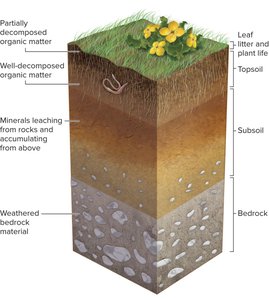
Soil Profile and Its Importance
The soil profile is a vertical section of soil that reveals its different layers, each with distinct physical and chemical properties. These layers play a crucial role in supporting plant growth by providing nutrients, water, and anchorage.
Topsoil: Contains leaf litter, plant life, and partially decomposed organic matter, which is rich in nutrients essential for plant growth.
Subsoil: Accumulates minerals leached from the topsoil and contains less organic matter.
Bedrock: The lowest layer, consisting of weathered rock material, which gradually contributes minerals to the upper layers.
Role of Soil Charge in Nutrient Transport
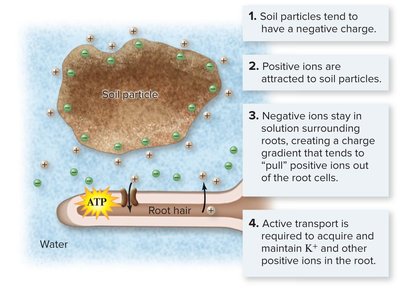
Soil particles, especially clay and organic matter, tend to have a negative charge, which influences the movement and availability of mineral nutrients for plant uptake.
Cation Exchange: Positive ions (cations) such as K+ and Ca2+ are attracted to negatively charged soil particles and can be exchanged with H+ ions released by plant roots.
Anion Mobility: Negative ions (anions) like NO3- remain in soil solution and are more easily leached away, making them less available to plants.
Active Transport: Plants use energy (ATP) to actively transport essential cations into root cells against concentration gradients.
Essential Elements for Plant Growth
Macronutrients and Micronutrients
Plants require a variety of mineral elements for optimal growth, which are classified based on the quantity needed:
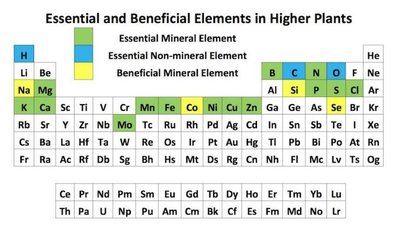
Macronutrients: Required in large amounts. Examples include carbon (C), hydrogen (H), oxygen (O), nitrogen (N), phosphorus (P), potassium (K), sulfur (S), calcium (Ca), and magnesium (Mg).
Micronutrients: Needed in trace amounts. Examples include chlorine (Cl), iron (Fe), manganese (Mn), zinc (Zn), boron (B), copper (Cu), molybdenum (Mo), and nickel (Ni).
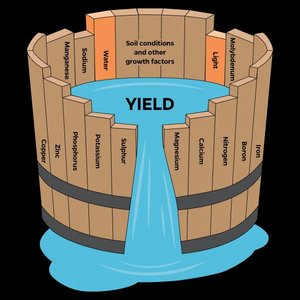
A deficiency in any essential element can severely limit plant growth, regardless of the abundance of other nutrients. This concept is illustrated by Liebig’s Law of the Minimum.
Photosynthesis and Nutrient Uptake
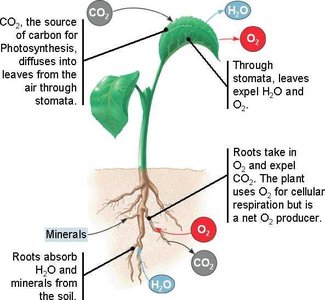
Photosynthesis is the primary process by which plants convert CO2 into sugars using solar energy. However, mineral nutrients from the soil are also essential for various physiological processes.
CO2 Uptake: Leaves absorb CO2 for photosynthesis through stomata.
Mineral Absorption: Roots absorb water and minerals from the soil, which are transported to other plant parts.
Categories of Essential Elements
Essential elements are grouped based on their biochemical roles and physiological functions:
Group 1: Part of carbon compounds (e.g., N, S)
Group 2: Important in energy storage or structural integrity (e.g., P, Si, B)
Group 3: Remain in ionic form (e.g., K, Ca, Mg, Cl, Mn, Na)
Group 4: Involved in redox reactions (e.g., Fe, Zn, Cu, Ni, Mo)
Assessing Nutritional Requirements
Hydroponic Culture Experiments
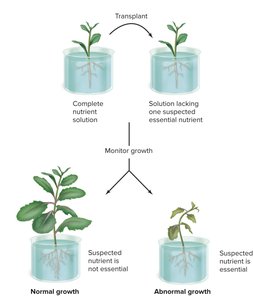
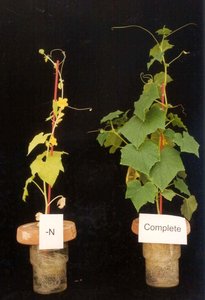
Hydroponic culture is used to determine the essentiality of nutrients by growing plants in controlled nutrient solutions.
Seedlings are first grown in a complete nutrient solution.
They are then transferred to a solution lacking one suspected essential nutrient.
Growth is monitored for abnormal symptoms, indicating the essentiality of the omitted nutrient.
Mineral Deficiencies in Plants
Symptoms of Mineral Deficiency
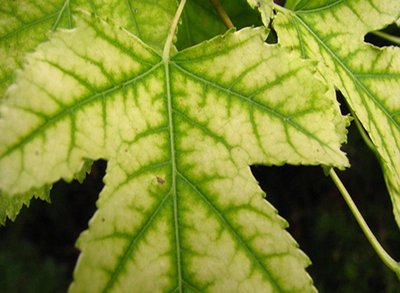
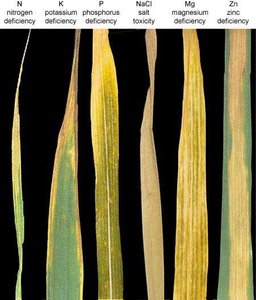
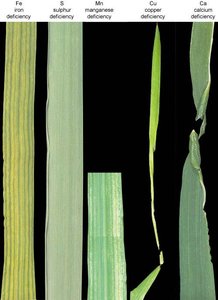
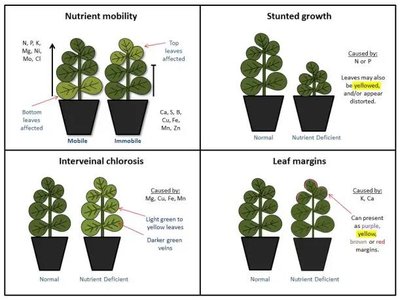
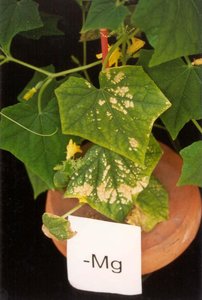
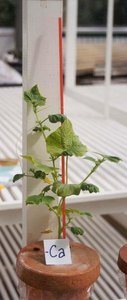
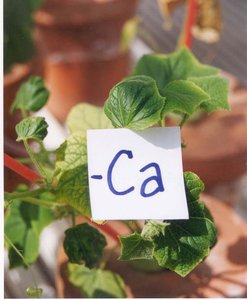
Deficiencies in essential minerals manifest as visible symptoms in plant leaves and overall growth. Common symptoms include chlorosis (yellowing), necrosis (death of tissue), stunted growth, and abnormal coloration.
Chlorosis: Yellowing of leaves due to lack of chlorophyll, often caused by deficiencies in N, Mg, or Fe.
Necrosis: Death of leaf tissue, often at the margins or tips, associated with deficiencies in K or Ca.
Stunted Growth: Reduced plant size, often due to lack of N or P.



Deficiency Patterns in Wheat and Other Crops
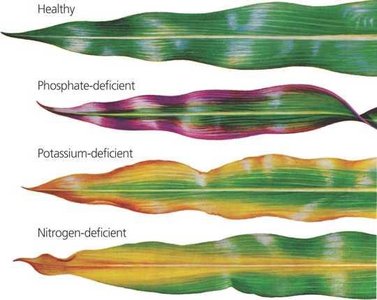
Different nutrients produce characteristic deficiency symptoms in specific crops, such as wheat. These can include changes in leaf color, shape, and overall plant vigor.
Summary Table: Common Deficiency Symptoms
Nutrient | Deficiency Symptom |
|---|---|
Nitrogen (N) | General chlorosis, stunted growth |
Phosphorus (P) | Purple coloration, stunted growth |
Potassium (K) | Marginal necrosis, leaf curling |
Magnesium (Mg) | Interveinal chlorosis |
Iron (Fe) | Interveinal chlorosis in young leaves |
Calcium (Ca) | Necrosis at tips and margins, distorted growth |
Zinc (Zn) | Small leaves, interveinal chlorosis |
Copper (Cu) | Dieback of stems and twigs |
Special Nutritional Strategies in Plants
Symbiotic Nitrogen Fixation
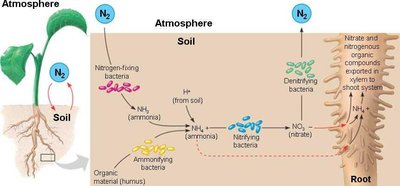
Most plants cannot convert atmospheric nitrogen (N2) into ammonia (NH3), which is required for amino acid synthesis. Legumes and some other plants form symbiotic relationships with nitrogen-fixing bacteria such as Rhizobium.
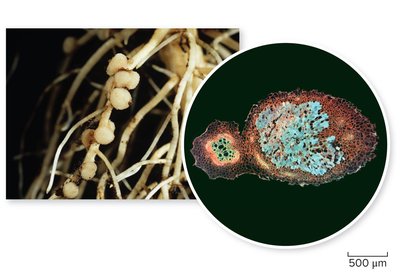
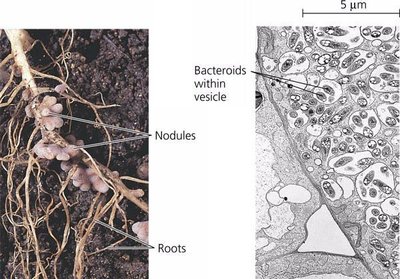
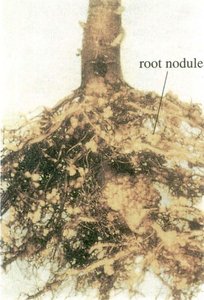
Root Nodules: Specialized structures that house nitrogen-fixing bacteria.
Mutual Benefit: The plant supplies carbohydrates and oxygen, while bacteria provide fixed nitrogen.
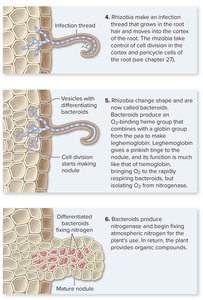
Nodule Formation and Function
Nodule formation involves complex signaling between plant roots and bacteria, leading to the development of structures where nitrogen fixation occurs under low-oxygen conditions, aided by leghaemoglobin.
Mycorrhizal Associations
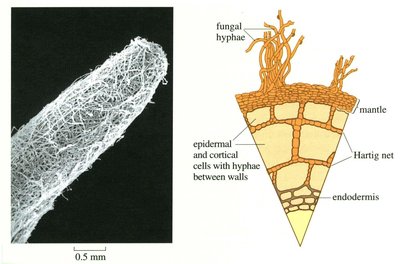
Mycorrhizae are symbiotic associations between plant roots and fungi, found in about 90% of vascular plants. They greatly enhance nutrient uptake, especially phosphate, and increase the surface area for absorption.
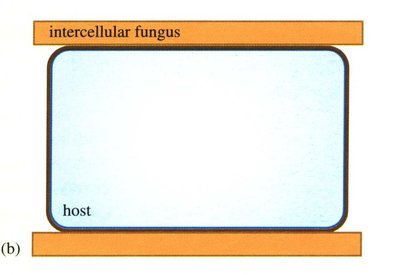
Ectomycorrhizae: Fungi form a sheath around roots and penetrate between root cells.
Endomycorrhizae (Arbuscular): Fungi penetrate root cell walls, forming arbuscules for nutrient exchange.
Carnivorous and Parasitic Plants
Some plants have evolved unique nutritional strategies to survive in nutrient-poor environments:
Carnivorous Plants: Trap and digest insects or small animals to obtain nitrogen. Examples include pitcher plants, Venus flytrap, sundews, and waterwheels.
Parasitic Plants: Obtain nutrients by tapping into the vascular tissue of host plants. They may be photosynthetic or non-photosynthetic.
Examples: Nepenthes (pitcher plant), Dionaea muscipula (Venus flytrap), Drosera (sundew), dodder, and Indian pipe.
Additional info: Carnivorous adaptations include modified leaves for trapping prey and secretion of digestive enzymes, while parasitic plants develop specialized structures called haustoria for nutrient extraction.
----------------------------------------
