 Back
Solids and Modern Materials: Structure, Properties, and Applications
Study Guide - Smart Notes
 Tailored notes based on your materials, expanded with key definitions, examples, and context.
Solids and Modern Materials
Classification and Structure of Solids
Solids are classified based on their atomic or molecular organization and bonding. Understanding these classifications is essential for predicting their properties and applications in engineering and biology.
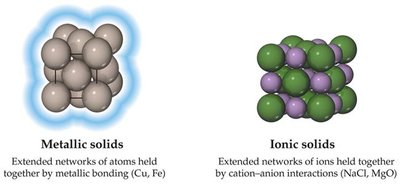
Metallic Solids: Composed of metal atoms held together by a 'sea' of delocalized electrons. This structure imparts conductivity, malleability, and luster.
Ionic Solids: Made of cations and anions held by strong electrostatic forces. They are typically hard, brittle, and have high melting points.
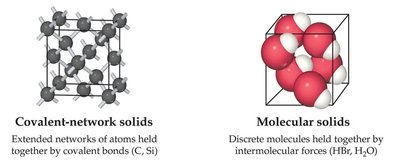
Covalent-Network Solids: Atoms are linked by extensive covalent bonds, resulting in very hard materials with high melting points.
Molecular Solids: Consist of discrete molecules held by weak intermolecular forces, making them soft with low melting points.
Diamond vs. Graphite
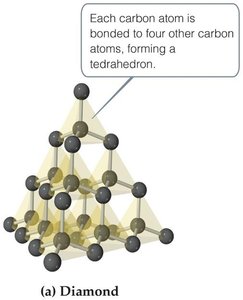
Diamond: Each carbon atom is sp3 hybridized, forming four strong covalent bonds in a tetrahedral lattice. Properties: extremely hard, high melting point, electrical insulator.
Graphite: Each carbon atom is sp2 hybridized, forming three covalent bonds in planar sheets. Properties: soft, slippery, good electrical conductor.
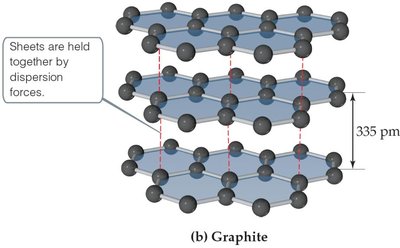
Organization of Solids
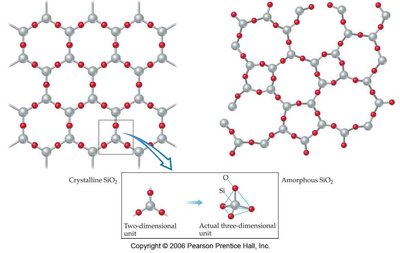
Solids can be crystalline (regular repeating pattern) or amorphous (lack of order). Crystalline solids are of greater interest due to their predictable properties.
Metallic Bonding and Alloys
Metallic bonding is described by the electron-sea model, where metal cations are surrounded by delocalized electrons. This explains metals' conductivity, ductility, and malleability.
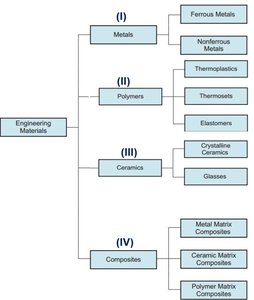
Alloys: Mixtures of metals or metals with other elements, classified as ferrous (iron-based) or nonferrous (no significant iron).
Types of Alloys:
Substitutional: Atoms of one metal replace another in the lattice.
Interstitial: Small atoms occupy spaces between metal atoms.
Heterogeneous: Components are not uniformly dispersed.
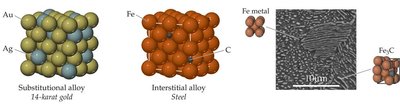
Ferrous vs. Nonferrous Alloys
Ferrous: Steel, cast iron, stainless steel. Strong, hard, but prone to corrosion and heavy.
Nonferrous: Brass, bronze, aluminum alloys. More corrosion-resistant, lighter, often used in aerospace and electrical applications.
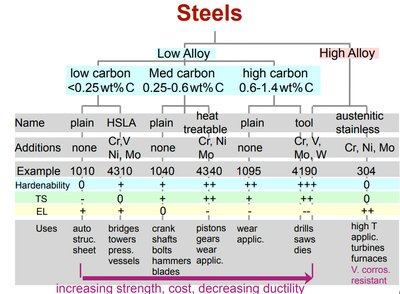

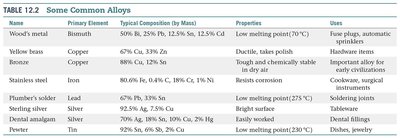
Common Alloy Properties and Uses
Name | Primary Element | Composition | Properties | Uses |
|---|---|---|---|---|
Wood's metal | Bismuth | 50% Bi, 25% Pb, 12.5% Sn, 12.5% Cd | Low melting point (70°C) | Fuses, sprinklers |
Yellow brass | Copper | 80% Cu, 20% Zn | Ductile, takes polish | Hardware items |
Bronze | Copper | 88% Cu, 12% Sn | Tough, stable | Early civilizations |
Stainless steel | Iron | 80% Fe, 0.4% C, 18% Cr, 1% Ni | Resists corrosion | Cookware, surgical instruments |
Plumber's solder | Lead | 63% Pb, 37% Sn | Low melting point (235°C) | Soldering joints |
Sterling silver | Silver | 92.5% Ag, 7.5% Cu | Bright surface | Tableware |
Dental amalgam | Silver | 50% Ag, 25% Sn, 25% Cu, 2% Hg | Easily worked | Dental fillings |
Pewter | Tin | 92% Sn, 6% Sb, 2% Cu | Low melting point (230°C) | Dishes, jewelry |
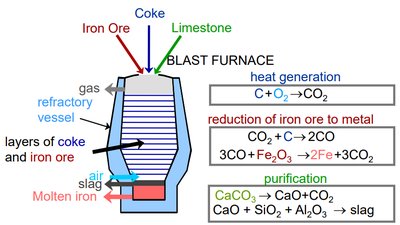
Refinement of Steel from Ore
Steel is produced from iron ore in a blast furnace, involving reduction and purification reactions:
Heat generation:
Reduction:
Iron extraction:
Purification: ; slag
Polymers
Polymers are large molecules made up of repeating units called monomers. They can be natural (e.g., proteins, cellulose) or synthetic (e.g., plastics, nylon).
Natural Polymers: Polysaccharides, polypeptides, nucleic acids.
Synthetic Polymers: Polyethylene, polystyrene, polyvinyl chloride.
Polymerization Types
Addition Polymerization: Monomers with double bonds react to form polymers without by-products. Example: Polyethylene from ethene.
Condensation Polymerization: Monomers join with elimination of a small molecule (e.g., water). Example: Polyesters, polyamides.
Cross-Linking in Polymers
Cross-linking introduces chemical bonds between polymer chains, increasing rigidity and heat resistance. Vulcanization of rubber is a classic example.
Types of Plastics
Thermoplastics: Can be reshaped multiple times when heated. Examples: polyethylene, nylon.
Thermosets: Harden irreversibly upon heating. Examples: Bakelite, epoxy resins.
Elastomers: Exhibit elastic behavior. Example: natural rubber.
Structure and Properties of Polymers
Molecular Weight: Polymers are mixtures of macromolecules with varying molecular weights.
Crystallinity: Degree of order in polymer chains affects density, hardness, and heat resistance.
Electrical Properties: Most polymers are insulators; some can be semiconductors if backbone has resonance.
Ceramics
Ceramics are inorganic, non-metallic materials with predominantly ionic or covalent bonding. They are hard, brittle, and resistant to heat and chemicals.
Examples: Carbides, nitrides, oxides, silicates.
Properties: High melting points, poor conductors, low density, high hardness, brittle.
Ionic Bonding in Ceramics
Electrostatic attraction between cations and anions.
Structures depend on ion size and ratio.
Uses of Ceramics
Electronic industry: Integrated circuits, insulating materials.
Piezoelectric materials: Quartz generates voltage under pressure.
Heat-resistant materials: Space shuttle tiles, furnace linings.
Cutting tools: Alumina, silicon nitride, cubic boron nitride.
Silicates: Main component of rocks, soils, clays.
Glass: Amorphous silica, produced by melting raw materials.
Cement: Inorganic material that hardens with water, used in construction.
Composites
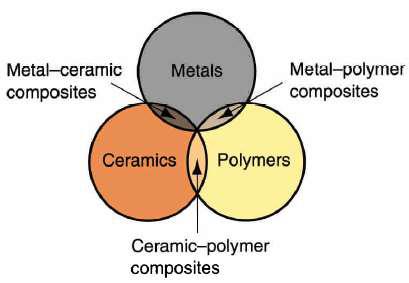
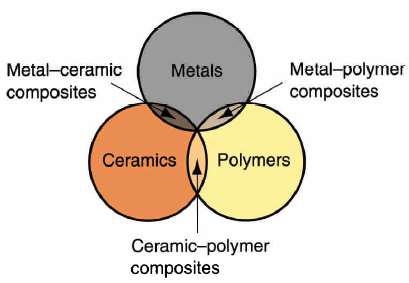
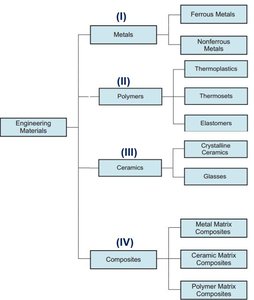
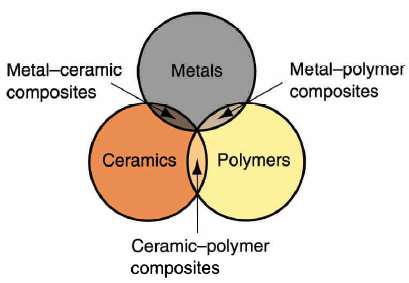
Composites are materials made from two or more distinct components to achieve a combination of properties. They are classified by matrix type: polymer, metal, or ceramic.
Matrix: Continuous phase, transfers stress, can be polymer, metal, or ceramic.
Reinforcement: Fibers or particles embedded in the matrix, provides strength and toughness.
Applications: Aircraft industry, automotive, construction.
General Comparison of Materials
Property | Ceramic | Metal | Polymer |
|---|---|---|---|
Hardness | Very High | Low | Very Low |
Elastic modulus | Very High | High | Low |
Thermal expansion | Low | High | Very Low |
Ductility | Low | High | High |
Corrosion resistance | High | Low | Low |
Wear resistance | High | Low | Low |
Electrical conductivity | Depends | High | Low |
Density | Low | High | Very Low |
Thermal conductivity | Depends | High | Low |
Magnetic | Depends | High | Very Low |
Summary
Solids and modern materials are classified based on their atomic structure and bonding, which determines their properties and applications. Metals, polymers, ceramics, and composites each offer unique advantages and limitations, making them essential in engineering, biology, and everyday life.
