 Back
Solution Chemistry and Chemical Reactions: Study Notes for General Biology Students
Study Guide - Smart Notes
 Tailored notes based on your materials, expanded with key definitions, examples, and context.
Reaction Yields and Limiting Reactants
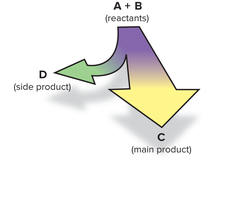
Theoretical and Actual Yield
Chemical reactions often produce less product than theoretically possible due to side reactions and incomplete conversion. The theoretical yield is the maximum amount of product predicted by stoichiometry, while the actual yield is the amount actually obtained in the experiment.
Theoretical yield: Calculated from the balanced equation using molar ratios.
Actual yield: Measured experimentally; usually less than theoretical yield.
Percent yield:
Limiting reactant: The reactant that is completely consumed first, limiting the amount of product formed.
Example: In a reaction between hydrazine (N2H4) and dinitrogen tetroxide (N2O4), the limiting reactant determines the maximum nitrogen gas produced.
Solution Chemistry
Solution Concentration and Molarity
A solution is a homogeneous mixture of solute(s) dissolved in a solvent. Molarity (M) is the most common unit for expressing concentration in chemistry, defined as moles of solute per liter of solution.
Solute: Substance dissolved, usually in smaller quantity.
Solvent: Substance in which solute dissolves, usually in larger quantity (water in aqueous solutions).
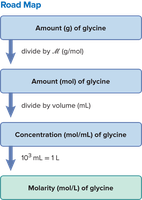
Molarity:
Example: Calculating the molarity of glycine in a solution.
Mass-Mole-Number-Volume Relationships
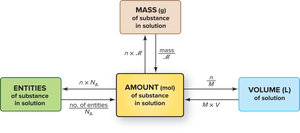
Understanding the relationships between mass, moles, number of entities, and volume is essential for solution calculations.
Mass to moles:
Moles to entities: (Avogadro's number)
Moles to volume:
Calculating Mass of Solute in Solution
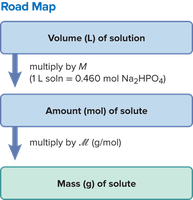
To find the mass of solute in a given volume of solution, use the molarity and molar mass.
Calculate moles of solute:
Convert moles to mass:
Laboratory Preparation of Molar Solutions
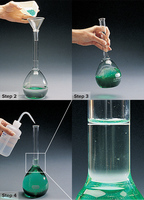
Preparing molar solutions involves dissolving a known mass of solute in a volumetric flask and diluting to a specific volume.
Weigh the solute accurately.
Dissolve in a portion of solvent.
Transfer to a volumetric flask and dilute to the mark.
Converting Concentrated Solutions to Dilute Solutions
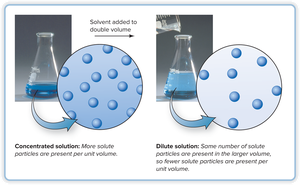
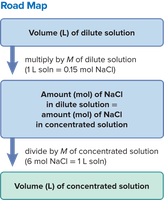
To prepare a dilute solution from a concentrated stock, add solvent to achieve the desired concentration. The number of moles of solute remains constant.
Use the equation:
and are the molarity and volume of the concentrated solution; and are those of the dilute solution.
Visualizing Changes in Solution Concentration
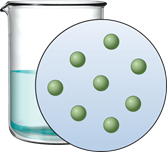
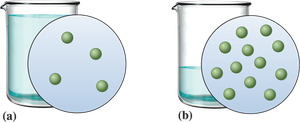
Changes in solution concentration can be visualized by the number of solute particles per unit volume. Adding solvent decreases concentration, while removing solvent increases it.
Adding solvent: Decreases concentration, same number of solute particles.
Boiling off solvent: Increases concentration, same number of solute particles.
The Polar Nature of Water
Water as a Solvent
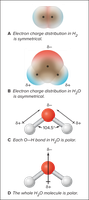
Water's ability to dissolve many substances arises from its polar nature. The uneven distribution of electron charge and bent molecular shape make water a highly effective solvent for ionic and polar compounds.
Polarity: Water molecules have partial positive and negative charges.
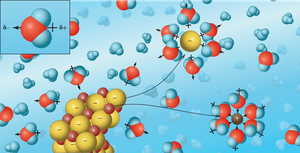
Hydration: Water surrounds ions, stabilizing them in solution.
Dissolution of Ionic Compounds
When ionic compounds dissolve in water, ions are separated and surrounded by water molecules, a process called hydration.
Example: Sodium chloride dissolves to form Na+ and Cl− ions, each hydrated by water.
Electrical Conductivity of Ionic Solutions
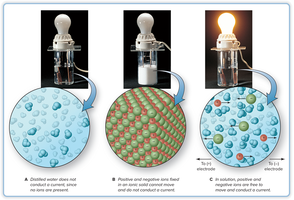
Ionic solutions conduct electricity due to the presence of free-moving ions. Distilled water does not conduct electricity, but ionic solutions do.
Strong electrolytes: Dissociate completely, conduct well.
Weak electrolytes: Dissociate partially, conduct poorly.
Nonelectrolytes: Do not dissociate, do not conduct.
Summary Table: Mass-Mole-Volume Relationships
Quantity | Formula | Unit |
|---|---|---|
Mass to moles | mol | |
Moles to volume | L | |
Moles to entities | entities |
Additional info: These concepts are foundational for understanding solution chemistry, chemical reactions, and their applications in biological systems.
