 Back
Speciation, Hybrid Zones, and Phylogenetic Trees: Mechanisms and Outcomes
Study Guide - Smart Notes
 Tailored notes based on your materials, expanded with key definitions, examples, and context.
Speciation Mechanisms
Allopatric Speciation
Allopatric speciation occurs when populations are geographically separated, leading to the formation of new species. This separation can happen through two main processes:
Dispersal: A subset of a population moves to a new area, becoming isolated from the original group.
Vicariance: A physical barrier (such as a mountain or river) divides a population, preventing gene flow between the groups.
Sympatric Speciation
Sympatric speciation occurs within a single geographic area, without physical barriers. It is driven by factors that reduce gene flow within the population:
Extrinsic Factors: Disruptive selection on phenotypes, where certain traits are favored in different ecological niches.
Intrinsic Factors: Genetic or behavioral changes that reduce interbreeding.
Ecological Niche
An ecological niche is the range of ecological resources a species can use and the range of environmental conditions it can tolerate.
Example: Disruptive Selection in Sympatric Speciation
Apple Maggot Flies: Originally, hawthorn flies relied on hawthorn fruit. After apples were introduced to North America, some flies began to prefer apples, while others continued to prefer hawthorn fruit.
About 60% of apple flies are attracted to apple scents, and 60% of hawthorn flies are attracted to hawthorn scents.
Prezygotic Barriers: Mechanisms that prevent mating or fertilization between groups (e.g., preference for different fruits).
Postzygotic Barriers: Hybrid offspring are less fit than either parent population.
Sympatric Speciation via Polyploidy
Polyploidy is the condition of having more than two sets of chromosomes. It can lead to rapid speciation, especially in plants.
Autopolyploid: Chromosome sets are identical and derived from a single species (less common).
Allopolyploid: Chromosome sets come from different species, often through hybridization (e.g., horse and donkey produce a mule).
Polyploids can only breed with individuals of the same chromosome number.
Polyploids often have higher heterozygosity and can tolerate higher levels of self-fertilization, reducing inbreeding depression.
Polyploidization has occurred multiple times in flowering plant evolution, contributing to novel functions and diversity.
Economic Importance of Polyploidy
Production of plants with larger organs (important in floriculture and fruit production).
Production of seedless fruits (often triploid).
Transfer of genes from wild to cultivated species.
Secondary Contact Between Populations
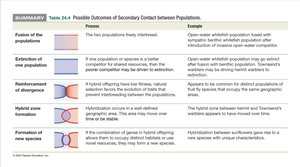
When previously isolated populations come back into contact, several outcomes are possible:
Process | Description | Example |
|---|---|---|
Fusion of the populations | The two populations freely interbreed, merging into one. | Open-water stickleback population fused with benthic population after introduction of invasive open-water competitor. |
Extinction of one population | If one population is a better competitor for shared resources, the poorer competitor may be driven to extinction. | Open-water stickleback population may go extinct if benthic population is a superior competitor for resources. |
Reinforcement of divergence | If hybrid offspring have lower fitness, natural selection favors traits that prevent interbreeding (prezygotic isolation). | Strong selection against hybridization in flycatchers, leading to increased differences in mating signals. |
Hybrid zone formation | Hybridization occurs in a well-defined geographic area, resulting in some hybrid individuals. | The hybrid zone between hermit and Townsend's warblers appears to have moved over time. |
Formation of new species | If hybrids occupy a distinct habitat or use novel resources, they may form a new species. | Hybridization between sunflowers gave rise to a new species with unique characteristics. |
Adaptive Radiation
Adaptive radiation is the rapid production of many new species from a single lineage, each adapted to different ecological niches. This process is characterized by:
Formation of a monophyletic group (all species share a common ancestor).
Rapid speciation.
Diversification into many ecological niches.
Example: Hawaiian tarweeds, which diversified from California tarweeds, are a classic example of adaptive radiation.
Phylogenetic Trees and Systematics
Phylogeny and Phylogenetic Trees
Phylogeny is the evolutionary history of a group of organisms. A phylogenetic tree is a graphical summary of these relationships, showing how genes, species, or higher taxa are related through evolution.
Systematics: The discipline that characterizes and classifies relationships among organisms.
Node (fork): A point where a branch splits, representing the most recent common ancestor of descendant groups.
Polytomy: A node that splits into three or more branches, indicating unresolved relationships.
Clade: A set of organisms that share a common ancestor (monophyletic group).
Monophyletic snip test: If a group can be separated from the tree with a single cut, it is a clade.
Phylogenetic Species Concept
Defines species as the smallest monophyletic group on a phylogenetic tree.
Applicable to both sexual and asexual species.
Directly reflects evolutionary relationships.
Limitations: Requires genetic data for all groups, not always available for fossils, and may not address subspecies distinctions.
Other Group Types in Phylogenetics
Paraphyletic group: Includes a common ancestor and some, but not all, descendants.
Polyphyletic group: Members do not share a recent common ancestor within the group.
Outgroup: A taxon that diverged before the group of interest, used to root the tree.
Clades can be rotated around nodes; what matters is the pattern of shared ancestry, not the order of branches.
Additional info: Phylogenetic trees are essential tools for understanding evolutionary relationships and for classifying biodiversity. Adaptive radiations are often revealed through phylogenetic analysis, showing bursts of speciation and ecological diversification.
