 Back
BackSpeciation, Macroevolution, and Classification: Study Notes
Study Guide - Smart Notes
 Tailored notes based on your materials, expanded with key definitions, examples, and context.
The Origin of Species
What Is a Species?
Speciation is the evolutionary process by which one species splits into two or more distinct species. The biological species concept defines a species as a group of populations whose members can interbreed in nature and produce fertile offspring. This concept is widely used but is not the only way to define species; other concepts include morphological, ecological, and phylogenetic species concepts.
Species: A group of organisms capable of interbreeding and producing fertile offspring.
Speciation: The process of forming new species through evolutionary mechanisms.
Example: The Galápagos finches, which evolved into multiple species from a common ancestor.
Reproductive Barriers between Species
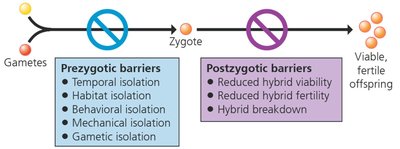
Reproductive barriers prevent members of different species from producing viable, fertile offspring. These barriers are classified as prezygotic (before fertilization) or postzygotic (after fertilization).
Prezygotic barriers: Prevent mating or fertilization between species (e.g., temporal, habitat, behavioral, mechanical, gametic isolation).
Postzygotic barriers: Prevent the development of viable, fertile offspring after fertilization (e.g., reduced hybrid viability, reduced hybrid fertility, hybrid breakdown).
Mechanisms of Speciation
Allopatric and Sympatric Speciation
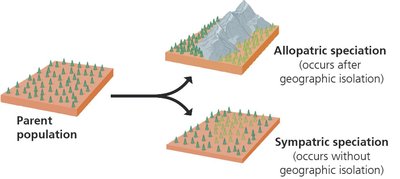
Speciation can occur through geographic isolation (allopatric speciation) or without geographic isolation (sympatric speciation). When populations are separated, their gene pools diverge, leading to the formation of new species.
Allopatric speciation: Occurs when populations are geographically separated, leading to reproductive isolation.
Sympatric speciation: Occurs within the same geographic area, often through mechanisms such as polyploidy, habitat differentiation, or sexual selection.
Hybridization and polyploidy: Common in plants, where hybridization can lead to new species with multiple sets of chromosomes.
Earth History and Macroevolution
Macroevolution
Macroevolution refers to evolutionary changes above the species level, including the origin of new groups, evolutionary novelties, and the effects of mass extinctions. It encompasses the broad patterns of evolution seen in the fossil record.
Evolutionary novelty: The emergence of new traits or groups.
Mass extinction: Periods when large numbers of species disappear, followed by diversification of survivors.
The Fossil Record
The fossil record provides evidence for macroevolution and is organized into a geologic time scale with four major divisions: Precambrian, Paleozoic, Mesozoic, and Cenozoic. Fossil ages are commonly determined by radiometric dating.
Geologic time scale: Chronological organization of Earth's history.
Radiometric dating: Method for determining the age of fossils using radioactive isotopes.
Plate Tectonics and Biogeography
Earth's crust is divided into plates that move over time, affecting the distribution and evolution of species. The formation and breakup of supercontinents like Pangaea led to geographic isolation and diversification.
Continental drift: Movement of Earth's plates, influencing biogeography.
Biogeography: Study of the geographic distribution of species.
Example: Unique marsupials in Australia due to isolation.
Mass Extinctions and Diversification
Mass extinctions are followed by periods of rapid diversification among surviving species. For example, the extinction of dinosaurs at the end of the Cretaceous period allowed mammals to diversify.
Cretaceous extinction: About 66 million years ago, led to the loss of many species including most dinosaurs.
Adaptive radiation: Rapid diversification of survivors into new ecological niches.
Mechanisms of Macroevolution
Large Effects from Small Genetic Changes
Small genetic changes, especially those affecting development, can have large evolutionary effects. Changes in the timing of developmental events can result in adults retaining juvenile features (a process called paedomorphosis).
Paedomorphosis: Retention of juvenile traits in the adult stage.
Example: Axolotl salamanders retain larval features as adults.
The Evolution of Biological Novelty
Structures can evolve for one function and later become adapted for another, a process known as exaptation. Complex structures often evolve incrementally from simpler versions.
Exaptation: Structure evolves in one context, then adapts for another function.
Example: Feathers evolved for insulation, later adapted for flight.
Classifying the Diversity of Life
Systematics and Taxonomy
Systematics is the scientific study of the diversity and relationships among organisms, including taxonomy (the naming and classification of species). Classification aims to reflect phylogeny, the evolutionary history of species.
Homology: Similarity due to shared ancestry.
Analogy: Similarity due to convergent evolution.
Cladistics: Groups organisms into clades based on shared characteristics.
Classification: A Work in Progress
Biologists currently use a three-domain system to classify life: Bacteria, Archaea, and Eukarya. Classification is based on fossil evidence, anatomical features, and DNA sequence comparisons.
Bacteria: Prokaryotic microorganisms.
Archaea: Prokaryotes with unique biochemical traits.
Eukarya: Organisms with eukaryotic cells, including plants, animals, fungi, and protists.
