 Back
Backlec 34
Study Guide - Smart Notes
 Tailored notes based on your materials, expanded with key definitions, examples, and context.
Speciation
Overview of Speciation
Speciation is the evolutionary process by which populations evolve to become distinct species. It typically involves three main steps: population isolation, divergence of phenotypic traits, and the development of reproductive isolation. These steps are driven by mechanisms such as genetic drift and natural selection, often influenced by geographic and ecological factors.
Population Isolation: Physical or ecological barriers prevent gene flow between populations.
Phenotypic Trait Divergence: Isolated populations experience different selective pressures, leading to divergence in traits.
Reproductive Isolation: Accumulated differences result in reproductive barriers, preventing interbreeding.
Genetic drift and natural selection both contribute to genetic differentiation between isolated populations. Drift is random, while selection is driven by environmental differences.
The Geography of Speciation
Geography plays a critical role in the evolution of reproductive isolation (RI). Ernst Mayr argued that dispersal limitation and niche occupancy are key factors in speciation. The spatial arrangement of populations determines the likelihood and mode of speciation.

Models of Speciation
There are three primary models of speciation, each defined by the geographic context and the nature of reproductive isolation:
Model | Original Population | Initiating Event | Reproductive Isolation | New Species |
|---|---|---|---|---|
Allopatric | Single population | Barrier arises | In isolation | Two distinct species |
Sympatric | Single population | Genetic change | Within population | Two distinct species |
Parapatric | Single population | New niche entered | In new niche | Two distinct species |
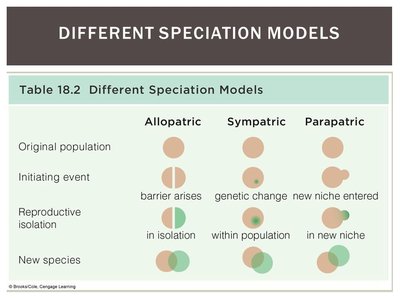
Parapatric Speciation
Mechanism and Examples
Parapatric speciation occurs when populations occupy adjacent regions with different selective pressures. Gene flow is reduced but not completely absent, and strong divergent selection leads to reproductive isolation. This model is common in plants adapting to different soils along environmental gradients.
Ecological Gradient: Continuous populations experience diverse environmental conditions.
Selection with Reduced Gene Flow: Localized selection pressures lead to specialized adaptations.
Reproductive Isolation: Non-random mating and reduced hybrid fitness reinforce isolation.
Sympatric Speciation
Mechanism and Case Study: Rhagoletis Flies
Sympatric speciation occurs within a single population when selection leads to the division into two diverging lineages. This is often observed in insects and their host plants, where host shifts can drive reproductive isolation.
Host Plant Specialization: Insects like Rhagoletis pomonella (apple maggot fly) specialize on different host plants, such as hawthorn and apple trees.
Genetic Basis: Host selection, diapause, and emergence times are under genetic control, leading to temporal isolation.
Reproductive Isolation: Mating occurs on host fruits, so host preference reinforces reproductive barriers.
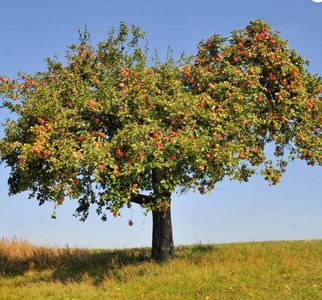
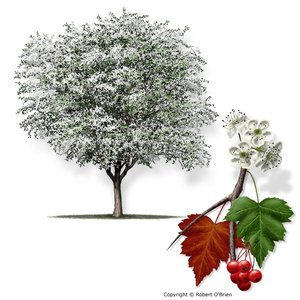
Case Study: Rhagoletis pomonella
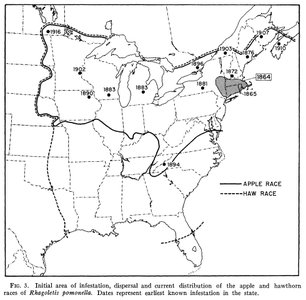
The introduction of apple trees to North America provided a new resource for Rhagoletis pomonella, which originally infested hawthorn trees. Over time, populations specializing on apples and hawthorns diverged in their life history timing and host preference, despite living in the same geographic area.
Key Findings from Research
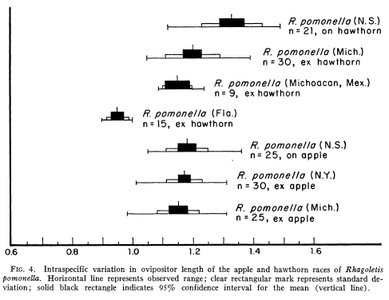
No Significant Difference in Ovipositor Length: Morphological divergence in ovipositor length was not observed between host races.
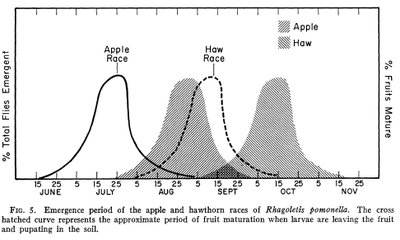
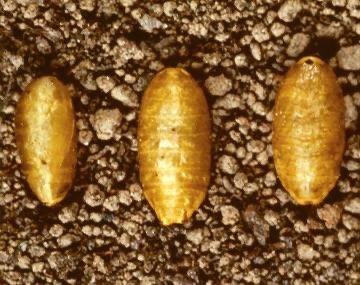
Significant Difference in Pupal Emergence: Timing of adult emergence matches the fruiting period of the host plant, leading to temporal isolation.
Genetic Differentiation and Host Races
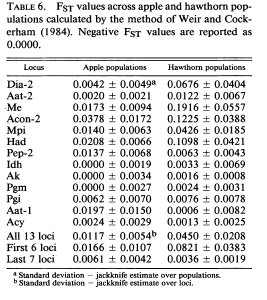
Genetic studies show differentiation between apple and hawthorn races of Rhagoletis pomonella. Emergence time and host preference are genetically controlled, reinforcing reproductive isolation.
Locus | Apple populations (FST) | Hawthorn populations (FST) |
|---|---|---|
Dia-2 | 0.0042 ± 0.0049 | 0.0676 ± 0.0404 |
Aat-2 | 0.0020 ± 0.0021 | 0.0126 ± 0.0067 |
Me | 0.0173 ± 0.0094 | 0.0196 ± 0.0557 |
All 13 loci | 0.0117 ± 0.0054 | 0.0480 ± 0.0208 |
Ecological Speciation
Ecological speciation is the process by which barriers to gene flow evolve due to divergent selection between environments. Three requirements are necessary:
A source of divergent selection
A form of reproductive isolation
A mechanism linking divergent selection to reproductive isolation
Premating Barriers to Gene Flow
Types of Premating Barriers
Physical and ecological barriers can prevent or reduce the transfer of gametes between populations, acting as premating barriers to reproduction.
Ecological Isolation: Species breed at different times (temporal isolation) or in different habitats (habitat isolation).
Mating Isolation: Potential mates come into contact but do not mate, due to behavioral differences in animals or specialized pollinators in plants.
Example: Rhagoletis pomonella races are temporally isolated due to differences in emergence timing, matching the fruiting periods of their respective host plants.
