 Back
BackSpeciation: Mechanisms and Concepts
Study Guide - Smart Notes
 Tailored notes based on your materials, expanded with key definitions, examples, and context.
Speciation
Introduction to Speciation
Speciation is the evolutionary process by which populations evolve to become distinct species. It typically involves two main steps: genetic isolation and genetic divergence. - Genetic isolation: Occurs when a barrier to gene flow isolates populations, preventing interbreeding. - Genetic divergence: Mutation, natural selection, and genetic drift cause populations to diverge genetically over time. - Speciation: The splitting event that creates two or more distinct species from an ancestral species. 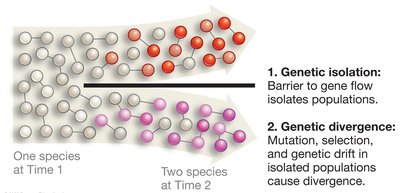
How Are Species Defined and Identified?
Species Concepts
Biologists use three main criteria to identify species: 1. Biological species concept 2. Morphospecies concept 3. Phylogenetic species concept
Biological Species Concept
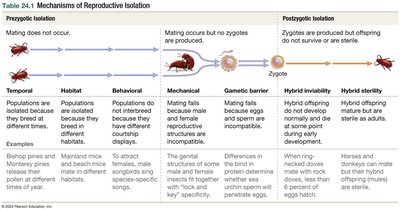
The biological species concept defines species based on reproductive isolation. - Reproductive isolation: Lack of gene flow between populations; members do not interbreed or fail to produce viable, fertile offspring. - Prezygotic isolation: Individuals are prevented from mating successfully. - Postzygotic isolation: Hybrid offspring do not survive or reproduce. Disadvantages: Cannot be applied to fossils, asexual species, or populations that do not overlap geographically.
Isolation Type | Mechanism | Example |
|---|---|---|
Temporal | Populations breed at different times | Bishop pines and Monterey pines release pollen at different times |
Habitat | Populations breed in different habitats | Mainland mice and beach mice live in different habitats |
Behavioral | Populations have different courtship displays | Birds have different songs |
Mechanical | Genitalia incompatible | Genitalia of insects are incompatible |
Gametic barrier | Eggs and sperm incompatible | Differences in proteins prevent sperm from penetrating eggs |
Hybrid inviability | Hybrid offspring do not develop | When ring-necked doves mate with rock doves, hybrids do not hatch |
Hybrid sterility | Hybrid offspring mature but are sterile | Horses and donkeys produce sterile mules |
Morphospecies Concept
The morphospecies concept identifies species based on morphological differences. - Advantages: Widely applicable, including to sexual, asexual, and fossil species. - Disadvantages: May misidentify polymorphic species, miss cryptic species, and is subjective.
Phylogenetic Species Concept
The phylogenetic species concept identifies species based on evolutionary history and monophyletic groups (clades). - Monophyletic group: An ancestral population plus all its descendants. - Synapomorphies: Unique traits found in a group but missing in more distant ancestors. - Advantages: Widely applicable, based on testable criteria. - Disadvantages: Few well-estimated phylogenies available; may recognize more species than other concepts. 
Criterion for Identifying Populations as Species | Advantages | Disadvantages |
|---|---|---|
Biological Species | Reproductive isolation = evolutionary independence | Not applicable to asexual or fossil species; difficult to assess if populations do not overlap geographically |
Morphospecies | Widely applicable | Misidentifies polymorphic species; misses cryptic species; subjective |
Phylogenetic Species | Widely applicable; based on testable criteria | Relatively few well-estimated phylogenies are currently available |

Species Definitions in Action: Elephant Species
Systematics and taxonomy are used to classify relationships among organisms. - Example: Morphological, genetic, and phylogenetic analyses support the existence of three distinct elephant species: African savanna, African forest, and Asian elephants. 
Isolation and Divergence in Allopatry
Allopatric Speciation
Allopatric speciation occurs when populations become geographically separated (allopatry). - Dispersal: Movement of individuals to a new habitat. - Vicariance: Physical splitting of a habitat by a barrier. 
Evidence for Vicariance
- Example: DNA analysis of trumpeters in the Amazon basin shows speciation by vicariance due to river formation and habitat subdivision. 
Isolation and Divergence in Sympatry
Sympatric Speciation
Sympatric speciation occurs among populations within the same geographic area. - External events: Disruptive selection based on ecological niches or mate preferences. - Internal events: Chromosomal mutations, such as polyploidy. 
Disruptive Selection
- Example: Killer whales in the Northeast Pacific occupy different ecological niches and exhibit distinct behaviors, leading to potential speciation.
Ecotype | Group Size | Feeding Culture |
|---|---|---|
Resident | Larger groups | Fish-eating |
Transient | Smaller groups | Mammal-eating |
Disruptive Selection for Mate Choice
- Example: The mFAS gene in fruit flies affects both ecological divergence and mate choice, leading to prezygotic isolation.
Polyploidization
Polyploidy is a mutation resulting in more than two sets of chromosomes, important in plant speciation. - Autopolyploid: Chromosome doubling within a single species. - Allopolyploid: Chromosome doubling from hybridization between species. 
Outcomes of Secondary Contact
Fusion or Extinction
- Fusion: Populations interbreed, erasing distinctions. - Extinction: One population outcompetes and drives the other to extinction.
Reinforcement of Divergence
- Reinforcement: Natural selection favors traits preventing interbreeding when hybrid fitness is low.
Hybrid Zone Formation
- Hybrid zone: Geographic area where interbreeding and hybrid offspring are common. - Example: Townsend’s and hermit warblers form a moving hybrid zone, potentially leading to extinction of one species.
New Species through Hybridization
- Hybridization: Interbreeding between species can produce new, ecologically distinct species. - Example: Hybrid sunflowers occupy new habitats and have unique genetic combinations.
Key Insights
Summary of Speciation
- Speciation is a two-step process involving genetic isolation and divergence. - It is ongoing, dynamic, and sometimes complex.
Process | Example |
|---|---|
Fusion of populations | Open-water whitefish population fused with benthic population after introduction of competitor |
Extinction | Townsend’s warblers may drive hermit warblers to extinction |
Reinforcement | Fruit fly species in overlapping ranges |
Hybrid zone formation | Hybrid zone between hermit and Townsend’s warblers |
Formation of new species | Hybridization between sunflowers gave rise to a new species |
