 Back
Chapter 24
Study Guide - Smart Notes
 Tailored notes based on your materials, expanded with key definitions, examples, and context.
Speciation
Introduction to Speciation
Speciation is the evolutionary process by which populations evolve to become distinct species. It involves the origin of two or more species from a common ancestral species. The process of speciation is fundamental to understanding biodiversity and evolutionary biology.
Speciation: The formation of new and distinct species in the course of evolution.
It is a two-step process:
Genetic isolation: The cessation of gene flow between populations.
Genetic divergence: Populations accumulate genetic differences through mutation, natural selection, and genetic drift.
Key Point: Genetic isolation means no gene flow between populations, which is essential for divergence and the formation of new species.
Hardy-Weinberg Principle: Of the five causes of allele frequency change, mutation, natural selection, and genetic drift play a role in genetic divergence.
How Are Species Defined and Identified?
Species Concepts
There is no single universal definition of a species, but three main concepts are commonly used to identify and define species. All agree that there can be no gene flow between different species.
Biological Species Concept:
Criterion: Reproductive isolation.
Species are groups of actually or potentially interbreeding populations that are reproductively isolated from other such groups.
Mechanisms of reproductive isolation:
Prezygotic barriers (prevent mating or fertilization):
Temporal isolation: Different mating times.
Habitat isolation: Different habitats prevent encounters.
Behavioral isolation: Different courtship behaviors.
Mechanical isolation: Incompatible mating structures.
Gametic isolation: Incompatible gametes prevent fertilization.
Postzygotic barriers (after fertilization):
Hybrid inviability: Hybrids do not survive to reproductive age.
Hybrid sterility: Hybrids are healthy but sterile (e.g., mule).
Limitations: Cannot be applied to fossil species, asexual species (including bacteria), or populations with non-overlapping ranges.
Morphospecies Concept:
Identified by physical differences (size, shape, color).
Assumes morphological differences reflect genetic differences.
Advantages: Useful for all species, including fossils and asexual organisms.
Disadvantages: May result in multiple names for the same species, cannot distinguish cryptic species, and is subjective.
Phylogenetic Species Concept:
Based on evolutionary history and phylogenetic trees.
A monophyletic group consists of a common ancestor and all its descendants.
Synapomorphies: Shared derived traits that define monophyletic groups; may be structural, developmental, or genetic (e.g., DNA sequences).
Species is the smallest monophyletic group on a phylogenetic tree.
Advantages: Based on testable criteria, widely applicable.
Disadvantage: Phylogenies are available for only a small number of species.
Additional info: In practice, all three species concepts are used together to clarify species boundaries.
Isolation and Divergence in Allopatry
Allopatric Speciation
Allopatric speciation occurs when populations of the same species become geographically isolated, leading to genetic isolation and divergence.
Allopatry: Populations are separated by a physical barrier or distance.
Two mechanisms of allopatry:
Dispersal: A group colonizes a new habitat, forming a new population (founder effect).
Vicariance: A physical barrier splits a population (e.g., river, mountain, glacier).
After isolation, mutation, genetic drift, and natural selection drive divergence.
Example: Finches on the Galapagos Islands diverged in beak size due to founder effects and natural selection after dispersal.
Example: Trumpeter birds in the Amazon basin diverged due to vicariance caused by changes in the river system.
Isolation and Divergence in Sympatry
Sympatric Speciation
Sympatric speciation occurs when populations diverge into new species while inhabiting the same geographic area. This can happen through disruptive selection or polyploidy.
Sympatry: Populations live in the same area and can potentially interbreed.
Two mechanisms of sympatric speciation:
Disruptive selection: Adaptation to different ecological niches within the same area leads to reproductive isolation.
Polyploidy: Chromosomal mutations result in individuals with more than two sets of chromosomes, instantly creating reproductive isolation.
Sympatric Speciation by Disruptive Selection
Niche: The range of ecological resources a species uses and the conditions it can tolerate.
Example: Apple maggot flies and hawthorn maggot flies are diverging due to genetically based preferences for different host plants, even when living side by side.
Disruptive selection is a major driver of insect speciation, as many insects are associated with specific host plants.
Sympatric Speciation by Polyploidy
Polyploidy: Having more than two sets of chromosomes, usually due to errors in meiosis or mitosis.
Common in plants; rare in animals.
Two mechanisms:
Autopolyploidy: Chromosome number doubles within a single species due to nondisjunction during meiosis. Results in instant reproductive isolation.
Allopolyploidy: Hybridization between different species followed by chromosome doubling creates a new, fertile polyploid species.
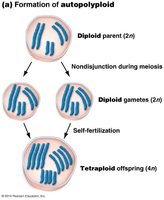
Example: Many crop plants (e.g., seedless watermelon, bananas) are autopolyploids. Some animals, like certain tree frogs, are also autopolyploid.
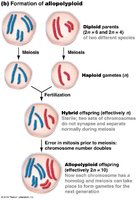
Example: Bread wheat is an allopolyploid species formed by hybridization and chromosome doubling.
Additional info: Polyploidy is a significant mechanism of speciation in plants because many can reproduce asexually, allowing new polyploid lineages to persist.
What Happens When Isolated Populations Come Into Contact?
Outcomes of Secondary Contact
When previously isolated populations come into contact, several outcomes are possible depending on the degree of reproductive isolation that has evolved.
If prezygotic barriers have evolved:
Little interbreeding occurs; divergence continues and two distinct species are maintained.
Reinforcement of prezygotic barriers occurs because hybrids have reduced fitness.
If prezygotic barriers have NOT evolved:
Populations may fuse back into a single species as gene flow erases differences.
If postzygotic isolation exists, selection may favor the evolution of prezygotic barriers.
A hybrid zone may form, where interbreeding occurs and hybrids may persist, be outcompeted, or find a unique niche.
Key Point: The real test of speciation is what happens when isolated groups mix. If they remain reproductively isolated, they are distinct species.
Additional info: Selection will favor any mechanism that increases reproductive isolation if hybrids have lower fitness.
