Back
BackSpeciation: Mechanisms and Concepts in Evolutionary Biology
Study Guide - Smart Notes
 Tailored notes based on your materials, expanded with key definitions, examples, and context.
Speciation and Evolution
Introduction to Speciation
Speciation is a fundamental process in evolutionary biology, bridging microevolution (changes within populations) and macroevolution (the emergence of new species and higher taxonomic groups). It occurs when populations become genetically isolated from one another, leading to the formation of new species from pre-existing ones, while some species are lost through extinction.
Microevolution: Small-scale changes within a population, such as allele frequency shifts.
Macroevolution: Large-scale evolutionary changes, including speciation and extinction events.
Genetic Isolation: The separation of populations so that gene flow is prevented, allowing independent evolutionary trajectories.
What is a Species?
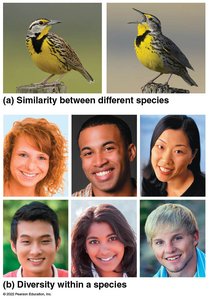
The concept of a species is central to biology, but definitions vary. The Biological Species Concept defines a species as a group of populations whose members can interbreed and produce viable, fertile offspring, but are reproductively isolated from other such groups.
Similarity between different species: Different species may appear similar but are reproductively isolated.
Diversity within a species: Members of the same species can show significant variation but remain capable of interbreeding.
Limitations of the Biological Species Concept
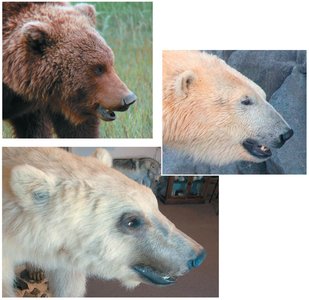
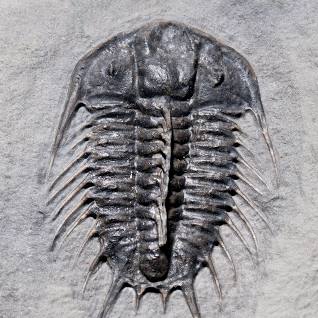
The Biological Species Concept is not universally applicable. It cannot be used for organisms that reproduce asexually, fossils, or cases where gene flow occurs between distinct groups.
Asexual organisms: Do not fit the interbreeding criterion.
Fossil species: Cannot test reproductive isolation.
Hybridization: Some species can interbreed and produce hybrids, blurring boundaries.
Other Species Definitions
Alternative concepts include:
Morphological Species Concept: Defines species based on structural features.
Ecological Species Concept: Defines species by their ecological niche.
Phylogenetic Species Concept: Defines species as the smallest group sharing a common ancestor.
Mechanisms of Reproductive Isolation
Reproductive Barriers
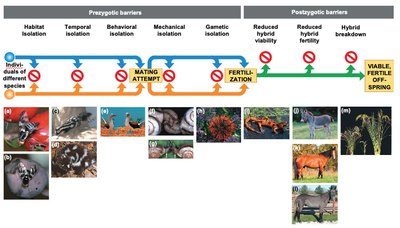
Reproductive isolation prevents gene flow between species and is essential for speciation. Barriers are classified as prezygotic (before fertilization) and postzygotic (after fertilization).
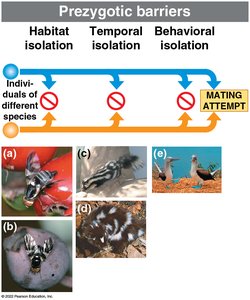
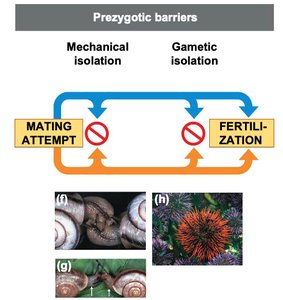
Prezygotic barriers: Prevent mating or fertilization.
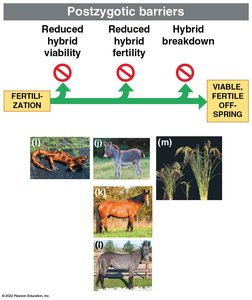
Postzygotic barriers: Prevent hybrid offspring from surviving or reproducing.
Prezygotic Barriers
Habitat Isolation: Species occupy different habitats and rarely encounter each other.
Temporal Isolation: Species breed at different times.
Behavioral Isolation: Unique courtship behaviors prevent mating.
Mechanical Isolation: Morphological differences prevent successful mating.
Gametic Isolation: Sperm of one species cannot fertilize eggs of another.
Postzygotic Barriers
Reduced Hybrid Viability: Hybrids have impaired development or survival.
Reduced Hybrid Fertility: Hybrids are sterile.
Hybrid Breakdown: First-generation hybrids are fertile, but their offspring are feeble or sterile.
Geography of Speciation
Allopatric Speciation
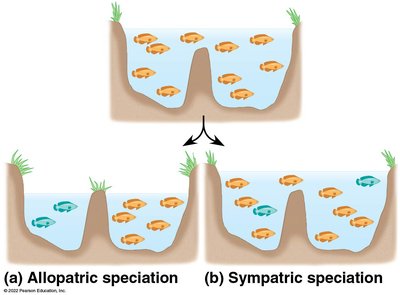
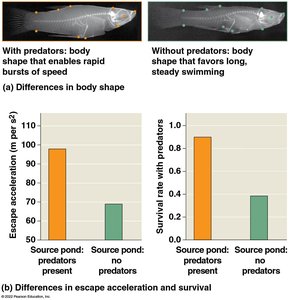
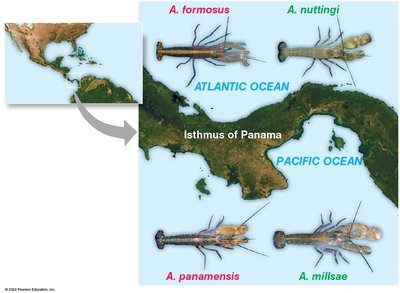
Allopatric speciation occurs when populations are geographically separated, leading to genetic divergence due to restricted gene flow. Physical barriers such as mountains, rivers, or land masses can isolate populations.
Geographic isolation: Prevents gene flow and allows independent evolution.
Genetic divergence: Accumulation of differences leads to speciation.
Sympatric Speciation
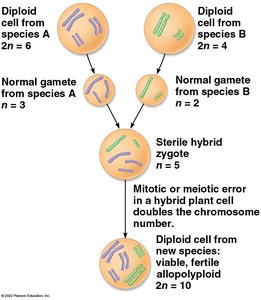
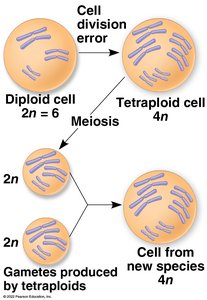
Sympatric speciation occurs within a single geographic area, often due to genetic changes such as polyploidy, habitat differentiation, or sexual selection.
Polyploidy: Chromosome duplication leads to reproductive isolation, especially in plants.
Habitat differentiation: Subpopulations exploit different resources.
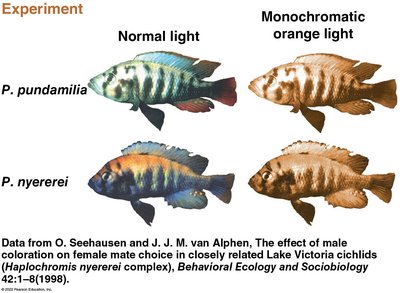
Sexual selection: Divergence in mate choice can drive speciation.
Habitat Differentiation
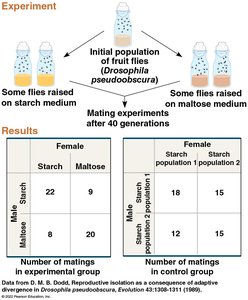
Habitat differentiation can lead to sympatric speciation when subpopulations adapt to different ecological niches within the same area.
Resource partitioning: Use of different resources reduces gene flow.
Ecological isolation: Adaptation to distinct microenvironments.
Summary Table: Reproductive Barriers
Barrier Type | Mechanism | Example |
|---|---|---|
Habitat Isolation | Different habitats | Fruit flies on different plants |
Temporal Isolation | Different breeding times | Closely related species with different mating seasons |
Behavioral Isolation | Unique courtship rituals | Birds with distinct mating dances |
Mechanical Isolation | Incompatible reproductive structures | Snails with different shell shapes |
Gametic Isolation | Sperm cannot fertilize eggs | Sea urchins with incompatible gametes |
Reduced Hybrid Viability | Hybrid fails to develop or survive | Hybrid salamanders |
Reduced Hybrid Fertility | Hybrid is sterile | Mule (horse × donkey) |
Hybrid Breakdown | Hybrid's offspring are feeble or sterile | Hybrid rice plants |
Conclusion
Speciation is a complex process driven by reproductive isolation, genetic divergence, and ecological factors. Understanding the mechanisms and concepts of speciation is essential for studying the diversity and evolution of life.