 Back
Backlec 33
Study Guide - Smart Notes
 Tailored notes based on your materials, expanded with key definitions, examples, and context.
Speciation
Introduction to Speciation
Speciation is the evolutionary process by which populations evolve to become distinct species. This process is central to understanding biodiversity and the mechanisms that drive the formation of new species. Charles Darwin's observations and subsequent evolutionary theory laid the foundation for modern concepts of speciation.
Species: Groups of actually or potentially interbreeding natural populations that are reproductively isolated from other such groups.
Reproductive Isolation: The existence of biological barriers that prevent two species from interbreeding and producing viable, fertile offspring.
Diversification: The process by which a lineage splits into two or more genetically distinct species.
Historical Perspectives on Species
Early naturalists, including Aristotle, believed in fixed and unchanging species. In contrast, Darwin proposed that species are not immutable but are the result of natural processes such as variation, inheritance, and natural selection. Darwin's contemporaries often attributed the creation of species to divine acts, as described in religious texts.
Essentialism (Aristotle): The belief that each species has an immutable essence.
Darwin's View: Species are dynamic populations with continual variation, making taxonomy challenging.
Darwin's Central Theses on Speciation
Variation in Populations: Natural populations exhibit continual variation, complicating species definitions.
Isolation and Adaptive Change: Geographic or reproductive isolation leads to adaptive divergence through natural selection.
Hybridization and Genetic Isolation: Hybridization studies reveal genetic isolation, helping distinguish species from varieties.
The Modern Synthesis and Species Concepts
The Modern Synthesis integrated genetics with Darwinian evolution, refining the concept of species. Theodosius Dobzhansky and Ernst Mayr were pivotal in this development.
Dobzhansky's View: Species are stages in the evolutionary process where interbreeding populations become reproductively isolated.
Mayr's Biological Species Concept: Species are groups of actually or potentially interbreeding natural populations, reproductively isolated from other such groups.
Reproductive Isolation and Diversification
Reproductive isolation is a key stage in the process of diversification, but it is just one outcome among many in the continuum of organismal diversification.
Reproductive Isolation: Prevents gene flow between populations, leading to speciation.
Continuous Process: Speciation is not a single event but a gradual process involving multiple stages.
The Geography of Speciation
Geographic Ranges and Speciation
Geographic distribution plays a crucial role in the formation of new species. Ernst Mayr emphasized the importance of geographic ranges and barriers in speciation.
Contiguous Range: Populations occupy a continuous area.
Disjunct Range: Populations are separated by a physical barrier, potentially leading to speciation (allopatry).
Vicariance and Allopatry
Vicariance refers to the physical splitting of a species' range by a barrier, resulting in isolated populations (allopatry) that may diverge into separate species.
Vicariance: The division of a once-contiguous population by a new barrier (e.g., mountain formation, river).
Allopatric Speciation: Speciation that occurs when populations are geographically isolated.
Founder Effect and Peripatric Speciation
The founder effect occurs when a small group from a population colonizes a new area, leading to genetic drift and potentially rapid speciation. Peripatric speciation is a special case of allopatric speciation involving small, isolated populations at the edge of the range.
Founder Effect: Genetic drift in a small founding population can lead to rapid divergence.
Peripatric Speciation: Speciation in peripheral, isolated populations.
Other Modes of Speciation
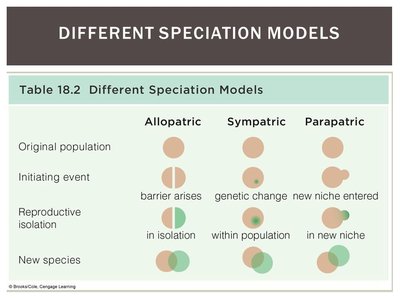
Parapatric Speciation: Occurs when adjacent populations experience different selective pressures and gene flow is limited.
Sympatric Speciation: Occurs within a single, randomly mating population, often due to ecological or behavioral isolation.
Speciation Model | Initiating Event | Reproductive Isolation | New Species |
|---|---|---|---|
Allopatric | Barrier arises | In isolation | Yes |
Sympatric | Genetic change | Within population | Yes |
Parapatric | New niche entered | In new niche | Yes |
Physical and Premating Barriers
Physical barriers to gene flow are a type of premating barrier, preventing or reducing the transfer of gametes between populations.
Ecological Isolation: Species breed at different times (temporal isolation) or in different habitats (habitat isolation).
Mating Isolation: Potential mates come into contact but do not mate due to behavioral differences or pollinator specificity.
Summary Table: Modes of Speciation
Mode | Description |
|---|---|
Allopatric | Evolution of reproductive barriers between geographically separated populations. |
Founder Effect | Dispersal of a small founding population leads to drift and selection in a new niche. |
Peripatric | Founder effect speciation in peripheral populations. |
Parapatric | Speciation with limited gene flow between adjacent populations under different selective pressures. |
Sympatric | Speciation within a single population without spatial segregation. |
Speciation as a Process
Speciation is not a single event but a process involving several steps:
Populations are isolated (geographically or reproductively).
Phenotypic trait divergence occurs due to selection, drift, or mutation.
Reproductive isolation is established, completing the speciation process.
Additional info: This summary integrates classic and modern views of speciation, emphasizing the importance of reproductive isolation, geographic context, and genetic mechanisms in the origin of species.
