 Back
Lec 35
Study Guide - Smart Notes
 Tailored notes based on your materials, expanded with key definitions, examples, and context.
Speciation
Overview of Speciation
Speciation is the evolutionary process by which populations evolve to become distinct species. It typically involves three main steps: population isolation, phenotypic divergence, and the evolution of reproductive isolation.
Population Isolation: Populations become separated by physical, ecological, or behavioral barriers, preventing gene flow.
Phenotypic Divergence: Isolated populations experience genetic drift and natural selection, leading to differences in traits.
Reproductive Isolation: Mechanisms evolve that prevent interbreeding between diverging populations, solidifying speciation.
Genetic Drift and Natural Selection in Speciation
Genetic Drift: Random changes in allele frequencies can lead to genetic differentiation between isolated populations.
Natural Selection: Different environments impose distinct selective pressures, driving adaptive divergence.
Ecological Speciation
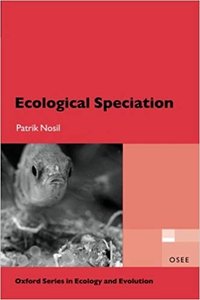
Ecological speciation occurs when barriers to gene flow evolve as a result of divergent natural selection between environments. This process links ecological divergence directly to reproductive isolation.
Requirements for Ecological Speciation:
A source of divergent selection (e.g., different habitats or resources)
A form of reproductive isolation (prezygotic or postzygotic)
A mechanism linking divergent selection to reproductive isolation
Mechanisms of Reproductive Isolation
Premating and Postzygotic Isolation
Premating Isolation: Mechanisms that prevent mating between populations, such as behavioral differences or habitat preferences.
Postzygotic Isolation: Mechanisms that reduce the fitness of hybrids, including intrinsic (developmental defects) and extrinsic (environmentally dependent) factors.

Darwin’s Dilemma and Hybrid Fitness
Natural selection typically favors traits that increase fitness, but the evolution of reproductive isolation can sometimes result in the production of unfit hybrids.
Intrinsic Isolation: Hybrid inviability or sterility due to genetic incompatibilities, independent of environment.
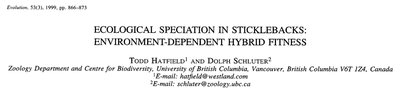
Extrinsic Isolation: Hybrids are less fit because they occupy intermediate niches that are not optimal in either parental environment.
Bateson-Dobzhansky-Muller (BDM) Model
The BDM model explains how genetic incompatibilities can accumulate between isolated populations, leading to extrinsic inviability when hybrids are formed.
As populations diverge, substitutions accumulate independently. Some genes from one population may perform poorly in the genetic background of the other due to local adaptation.
Reinforcement
Reinforcement is the process by which natural selection increases reproductive isolation between populations in sympatry, favoring individuals that avoid producing unfit hybrids.
Females and males that preferentially mate with their own species have higher fitness.
Selection favors alleles that enhance mating discrimination.
Case Study: Sticklebacks and Adaptive Divergence
Adaptive Change After Colonization
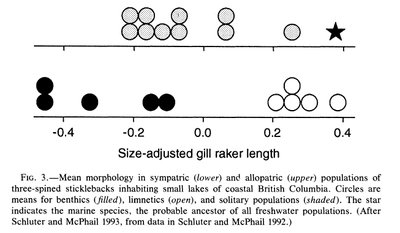
The three-spined stickleback (*Gasterosteus aculeatus*) is a model organism for studying ecological speciation. After colonizing freshwater lakes, sticklebacks diverged into benthic (bottom-dwelling) and limnetic (open-water) forms.
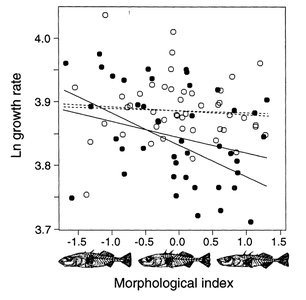
Growth Rate: Growth rate is a key fitness trait, with each form exhibiting highest growth in its native niche.
Sympatric vs. Allopatric Populations: In lakes with both forms (sympatry), clear phenotypic differentiation is observed; in lakes with only one form (allopatry), differentiation is absent.
Evolution of Reproductive Isolation in Sticklebacks
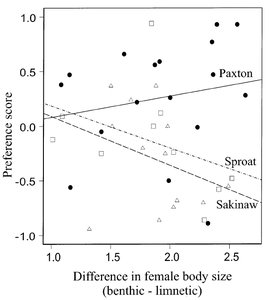
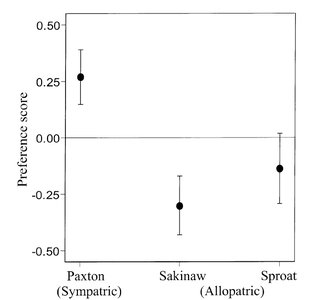
Premating Isolation: Male sticklebacks show preference for mates based on size and form, reinforcing reproductive barriers.
Postzygotic Isolation: Hybrids between benthic and limnetic forms have reduced fitness, especially in natural environments.
Genomic Perspectives on Speciation
Genic View of Speciation
The genic view of speciation emphasizes that adaptation and reproductive isolation can be driven by specific genes or gene sets, rather than the entire genome.
Polygenic Adaptation: Multiple genes, often in linkage disequilibrium, contribute to adaptive divergence.
Revision of the Biological Species Concept (BSC): The BSC focuses on genome-wide reproductive isolation, but the genic view highlights the importance of differential adaptation at the gene level.
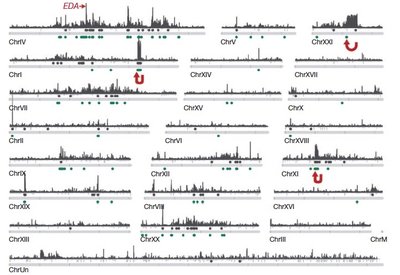
Genomic Evidence from Sticklebacks
Genomic studies reveal that adaptive divergence often involves regulatory and coding changes at specific loci.
Key genes, such as EDA, are associated with morphological and ecological differences between marine and freshwater sticklebacks.
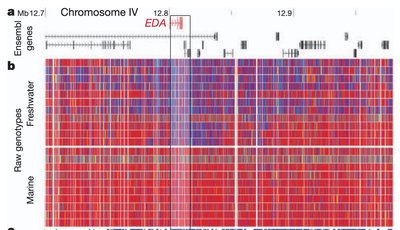
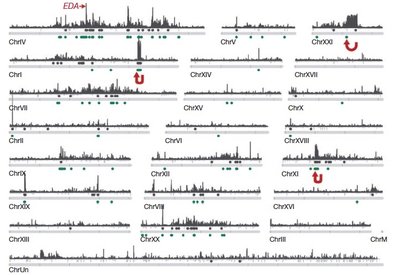
Table: Examples of Speciation by Natural Selection
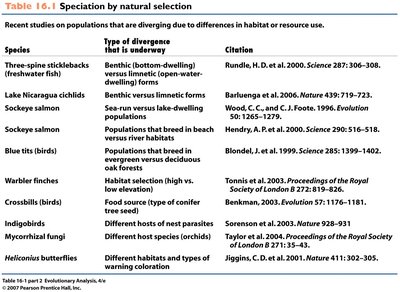
The following table summarizes recent studies on populations diverging due to differences in habitat or resource use:
Species | Type of Divergence | Citation |
|---|---|---|
Three-spine sticklebacks (freshwater fish) | Benthic (bottom-dwelling) versus limnetic (open-water-dwelling) forms | Rundle, H.D. et al. 2000. Science 287:306–308. |
Lake Nicaragua cichlids | Benthic versus limnetic forms | Barluenga et al. 2006. Nature 439:719–723. |
Sockeye salmon | Sea-run versus lake-dwelling populations | Wood, C.C. and C.J. Foote. 1996. Evolution 50:1265–1279. |
Sockeye salmon | Populations that breed in beach versus river habitats | Hendry, A.P. et al. 2000. Science 290:516–518. |
Blue tits (birds) | Populations that breed in deciduous versus evergreen habitats | Blondel, J. et al. 1999. Science 285:1399–1402. |
Warbler finches (birds) | High versus low elevation | Tonnis et al. 2003. Proceedings of the Royal Society of London B 272:819–826. |
Crossbills (birds) | Food source (type of conifer) | Benkman, 2003. Evolution 57:1176–1181. |
Indigobirds | Different hosts of nest parasites | Payne et al. 2004. Nature 928–931. |
Mycorrhizal fungi | Different host species (orchids) | Otero et al. 2004. Proceedings of the Royal Society of London B 271:1799–1806. |
Heliconius butterflies | Different habitats and types of warning coloration | Jiggins, C.D. et al. 2001. Nature 411:302–305. |
Summary
Speciation is a multifaceted process driven by genetic drift, natural selection, and ecological factors. The evolution of reproductive isolation, both prezygotic and postzygotic, is central to the formation of new species. Genomic studies, particularly in model systems like sticklebacks, reveal that speciation often involves changes at specific loci, supporting the genic view of speciation. Ecological speciation highlights the importance of divergent selection in different environments as a powerful force in generating biodiversity.
