 Back
Speciation: The Origin of New Species (Chapter 24 Study Notes)
Study Guide - Smart Notes
 Tailored notes based on your materials, expanded with key definitions, examples, and context.
Speciation: The Origin of New Species
Introduction to Speciation
Speciation is the evolutionary process by which new biological species arise. It forms a conceptual bridge between microevolution (small-scale changes in allele frequencies within populations) and macroevolution (broad patterns of evolutionary change above the species level). Understanding speciation is essential for grasping how biodiversity is generated and maintained.
Microevolution: Changes in allele frequency in a population over time.
Macroevolution: Broad evolutionary changes above the species level, including the origin of new species.
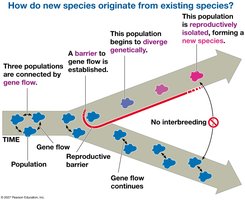
The Biological Species Concept
Definition and Application
The biological species concept defines a species as a group of populations whose members have the potential to interbreed in nature and produce viable, fertile offspring, but do not produce viable, fertile offspring with members of other such groups. Gene flow between populations holds a species together genetically.
Potential to interbreed is key, not just physical similarity.
Gene flow maintains genetic cohesion within a species.
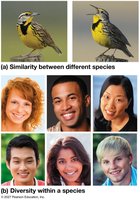
Reproductive Isolation
Barriers to Gene Flow
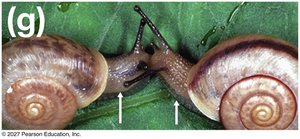
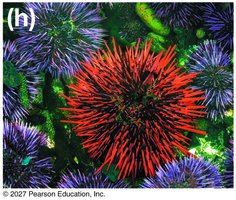
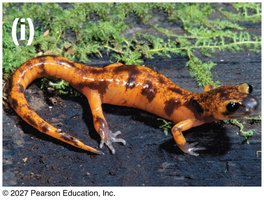
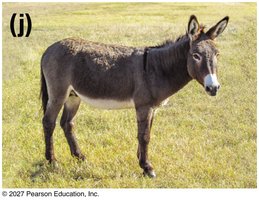
Reproductive isolation occurs when biological barriers prevent members of two species from interbreeding and producing viable, fertile offspring. These barriers limit the formation of hybrids (offspring from interspecific mating) and can be classified based on whether they act before or after fertilization.
Prezygotic barriers: Block fertilization from occurring.
Postzygotic barriers: Prevent hybrid zygotes from developing into viable, fertile adults.
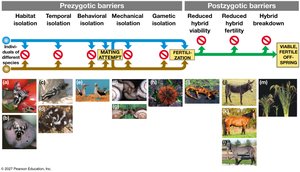
Prezygotic Barriers
Habitat Isolation: Species occupy different habitats and rarely encounter each other.
Temporal Isolation: Species breed at different times (day, season, or year).
Behavioral Isolation: Unique courtship rituals or behaviors prevent mating.
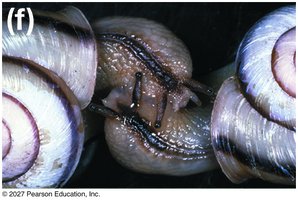
Mechanical Isolation: Morphological differences prevent successful mating.
Gametic Isolation: Sperm of one species may not fertilize eggs of another due to incompatibility.
Postzygotic Barriers
Reduced Hybrid Viability: Hybrid offspring have impaired development or survival.
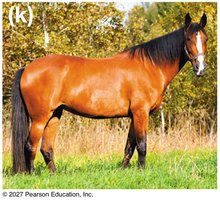
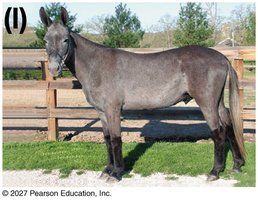
Reduced Hybrid Fertility: Hybrids are sterile (e.g., mules).
Hybrid Breakdown: First-generation hybrids are viable and fertile, but offspring of hybrids are feeble or sterile.
Limitations of the Biological Species Concept
Scope and Exceptions
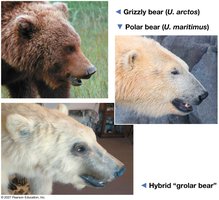
The biological species concept is not universally applicable. It cannot be used for fossils or asexual organisms, as mating cannot be observed. Additionally, gene flow can occur between distinct species, resulting in hybrids (e.g., grizzly and polar bears producing "grolar bears").
Other Species Concepts
Morphological, Ecological, and Other Concepts
Morphological Species Concept: Distinguishes species by structural features; applies to sexual and asexual species but is subjective.
Ecological Species Concept: Defines species by their ecological niche; applies to sexual and asexual species and emphasizes ecological roles.
More than 20 other species definitions exist, each useful in different contexts.
Modes of Speciation
Allopatric and Sympatric Speciation
Speciation can occur with or without geographic separation:
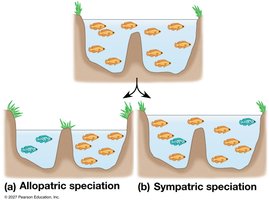
Allopatric speciation: Populations are geographically isolated, leading to divergence.
Sympatric speciation: Populations are not geographically isolated; speciation occurs within the same area.
Allopatric Speciation
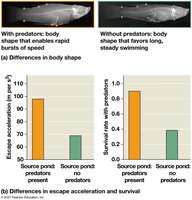
In allopatric speciation, gene flow is interrupted when a population is divided by a geographic barrier or when individuals colonize a remote area. Over time, genetic divergence leads to reproductive isolation.
Examples: Formation of new lakes, colonization of islands, or geographic barriers like canyons.
Genetic divergence occurs via mutation, natural selection, and genetic drift.
Evidence for Allopatric Speciation
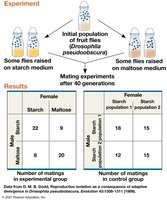
Laboratory experiments: Fruit flies raised on different diets develop mating preferences for their own group.
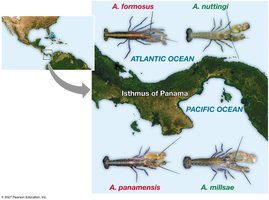
Natural examples: Sister species of snapping shrimp diverged after the formation of the Isthmus of Panama.
Isolated regions (e.g., islands) have high species diversity due to barriers to gene flow.
Sympatric Speciation
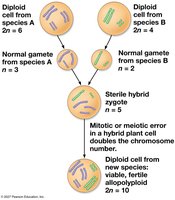
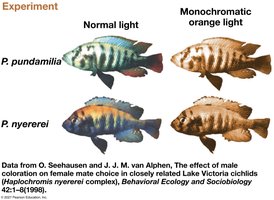
Sympatric speciation occurs without geographic separation. It is less common and typically results from reduced gene flow due to polyploidy, sexual selection, or habitat differentiation.
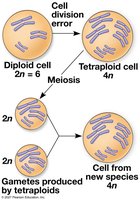
Polyploidy: Extra sets of chromosomes form new species rapidly, common in plants.
Sexual selection: Mate choice based on traits (e.g., coloration in cichlids) can drive speciation.
Habitat differentiation: Use of different resources or habitats leads to reproductive isolation.
From Speciation to Macroevolution
Long-Term Evolutionary Patterns
Speciation events accumulate over time, leading to the formation of new groups of organisms and contributing to macroevolution. Extinction events also shape the diversity of life by reducing the number of species.
Macroevolution: The cumulative effect of many speciation and extinction events over long periods.
