 Back
Spectrophotometry of Chlorophyll Pigments: Principles and Laboratory Practice
Study Guide - Smart Notes
 Tailored notes based on your materials, expanded with key definitions, examples, and context.
Spectrophotometry of Chlorophyll Pigments
Introduction to Electromagnetic Radiation and the Visible Spectrum
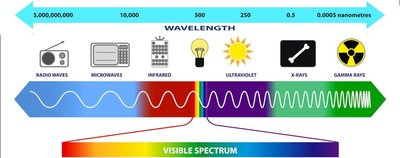
Electromagnetic (EM) radiation is a form of energy that travels through space as oscillating electric and magnetic fields. Sunlight, a type of EM radiation, can also be described as a stream of massless particles called photons, each traveling at a specific wavelength measured in nanometers (nm). The energy of light is inversely proportional to its wavelength: shorter wavelengths carry more energy. The electromagnetic spectrum encompasses a wide range of wavelengths, including radio waves, microwaves, infrared, visible light, ultraviolet, X-rays, and gamma rays. The visible spectrum, which ranges from 700 nm (red) to 400 nm (violet), contains the wavelengths that can excite photoreceptors in the human eye, allowing us to perceive color.
Visible Spectrum: 400–700 nm, includes red, orange, yellow, green, blue, indigo, and violet.
Color Perception: Determined by the wavelengths of light reflected or transmitted by an object; absorbed wavelengths are not seen.
Absorbance and Transmittance
When light passes through a solution, some wavelengths are absorbed by the solute molecules, while others are transmitted. The absorbance (A) of a solution is a measure of how much light is absorbed at a particular wavelength, while transmittance (T) is the fraction of light that passes through the sample. The relationship between absorbance and transmittance is given by:
Absorbance (A): , where
Transmittance (T): , where is the incident light intensity and is the transmitted light intensity.
High absorbance means low transmittance and vice versa. The color observed is due to the wavelengths that are transmitted or reflected, not those absorbed.
Principle and Structure of the Spectrophotometer
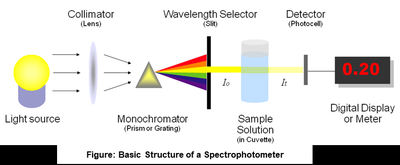
A spectrophotometer is an instrument used to measure the amount of light absorbed by a solution at specific wavelengths. It operates by passing a selected wavelength of light through a sample and detecting the intensity of transmitted light. The difference between the incident and transmitted light is used to calculate absorbance.
Key Components:
Light Source: Provides a broad spectrum of light.
Collimator (Lens): Focuses the light into a beam.
Monochromator (Prism or Grating): Separates light into its component wavelengths.
Wavelength Selector (Slit): Selects the desired wavelength to pass through the sample.
Sample Holder (Cuvette): Contains the solution to be analyzed.
Detector (Photocell): Measures the intensity of transmitted light and converts it to an electrical signal.
Digital Display or Meter: Shows the absorbance or percent transmittance.
Calibration and Use of the Spectrophotometer
Before measuring the absorbance of a sample, the spectrophotometer must be calibrated using a blank solution (solvent only). This step ensures that any absorbance due to the solvent or the cuvette is subtracted from the sample reading, so only the solute's absorbance is measured.
Calibration: Insert the blank, set absorbance to zero, then measure the sample.
Blank Solution: Contains only the solvent (e.g., 95% ethanol) used to dissolve the sample.
Laboratory Procedure: Extraction and Measurement of Chlorophyll
To determine the absorbance spectrum of chlorophyll pigments from spinach leaves, the following steps are performed:
Extract chlorophyll from spinach leaves using ethanol and filtration.
Centrifuge to remove debris and dilute the supernatant to prepare the chlorophyll solution.
Prepare a blank (solvent only) and a sample (chlorophyll solution) in separate cuvettes.
Calibrate the spectrophotometer with the blank at each wavelength.
Measure and record the absorbance of the chlorophyll solution at various wavelengths (360–700 nm).
Plot a graph of wavelength versus absorbance to obtain the absorption spectrum.
Absorption Spectrum of Chlorophyll
The absorption spectrum of chlorophyll typically shows peaks in the blue (around 430–450 nm) and red (around 660–680 nm) regions, with low absorbance in the green region (500–560 nm), which is why leaves appear green. The absorption spectrum can be used to predict the rate of photosynthesis at different wavelengths, as chlorophyll absorbs light most efficiently in the blue and red regions.
Table: Visible Light Spectrum and Color Ranges
Color | Wavelength (nm) |
|---|---|
Red | 630–700 |
Orange | 590–630 |
Yellow | 560–590 |
Green | 490–560 |
Blue | 450–490 |
Indigo | 420–450 |
Violet | 380–420 |
Key Questions and Concepts
Relation between Absorbance and Transmittance: As absorbance increases, transmittance decreases; they are inversely related by .
Use of a Spectrophotometer: To measure the absorbance of light by a solution at specific wavelengths, allowing for the analysis of concentration and properties of solutes.
Purpose of a Blank Solution: To calibrate the spectrophotometer and account for absorbance due to the solvent and cuvette, ensuring accurate measurement of the solute's absorbance.
Maximum Absorbance for Chlorophyll: Typically observed in the blue (around 430–450 nm) and red (around 660–680 nm) regions.
Photosynthesis Prediction: The rate of photosynthesis is highest at wavelengths where chlorophyll absorbs most strongly (blue and red regions).
Additional info: The described procedure and principles are foundational for understanding how pigments like chlorophyll interact with light, which is essential for studying photosynthesis and plant physiology.
