 Back
Step-by-Step Guidance for Biodiversity: Animal Phyla and Structures
Study Guide - Smart Notes
 Tailored notes based on your materials, expanded with key definitions, examples, and context.
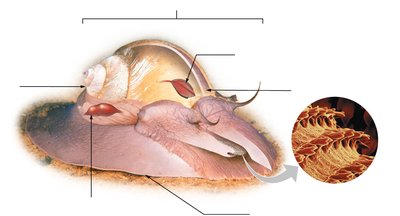
Q1. Complete the diagram illustrating a typical mollusk.
Background
Topic: Mollusk Anatomy
This question tests your understanding of the basic body plan and key anatomical features of mollusks, a diverse animal phylum. Mollusks include snails, clams, and octopuses, and their anatomy is important for understanding their classification and function.
Key Terms and Structures:
Shell: The hard, protective outer covering.
Mantle: The tissue that secretes the shell.
Foot: The muscular structure used for movement.
Radula: A toothed, chitinous ribbon used for feeding (shown in the inset).
Visceral mass: Contains most of the internal organs.
Step-by-Step Guidance
Examine the diagram and identify the main external and internal features. Look for the shell, mantle, foot, and visceral mass.
Locate the radula in the inset image. The radula is a unique feeding structure found in most mollusks.
Label the shell as the hard, outermost structure, and the mantle as the tissue just beneath the shell.
Identify the foot, which is usually the large, muscular area used for movement.
Find the visceral mass, which houses the internal organs, and label it accordingly.
Try solving on your own before revealing the answer!
Final Answer:
The diagram should be labeled with the following parts: shell, mantle, foot, visceral mass, and radula. The radula is shown in the inset as a toothed structure used for scraping food.
These features are characteristic of mollusks and help distinguish them from other animal phyla.
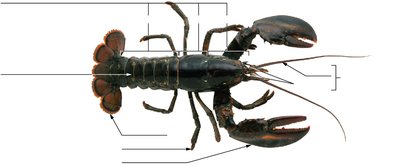
Q2. Complete the diagram illustrating the typical body structures of an arthropod.
Background
Topic: Arthropod Anatomy
This question focuses on the basic anatomy of arthropods, which include insects, crustaceans, and arachnids. Arthropods are the most diverse animal phylum, and their body plan is key to their success.
Key Terms and Structures:
Exoskeleton: A hard, external covering made of chitin.
Jointed appendages: Limbs that are segmented and flexible.
Body segments: Typically divided into head, thorax, and abdomen.
Antennas: Sensory organs.
Claws: Specialized appendages for feeding or defense.
Step-by-Step Guidance
Observe the diagram and identify the three main body segments: head, thorax, and abdomen.
Locate the jointed appendages, such as legs and claws, and note their positions.
Find the exoskeleton, which covers the entire body and provides protection.
Identify the antennas on the head, which are used for sensing the environment.
Label the claws, which are specialized for feeding or defense.
Try solving on your own before revealing the answer!
Final Answer:
The diagram should be labeled with head, thorax, abdomen, exoskeleton, jointed appendages, antennas, and claws. These features are shared by all arthropods and are essential for their survival and diversity.
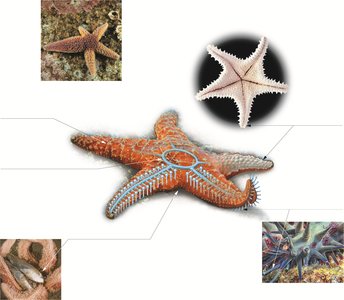
Q3. Complete the diagram illustrating the typical body structure of an echinoderm.
Background
Topic: Echinoderm Anatomy
This question tests your knowledge of echinoderm body structure, including sea stars, sea urchins, and sea cucumbers. Echinoderms are known for their unique symmetry and water vascular system.
Key Terms and Structures:
Radial symmetry: Body parts arranged around a central axis.
Water vascular system: A network of hydraulic canals used for movement and feeding.
Tube feet: Extensions used for locomotion and grasping.
Endoskeleton: Internal skeleton made of calcareous plates.
Step-by-Step Guidance
Examine the diagram and identify the central disk and radiating arms characteristic of echinoderms.
Locate the tube feet, which are small, flexible extensions used for movement.
Find the water vascular system, often shown as blue lines or canals in the diagram.
Identify the endoskeleton, which provides structural support.
Label the radial symmetry, noting how the arms are arranged around the central axis.
Try solving on your own before revealing the answer!
Final Answer:
The diagram should be labeled with central disk, arms (radial symmetry), tube feet, water vascular system, and endoskeleton. These features are unique to echinoderms and distinguish them from other animal phyla.
