 Back
BackStep-by-Step Guidance for Cellular Respiration, Energy, and Metabolism
Study Guide - Smart Notes
 Tailored notes based on your materials, expanded with key definitions, examples, and context.
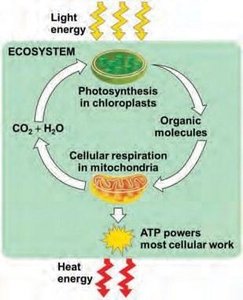
Q1. Using figure 7.2, describe photosynthesis and how it makes the macromolecules that are in your food.
Background
Topic: Photosynthesis and Energy Flow in Ecosystems
This question tests your understanding of how photosynthesis converts light energy into chemical energy, producing organic molecules that serve as the building blocks for macromolecules in food.
Key Terms:
Photosynthesis: The process by which plants, algae, and some bacteria convert light energy, carbon dioxide, and water into glucose and oxygen.
Macromolecules: Large molecules such as carbohydrates, proteins, and lipids, which are synthesized from smaller organic molecules.
Chloroplast: The organelle in plant cells where photosynthesis occurs.
Step-by-Step Guidance
Examine figure 7.2 and identify the main components: light energy, chloroplasts, photosynthesis, organic molecules, and cellular respiration.
Recall that photosynthesis uses light energy to convert CO2 and H2O into glucose and other organic molecules.
Understand that these organic molecules (such as glucose) are the starting materials for building macromolecules like starch, proteins, and fats.
Think about how these macromolecules are present in food and are synthesized by plants using the products of photosynthesis.
Try solving on your own before revealing the answer!
Final Answer:
Photosynthesis in chloroplasts uses light energy to convert CO2 and H2O into organic molecules (such as glucose). These molecules are then used to build macromolecules found in food, like carbohydrates, proteins, and lipids.
Q2. Using figure 7.2 again, describe how photosynthesis is related to cellular respiration.
Background
Topic: Relationship Between Photosynthesis and Cellular Respiration
This question tests your ability to connect the processes of photosynthesis and cellular respiration, showing how energy and matter cycle in ecosystems.
Key Terms:
Cellular Respiration: The process by which cells break down organic molecules to release energy (ATP).
ATP: Adenosine triphosphate, the energy currency of the cell.
CO2 and H2O: Byproducts of cellular respiration, which are used again in photosynthesis.
Step-by-Step Guidance
Look at figure 7.2 and note the cyclical relationship between photosynthesis and cellular respiration.
Photosynthesis produces organic molecules and oxygen, which are used in cellular respiration.
Cellular respiration breaks down these organic molecules to produce ATP, CO2, and H2O.
CO2 and H2O released from cellular respiration are then used again in photosynthesis.
Try solving on your own before revealing the answer!
Final Answer:
Photosynthesis and cellular respiration are interconnected. Photosynthesis creates organic molecules and oxygen, which are used in cellular respiration to produce ATP, CO2, and H2O. The CO2 and H2O are then recycled back into photosynthesis.
Q9. What is the overall purpose of glycolysis? What are the end products of glycolysis?
Background
Topic: Glycolysis
This question tests your understanding of the first stage of cellular respiration, where glucose is broken down to extract energy.
Key Terms and Formula:
Glycolysis: The metabolic pathway that converts glucose into pyruvate, generating ATP and NADH.
ATP: Energy molecule produced during glycolysis.
NADH: Electron carrier produced during glycolysis.
Pyruvate: The end product of glycolysis.
Step-by-Step Guidance
Recall that glycolysis occurs in the cytoplasm and involves a series of enzyme-catalyzed reactions.
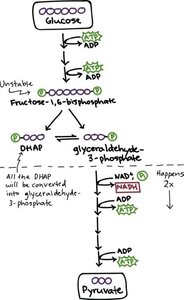
Understand that the main purpose of glycolysis is to break down glucose into two molecules of pyruvate.
During glycolysis, ATP and NADH are produced as energy carriers.
Review the pathway and note the key intermediates and products.
Try solving on your own before revealing the answer!
Final Answer:
The overall purpose of glycolysis is to extract energy from glucose by breaking it down into pyruvate. The end products are 2 pyruvate, 2 ATP (net gain), and 2 NADH per glucose molecule.
Q12. Describe the oxidation of pyruvate. What occurs and why is this necessary? Be sure to include where in the cell this occurs and what are the byproducts.
Background
Topic: Pyruvate Oxidation
This question tests your understanding of the transition step between glycolysis and the citric acid cycle, where pyruvate is converted to acetyl CoA.
Key Terms and Formula:
Pyruvate: Product of glycolysis.
Acetyl CoA: Molecule that enters the citric acid cycle.
NAD+ and NADH: Electron carriers involved in the reaction.
CO2: Byproduct released during pyruvate oxidation.
Step-by-Step Guidance
Recall that pyruvate oxidation occurs in the mitochondrial matrix.
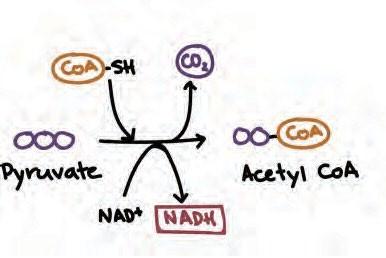
Pyruvate is transported into the mitochondria and converted into acetyl CoA.
During this process, NAD+ is reduced to NADH, and CO2 is released as a byproduct.
Understand why this step is necessary: acetyl CoA is required for the citric acid cycle to proceed.
Try solving on your own before revealing the answer!
Final Answer:
Pyruvate oxidation converts pyruvate into acetyl CoA in the mitochondrial matrix, producing NADH and CO2 as byproducts. This step is necessary to provide acetyl CoA for the citric acid cycle.
Q13. Describe the overall purpose of the Citric Acid Cycle.
Background
Topic: Citric Acid Cycle (Krebs Cycle)
This question tests your understanding of the citric acid cycle's role in cellular respiration and energy production.
Key Terms:
Citric Acid Cycle: A series of reactions that generate NADH, FADH2, and ATP from acetyl CoA.
NADH and FADH2: Electron carriers produced during the cycle.
ATP/GTP: Energy molecules produced in the cycle.
Step-by-Step Guidance
Recall that the citric acid cycle occurs in the mitochondrial matrix.
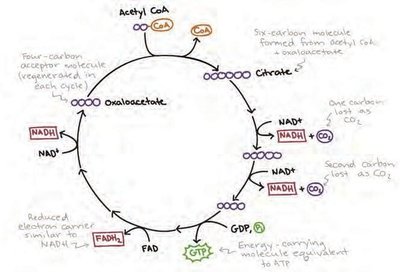
Acetyl CoA enters the cycle and combines with oxaloacetate to form citrate.
Through a series of reactions, citrate is converted back to oxaloacetate, releasing CO2, NADH, FADH2, and ATP/GTP.
Understand that the main purpose is to harvest high-energy electrons for the electron transport chain.
Try solving on your own before revealing the answer!
Final Answer:
The citric acid cycle's overall purpose is to generate NADH and FADH2 for the electron transport chain, as well as ATP/GTP and CO2 as byproducts.
Q15. Describe the purpose of the electron transport chain. What conditions are needed to arrive at the ETC?
Background
Topic: Electron Transport Chain (ETC)
This question tests your understanding of the final stage of cellular respiration, where most ATP is produced.
Key Terms:
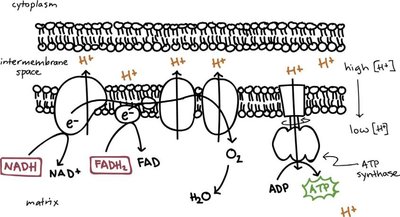
Electron Transport Chain: A series of protein complexes in the mitochondrial membrane that transfer electrons and pump protons.
ATP Synthase: Enzyme that synthesizes ATP using the proton gradient.
NADH and FADH2: Electron carriers that donate electrons to the ETC.
Oxygen: Final electron acceptor in the chain.
Step-by-Step Guidance
Recall that the ETC is located in the inner mitochondrial membrane.
NADH and FADH2 produced from earlier steps donate electrons to the ETC.
Electrons move through protein complexes, pumping protons into the intermembrane space.
ATP synthase uses the proton gradient to produce ATP.
Try solving on your own before revealing the answer!
Final Answer:
The purpose of the electron transport chain is to produce ATP by transferring electrons from NADH and FADH2 to oxygen, creating a proton gradient used by ATP synthase. Oxygen and sufficient NADH/FADH2 are required to arrive at the ETC.
