 Back
BackStep-by-Step Guidance for Chapter 17: Gene Expression and Protein Synthesis
Study Guide - Smart Notes
 Tailored notes based on your materials, expanded with key definitions, examples, and context.
Q1. What is gene expression?
Background
Topic: Gene Expression
This question is testing your understanding of how genetic information in DNA is used to produce functional proteins, which are responsible for traits and cellular functions.
Key Terms:
Gene Expression: The process by which information from a gene is used to synthesize a functional gene product, usually a protein.
Transcription: The synthesis of RNA from a DNA template.
Translation: The synthesis of a protein from an mRNA template.
Step-by-Step Guidance
Start by defining gene expression as the process that links genotype (genetic makeup) to phenotype (observable traits).
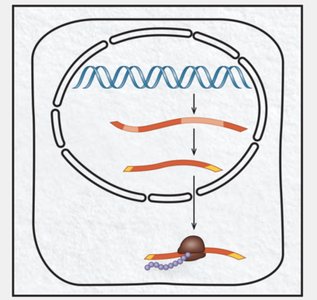
Recall that gene expression involves two main stages: transcription and translation.
Transcription occurs in the nucleus, where DNA is used as a template to make mRNA.
Translation occurs in the cytoplasm, where the mRNA is decoded by ribosomes to build a polypeptide (protein).
Try solving on your own before revealing the answer!
Final Answer:
Gene expression is the process by which information encoded in DNA directs the synthesis of proteins (or sometimes RNAs), connecting genotype to phenotype through transcription and translation.
This process is fundamental to all living organisms and explains how genetic information results in observable traits.
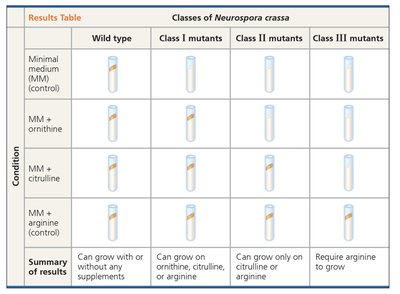
Q8. Using the Results Table for Class II mutants, explain why two test tubes show no growth and two test tubes show growth.
Background
Topic: Experimental Evidence for One Gene-One Enzyme Hypothesis
This question is testing your ability to interpret experimental results from Beadle and Tatum's work with Neurospora crassa mutants, which helped establish the relationship between genes and enzymes.
Key Terms:
Mutant: An organism with a genetic alteration.
Minimal Medium (MM): A growth medium containing only basic nutrients.
Supplement: Additional nutrients (e.g., arginine, citrulline, or ornithine) added to MM.
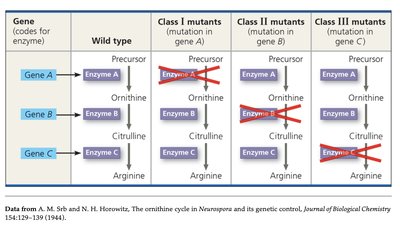
Class II Mutants: Mutants with a defect in the gene encoding the enzyme that converts citrulline to arginine.
Step-by-Step Guidance
Examine the Results Table for Class II mutants. Notice which supplements allow growth and which do not.
Recall that Class II mutants cannot convert citrulline to arginine due to a defective enzyme.
Predict that these mutants will not grow on minimal medium or minimal medium plus ornithine, since they cannot make arginine from these sources.
Understand that growth occurs when citrulline or arginine is provided, because citrulline can be converted to arginine (if the enzyme is functional), or arginine can be used directly.
Try solving on your own before revealing the answer!
Final Answer:
Class II mutants show no growth in test tubes with minimal medium or minimal medium plus ornithine because they lack the enzyme to convert citrulline to arginine. Growth occurs in tubes with citrulline or arginine, as these supplements bypass the defective step.
This supports the one gene-one enzyme hypothesis, showing that a single gene mutation can block a specific step in a metabolic pathway.
Q22. Here is a short DNA template. Below it, assemble the complementary mRNA strand. Recall that DNA-to-DNA, DNA-to-RNA, and RNA-to-RNA strand interactions are antiparallel. This means your mRNA strand will run 5ʹ to 3ʹ. 3ʹ TACAGAACGGTA 5ʹ
Background
Topic: Transcription and Antiparallel Strand Orientation
This question is testing your ability to transcribe a DNA template into an mRNA strand, considering the antiparallel nature of nucleic acid strands.
Key Terms and Formula:
Transcription: The process of copying a DNA sequence into an RNA sequence.
Antiparallel: The two strands run in opposite directions (3' to 5' and 5' to 3').
Base Pairing Rules: A (adenine) pairs with U (uracil) in RNA, T (thymine) pairs with A, C (cytosine) pairs with G, and G pairs with C.
Step-by-Step Guidance
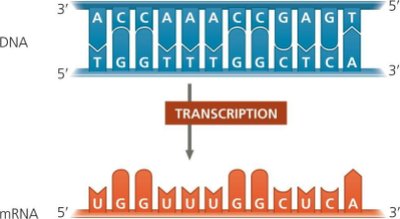
Write the DNA template strand: 3' TACAGAACGGTA 5'
Remember that the mRNA strand will be synthesized in the 5' to 3' direction, complementary to the DNA template.
Apply the base pairing rules: T → A, A → U, C → G, G → C.
Write out the mRNA sequence, making sure it is antiparallel to the template strand.
Try solving on your own before revealing the answer!
Final Answer:
The complementary mRNA strand is 5' AUGUCUUGCCA 3'.
This sequence is antiparallel to the DNA template and follows the correct base pairing rules for transcription.
