 Back
BackStep-by-Step Guidance for Gene Expression: From Gene to Protein
Study Guide - Smart Notes
 Tailored notes based on your materials, expanded with key definitions, examples, and context.
Q1. What is gene expression?
Background
Topic: Gene Expression
This question is testing your understanding of how genetic information in DNA is used to produce functional products, usually proteins.
Key Terms:
Gene expression: The process by which information from a gene is used to synthesize a functional gene product (often a protein).
Step-by-Step Guidance
Consider what happens to the information stored in DNA—how is it converted into something useful for the cell?
Think about the end products of gene expression. Are they always proteins, or can they be other molecules?
Reflect on why gene expression is essential for cellular function and organismal traits.
Try solving on your own before revealing the answer!
Q2. What are the TWO stages of gene expression?
Background
Topic: Central Dogma of Molecular Biology
This question is testing your knowledge of the two main processes that convert genetic information into proteins.
Key Terms:
Transcription: The process of copying DNA into RNA.
Translation: The process of converting RNA into a protein.
Step-by-Step Guidance
Recall the central dogma: DNA → RNA → Protein.
Identify which process occurs first and which follows.
Think about where each process occurs in the cell (nucleus vs. cytoplasm).
Try solving on your own before revealing the answer!
Q3. What do genes code for?
Background
Topic: Function of Genes
This question is testing your understanding of the products of gene expression.
Key Terms:
Gene: A segment of DNA that codes for a functional product.
Protein: The most common product, but some genes code for RNA molecules.
Step-by-Step Guidance
Think about the types of molecules that genes can produce.
Consider whether all genes code for proteins or if some code for other types of RNA.
Reflect on the importance of these products for cellular function.
Try solving on your own before revealing the answer!
Q4. Identify the three differences of RNA to DNA.
Background
Topic: Structure of Nucleic Acids
This question is testing your knowledge of the structural differences between RNA and DNA.
Key Terms:
RNA: Ribonucleic acid
DNA: Deoxyribonucleic acid
Step-by-Step Guidance
Recall the sugar component in each molecule.
Think about the nitrogenous bases present in RNA vs. DNA.
Consider the number of strands in each molecule.
Try solving on your own before revealing the answer!
Q5. What occurs during transcription?
Background
Topic: Transcription Process
This question is testing your understanding of how genetic information is transferred from DNA to RNA.
Key Terms:
Transcription: The synthesis of RNA from a DNA template.
mRNA: Messenger RNA, carries genetic information from DNA to the ribosome.
Step-by-Step Guidance
Think about the enzyme responsible for transcription.
Consider the direction in which the RNA is synthesized.
Reflect on the role of mRNA in the process.
Try solving on your own before revealing the answer!
Q6. What occurs during translation? Where does it occur?
Background
Topic: Translation Process
This question is testing your understanding of how mRNA is used to synthesize proteins and where this process takes place.
Key Terms:
Translation: The process of synthesizing a polypeptide from mRNA.
Ribosome: The cellular machinery where translation occurs.
Step-by-Step Guidance
Recall the role of ribosomes in translation.
Think about the location of ribosomes in the cell (cytoplasm or attached to the ER).
Consider the steps involved in translation: initiation, elongation, termination.
Try solving on your own before revealing the answer!
Q7. How does the protein process differ in prokaryotes and eukaryotes?
Background
Topic: Differences in Gene Expression
This question is testing your understanding of how transcription and translation are organized differently in prokaryotic and eukaryotic cells.
Key Terms:
Prokaryotes: Cells without a nucleus; transcription and translation occur simultaneously.
Eukaryotes: Cells with a nucleus; transcription occurs in the nucleus, translation in the cytoplasm.
Step-by-Step Guidance
Think about the cellular structures present in each cell type.
Consider how the separation of processes affects gene expression.
Reflect on the implications for RNA processing in eukaryotes.
Try solving on your own before revealing the answer!
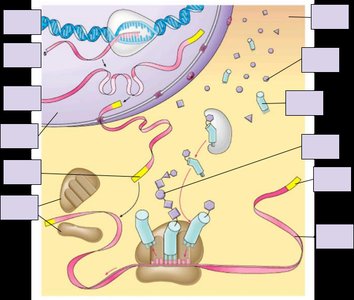
Q8. Construct/Draw OR insert an ACCURATE image of the central dogma of biology.
Background
Topic: Central Dogma
This question is testing your understanding of the flow of genetic information from DNA to RNA to protein.
Key Terms:
Central Dogma: The concept that genetic information flows from DNA to RNA to protein.
Step-by-Step Guidance
Recall the sequence of events: transcription followed by translation.
Think about how each stage is represented visually.
Identify the molecules involved at each step.
Try solving on your own before revealing the answer!
Q9. How many strands of DNA are transcribed for one gene? What is this strand called?
Background
Topic: DNA Transcription
This question is testing your understanding of which strand of DNA serves as the template for transcription.
Key Terms:
Template strand: The DNA strand used to synthesize RNA.
Nontemplate strand: The opposite strand, sometimes called the coding strand.
Step-by-Step Guidance
Recall that only one strand of DNA is used as a template for each gene.
Identify the name of this strand and its alternative name.
Consider whether the same strand is always used for every gene.
Try solving on your own before revealing the answer!
Q10. Explain the base-pairing rules of RNA nucleotides. What is a codon?
Background
Topic: RNA Structure and Genetic Code
This question is testing your understanding of how RNA nucleotides pair during transcription and what a codon is.
Key Terms:
Base-pairing: A-U, C-G in RNA.
Codon: A sequence of three RNA nucleotides that codes for an amino acid.
Step-by-Step Guidance
Recall the base-pairing rules for RNA: Adenine pairs with Uracil, Cytosine with Guanine.
Think about how codons are formed from the mRNA sequence.
Consider the importance of codons in translation.
Try solving on your own before revealing the answer!
Q11. What is the nontemplate strand? What is this strand also called?
Background
Topic: DNA Strands in Transcription
This question is testing your understanding of the roles of the two DNA strands during transcription.
Key Terms:
Nontemplate strand: The DNA strand not used for transcription; also called the coding strand.
Step-by-Step Guidance
Recall which strand is used as a template and which is not.
Identify the alternative name for the nontemplate strand.
Consider why the nontemplate strand is important for understanding the genetic code.
Try solving on your own before revealing the answer!
Q12. Identify several features of the genetic code.
Background
Topic: Genetic Code
This question is testing your understanding of the properties of the genetic code.
Key Terms:
Genetic code: The set of rules by which information encoded in mRNA is translated into proteins.
Step-by-Step Guidance
Think about the number of nucleotides in a codon.
Consider the redundancy and universality of the code.
Reflect on the start and stop codons.
Try solving on your own before revealing the answer!
Q13. Give an example of what happens when reading frames are altered.
Background
Topic: Reading Frame and Mutations
This question is testing your understanding of how changes in the reading frame affect protein synthesis.
Key Terms:
Reading frame: The way nucleotides are grouped into codons.
Frameshift mutation: A mutation that alters the reading frame.
Step-by-Step Guidance
Recall what happens when nucleotides are inserted or deleted.
Think about how this affects the grouping of codons.
Consider the impact on the resulting protein.
Try solving on your own before revealing the answer!
Q14. What is the genetic code and why is it said to be universal?
Background
Topic: Universality of the Genetic Code
This question is testing your understanding of why the genetic code is shared among almost all organisms.
Key Terms:
Universal genetic code: The same codons specify the same amino acids in nearly all organisms.
Step-by-Step Guidance
Recall the definition of the genetic code.
Think about examples of organisms that use the same code.
Consider the evolutionary significance of this universality.
Try solving on your own before revealing the answer!
Q15. Explain the role of RNA polymerase. In what direction does RNA polymerase work?
Background
Topic: Enzymes in Transcription
This question is testing your understanding of the enzyme responsible for synthesizing RNA and its directionality.
Key Terms:
RNA polymerase: The enzyme that synthesizes RNA from a DNA template.
Directionality: RNA is synthesized in the 5' to 3' direction.
Step-by-Step Guidance
Recall the function of RNA polymerase during transcription.
Think about the direction in which nucleotides are added.
Consider why directionality is important for transcription.
Try solving on your own before revealing the answer!
Q16. Where within DNA does transcription start and end?
Background
Topic: Transcription Initiation and Termination
This question is testing your understanding of the specific regions of DNA involved in starting and ending transcription.
Key Terms:
Promoter: The DNA sequence where transcription begins.
Terminator: The DNA sequence where transcription ends.
Step-by-Step Guidance
Recall the names of the DNA regions involved in transcription initiation and termination.
Think about the role of these sequences in regulating gene expression.
Consider how RNA polymerase recognizes these regions.
Try solving on your own before revealing the answer!
Q17. Briefly describe the three stages of transcription: Initiation, Elongation, Termination
Background
Topic: Stages of Transcription
This question is testing your understanding of the steps involved in synthesizing RNA from DNA.
Key Terms:
Initiation: RNA polymerase binds to the promoter.
Elongation: RNA strand is synthesized.
Termination: RNA polymerase releases the completed RNA.
Step-by-Step Guidance
Recall what happens at each stage of transcription.
Think about the role of RNA polymerase in each stage.
Consider how the transcript is processed after termination.
Try solving on your own before revealing the answer!
Q18. What happens to the transcript RNA before it leaves the nucleus? What is the advantage of the 5’ cap and poly-A tail?
Background
Topic: RNA Processing
This question is testing your understanding of the modifications made to RNA before it is exported from the nucleus.
Key Terms:
5’ cap: A modified guanine nucleotide added to the 5’ end.
Poly-A tail: A stretch of adenine nucleotides added to the 3’ end.
Step-by-Step Guidance
Recall the modifications made to pre-mRNA.
Think about the functions of the 5’ cap and poly-A tail.
Consider how these modifications affect mRNA stability and translation.
Try solving on your own before revealing the answer!
Q19. Describe the mechanism for RNA splicing. Distinguish between exons and introns. What does alternative RNA splicing do for cells?
Background
Topic: RNA Splicing
This question is testing your understanding of how introns are removed and exons joined, and the significance of alternative splicing.
Key Terms:
Exons: Coding regions of RNA.
Introns: Non-coding regions removed during splicing.
Alternative splicing: Allows cells to produce different proteins from the same gene.
Step-by-Step Guidance
Recall the process of removing introns and joining exons.
Think about how alternative splicing increases protein diversity.
Consider the role of spliceosomes in this process.
Try solving on your own before revealing the answer!
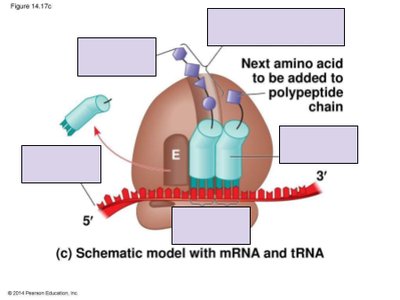
Q20. Describe the composition and roles of the molecules in the translation process: tRNA, anticodon, ribosomes (rRNA)
Background
Topic: Translation Machinery
This question is testing your understanding of the molecules involved in translation and their functions.
Key Terms:
tRNA: Transfer RNA, brings amino acids to the ribosome.
Anticodon: A sequence of three bases in tRNA that pairs with the mRNA codon.
Ribosome: The site of protein synthesis, composed of rRNA and proteins.
Step-by-Step Guidance
Recall the role of tRNA in translation.
Think about how the anticodon matches the mRNA codon.
Consider the structure and function of the ribosome.
Try solving on your own before revealing the answer!
Q21. Identify all applicable molecules in the diagram below using Figure 14.17.
Background
Topic: Translation Diagram
This question is testing your ability to recognize and label the molecules involved in translation.
Key Terms:
mRNA, tRNA, ribosome, polypeptide chain, amino acids
Step-by-Step Guidance
Examine the diagram and identify the labeled parts.
Recall the roles of each molecule in translation.
Match the visual features to the molecular names.
Try solving on your own before revealing the answer!
Q22. Briefly describe the steps of translation: Initiation, Elongation, Termination
Background
Topic: Steps of Translation
This question is testing your understanding of the sequence of events in protein synthesis.
Key Terms:
Initiation: Assembly of the translation machinery.
Elongation: Addition of amino acids to the growing polypeptide.
Termination: Release of the completed polypeptide.
Step-by-Step Guidance
Recall what happens at each stage of translation.
Think about the role of start and stop codons.
Consider how the polypeptide is released from the ribosome.
Try solving on your own before revealing the answer!
Q23. Is the polypeptide produced from translation complete? Describe some ways the polypeptide is modified before it can function for the cell.
Background
Topic: Post-Translational Modifications
This question is testing your understanding of how proteins are modified after translation.
Key Terms:
Post-translational modification: Changes made to proteins after translation.
Step-by-Step Guidance
Recall that proteins often require modifications to become functional.
Think about examples of modifications (folding, cleavage, addition of groups).
Consider the importance of these modifications for protein function.
Try solving on your own before revealing the answer!
Q24. Where are two locations where ribosomes can be found in the cell? Give an example of how a polypeptide gets into the ER for additional processing.
Background
Topic: Ribosome Location and Protein Targeting
This question is testing your understanding of ribosome distribution and protein targeting in the cell.
Key Terms:
Ribosomes: Found in the cytoplasm and on the rough ER.
Signal peptide: Directs the polypeptide to the ER.
Step-by-Step Guidance
Recall the two main locations of ribosomes.
Think about how proteins are targeted to the ER.
Consider the role of signal peptides in this process.
Try solving on your own before revealing the answer!
Q25. Using Figure 14.24, label the diagram to trace the flow of chemical information from the gene to protein product. Then, explain the processes occurring in the diagram.
Background
Topic: Central Dogma and Cellular Processes
This question is testing your ability to interpret a diagram showing the flow of genetic information.
Key Terms:
Transcription, translation, mRNA, ribosome, polypeptide
Step-by-Step Guidance
Examine the diagram and identify the labeled steps.
Recall the sequence of events from DNA to protein.
Match the visual features to the molecular processes.
Try solving on your own before revealing the answer!
Q26. What are mutations responsible for in organisms?
Background
Topic: Mutations and Variation
This question is testing your understanding of the effects of mutations on organisms.
Key Terms:
Mutation: A change in the DNA sequence.
Step-by-Step Guidance
Recall the types of changes mutations can cause.
Think about the impact on phenotype and genetic diversity.
Consider the role of mutations in evolution.
Try solving on your own before revealing the answer!
Q27. Define point mutations.
Background
Topic: Types of Mutations
This question is testing your understanding of mutations that affect a single nucleotide.
Key Terms:
Point mutation: A change in a single nucleotide in DNA.
Step-by-Step Guidance
Recall the definition of a point mutation.
Think about the possible effects on protein coding.
Consider examples of point mutations.
Try solving on your own before revealing the answer!
Q28. Describe the mutations that are: Substitution (silent, missense, nonsense), Insertion or deletion
Background
Topic: Mutation Types
This question is testing your understanding of different types of mutations and their effects.
Key Terms:
Substitution: Replacing one nucleotide with another.
Silent: No change in amino acid.
Missense: Changes amino acid.
Nonsense: Creates a stop codon.
Insertion/deletion: Adds or removes nucleotides, often causing frameshift.
Step-by-Step Guidance
Recall the definitions of each mutation type.
Think about the effects on the protein product.
Consider why insertion/deletion often leads to frameshift.
Try solving on your own before revealing the answer!
Q29. Explain how mutations are sources of variation within genes. Describe how this relates to natural selection.
Background
Topic: Genetic Variation and Evolution
This question is testing your understanding of the role of mutations in evolution and natural selection.
Key Terms:
Variation: Differences in genetic makeup.
Natural selection: Process by which advantageous traits become more common.
Step-by-Step Guidance
Recall how mutations introduce new alleles.
Think about the impact on population diversity.
Consider how natural selection acts on variation.
Try solving on your own before revealing the answer!
Q30. What are mutagens? What do they do? How are chemical mutagens related to carcinogens?
Background
Topic: Mutagens and Carcinogens
This question is testing your understanding of agents that cause mutations and their relationship to cancer.
Key Terms:
Mutagen: An agent that causes mutations.
Carcinogen: A substance that causes cancer, often by being a mutagen.
Step-by-Step Guidance
Recall the definition of mutagens.
Think about how mutagens cause changes in DNA.
Consider the link between mutagens and carcinogens.
Try solving on your own before revealing the answer!
Q31. Recap the three definitions of a gene we have learned thus far.
Background
Topic: Definitions of a Gene
This question is testing your understanding of the evolving definitions of a gene.
Key Terms:
Gene: A unit of heredity, a sequence coding for a product, a regulatory element.
Step-by-Step Guidance
Recall the classical definition of a gene.
Think about the molecular definition.
Consider regulatory and functional definitions.
Try solving on your own before revealing the answer!
Q32. Proteins bring about an organism’s observable…
Background
Topic: Proteins and Phenotype
This question is testing your understanding of how proteins determine traits.
Key Terms:
Phenotype: Observable characteristics of an organism.
Step-by-Step Guidance
Recall the role of proteins in cellular function.
Think about how protein activity leads to observable traits.
Consider examples of protein-driven phenotypes.
Try solving on your own before revealing the answer!
