 Back
Step-by-Step Guidance for Molecular Biology and Genetics Techniques
Study Guide - Smart Notes
 Tailored notes based on your materials, expanded with key definitions, examples, and context.
Q1. Welke techniek zie je hier?
Background
Topic: DNA sequencing (Nanopore sequencing)
This question tests your ability to recognize and understand modern DNA sequencing techniques, specifically those that use ionic current to determine DNA sequence.
Key Terms and Formulas
Nanopore sequencing: A method where DNA passes through a nanopore and changes in ionic current are used to identify bases.
Basecalling: The process of converting ionic current signals into DNA sequence data.
Step-by-Step Guidance
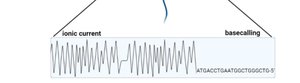
Observe the image and note the labels "ionic current" and "basecalling". This indicates a sequencing technology that translates electrical signals into DNA bases.
Recall that nanopore sequencing is a technique where DNA strands pass through a tiny pore, and the change in current is measured to identify each nucleotide.
Think about what you can do with this technique: direct sequencing of DNA, real-time analysis, and detection of modifications.
Consider what you cannot do: for example, it may not be as accurate as other sequencing methods for certain applications, or may have limitations in read length or error rate.
Try solving on your own before revealing the answer!
Final Answer: Nanopore sequencing
This is a schematic of nanopore sequencing, where DNA is sequenced by measuring changes in ionic current as the strand passes through a nanopore. The technique allows for real-time sequencing and can detect base modifications.
Q2. Een onderzoeksmethode waarbij de functie van een gen wordt bestudeerd door eerst een mutatie in het genoom van een organisme aan te brengen en vervolgens de resulterende fenotypische veranderingen te observeren. Waar hoort dit bij?
Background
Topic: Reverse genetics
This question tests your understanding of genetic research methods, specifically how scientists study gene function by creating targeted mutations and observing phenotypes.
Key Terms and Formulas
Reverse genetics: Starting with a known gene and altering it to study the resulting phenotype.
Mutation: A change in the DNA sequence.
Phenotype: Observable traits resulting from genetic changes.
Step-by-Step Guidance
Identify that the method described involves starting with a gene, introducing a mutation, and observing the effect.
Recall that this approach is characteristic of reverse genetics, as opposed to forward genetics (which starts with a phenotype).
Think about examples: gene knockout, gene silencing, or CRISPR-based editing.

Try solving on your own before revealing the answer!
Final Answer: Reverse genetics
This method is part of reverse genetics, where researchers manipulate a known gene to study its function by observing phenotypic changes.
Q3. Een onderzoeksmethode waarbij willekeurige mutaties worden gegenereerd en vervolgens gezocht wordt naar fenotypische veranderingen die veroorzaakt worden door deze mutaties om de genen te identificeren die betrokken zijn bij bepaalde processen. Waar hoort dit bij?
Background
Topic: Forward genetics
This question tests your understanding of genetic screening methods, where random mutations are used to discover genes responsible for specific phenotypes.
Key Terms and Formulas
Forward genetics: Starting with a phenotype and identifying the gene responsible.
Mutagenesis: The process of inducing mutations.
Phenotypic screening: Observing changes in traits to find genetic causes.
Step-by-Step Guidance
Recognize that the method starts with random mutations and searches for phenotypic changes.
Recall that this is characteristic of forward genetics, which is used to discover genes underlying specific traits.
Think about techniques like chemical mutagenesis or radiation, followed by screening for altered phenotypes.
Try solving on your own before revealing the answer!
Final Answer: Forward genetics
This method is part of forward genetics, where random mutations are used to identify genes responsible for observed phenotypes.
Q4. Welke techniek is dit? Wat is het groene deel? Wat is die gele blob? Wat analyseer je met deze techniek? Wat is de resolutie? Wat geeft het piekenpatroon hieronder aan?
Background
Topic: DNA microarray analysis
This question tests your ability to interpret DNA microarray technology, which is used to analyze gene expression or detect genomic changes.
Key Terms and Formulas
Microarray: A grid of DNA probes used to detect gene expression or genomic changes.
Hybridization: Binding of labeled DNA to complementary probes.
Resolution: The smallest difference detectable by the technique.
Peaks: Represent signal intensity, indicating presence or absence of specific DNA sequences.
Step-by-Step Guidance
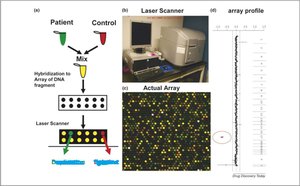
Identify the technique as DNA microarray based on the grid and colored spots.
Interpret the green and yellow colors: green may indicate control, yellow may indicate overlap or co-expression.
Analyze what is measured: gene expression, copy number variation, or genomic deletions/duplications.
Consider the resolution: microarrays can detect changes at the level of individual genes or small chromosomal regions.
Understand the peaks: they show signal intensity, which correlates with the amount of DNA or RNA hybridized.
Try solving on your own before revealing the answer!
Final Answer: DNA microarray
The green part represents control DNA, the yellow blob indicates overlap or co-expression, and the peaks show signal intensity for specific probes. The technique analyzes gene expression or genomic changes with high resolution.
Q5. Het fenomeen waarbij één allel van een gen de expressie van het andere allel maskeert in een heterozygoot individu. Waar hoort dit bij?
Background
Topic: Dominantie in genetica
This question tests your understanding of allele interactions, specifically dominance, where one allele masks the expression of another in a heterozygote.
Key Terms and Formulas
Dominant allele: An allele that masks the expression of another (recessive) allele.
Heterozygote: An organism with two different alleles for a gene.
Step-by-Step Guidance
Recognize that the phenomenon described is dominance.
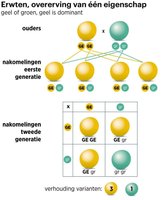
Recall that in a heterozygote, the dominant allele determines the phenotype.
Think about classic Mendelian inheritance examples, such as pea plant color.
Try solving on your own before revealing the answer!
Final Answer: Dominantie
This phenomenon is called dominance, where one allele masks the expression of another in a heterozygote.
