 Back
Step-by-Step Guidance for Photosynthesis and Carbon Fixation Mechanisms
Study Guide - Smart Notes
 Tailored notes based on your materials, expanded with key definitions, examples, and context.
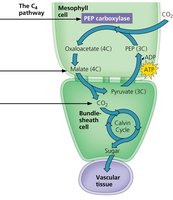
Q38. Using Figure 10.19 in your text as a guide, explain the three key events—indicated by the arrows below—in the C4 pathway.
Background
Topic: C4 Photosynthesis Pathway
This question is testing your understanding of the C4 pathway, an adaptation in some plants to efficiently fix carbon in hot, arid climates. The C4 pathway helps minimize photorespiration and maximize photosynthetic efficiency by spatially separating initial carbon fixation from the Calvin cycle.
Key Terms and Concepts:
PEP carboxylase: An enzyme that fixes CO2 in the mesophyll cells, forming a four-carbon compound (oxaloacetate).
Bundle-sheath cell: Specialized cells where the Calvin cycle occurs, receiving CO2 from the C4 pathway.
Calvin cycle: The cycle that uses ATP and NADPH to convert CO2 into sugars.
Photorespiration: A wasteful process minimized by the C4 pathway.
Key Formula:
Step-by-Step Guidance
First, CO2 enters the mesophyll cell and is fixed by the enzyme PEP carboxylase, forming oxaloacetate (a four-carbon compound). This step is crucial because PEP carboxylase has a higher affinity for CO2 and does not bind O2, reducing photorespiration.
Oxaloacetate is then converted into malate (another four-carbon compound), which is transported into the bundle-sheath cell. Here, malate is decarboxylated, releasing CO2 for use in the Calvin cycle. This spatial separation ensures a high concentration of CO2 around rubisco, minimizing its interaction with O2.
Pyruvate, a three-carbon compound, is returned to the mesophyll cell, where it is converted back into PEP using ATP. This regeneration of PEP is essential for the cycle to continue and requires energy input.
Try solving on your own before revealing the answer!
Final Answer:
The three key events in the C4 pathway are: (1) CO2 fixation by PEP carboxylase in the mesophyll cell, (2) transport and decarboxylation of malate in the bundle-sheath cell to release CO2 for the Calvin cycle, and (3) regeneration of PEP from pyruvate in the mesophyll cell using ATP. This process efficiently concentrates CO2 around rubisco, reducing photorespiration and increasing photosynthetic efficiency in hot, arid environments.
