 Back
Step-by-Step Study Guidance for Introductory Genetics (General Biology)
Study Guide - Smart Notes
 Tailored notes based on your materials, expanded with key definitions, examples, and context.
Q1. What is the order of the genes R, W, and L on the chromosome, given the recombination frequencies: R & W = 17%, R & L = 35%, W & L = 18%?
Background
Topic: Genetic Linkage and Gene Mapping
This question tests your understanding of how recombination frequencies are used to determine the order of genes on a chromosome.
Key Terms and Formulas:
Recombination frequency: The percentage of recombinant offspring, used to estimate the distance between genes.
Gene order: The sequence in which genes are arranged on a chromosome.
Step-by-Step Guidance
List the recombination frequencies between each pair of genes: R & W = 17%, R & L = 35%, W & L = 18%.
Recall that the largest recombination frequency is likely between the two genes that are furthest apart.
Arrange the genes so that the sum of the two smaller distances equals the largest distance.
Set up the possible orders and check which arrangement fits the recombination data.
Try solving on your own before revealing the answer!
Final Answer: R, W, L
The correct order is R, W, L. The sum of R & W (17%) and W & L (18%) equals R & L (35%), which matches the recombination data.
Q2. If the A and B loci are 20 map units apart in humans, and an A B / a b woman marries an a b / a b man, what is the probability that their first child will be A b / a b?
Background
Topic: Linkage and Recombination
This question tests your ability to calculate the probability of a recombinant genotype in offspring, given the map distance between loci.
Key Terms and Formulas:
Map unit (centimorgan): 1% recombination frequency.
Recombinant gamete: A gamete with a new combination of alleles due to crossing over.
Probability of recombinant gamete = recombination frequency / 2 for each recombinant type.
Step-by-Step Guidance
Identify the genotypes: Woman is A B / a b, man is a b / a b.
Determine the possible gametes from the woman, considering the 20% recombination frequency.
Calculate the probability of producing the recombinant gamete A b.
Combine this with the gamete from the man to get the child's genotype.
Try solving on your own before revealing the answer!
Final Answer: 0.2
The probability is 0.2. This is because the recombinant gamete A b is produced with a frequency of 10% (half of 20%), and the man always provides a b.
Q3. In a species with a haploid number of 10 (n=10), how many chromosomes would a monosomic individual have in his somatic cells?
Background
Topic: Chromosome Number and Aneuploidy
This question tests your understanding of chromosome numbers in normal and aneuploid individuals.
Key Terms:
Haploid number (n): Number of chromosomes in a gamete.
Diploid number (2n): Number of chromosomes in a somatic cell.
Monosomic: Missing one chromosome from the diploid set.
Step-by-Step Guidance
Calculate the diploid number: .
Monosomic means one chromosome is missing from the diploid set.
Subtract one chromosome from the diploid number to find the total in a monosomic individual.
Try solving on your own before revealing the answer!
Final Answer: 19 chromosomes
A monosomic individual has 19 chromosomes in his somatic cells (20 - 1 = 19).
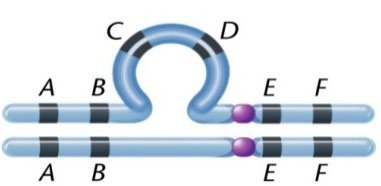
Q4. What type of chromosome rearrangement results in the pairing configuration shown during prophase I of meiosis?
Background
Topic: Chromosome Structure and Rearrangements
This question tests your ability to recognize chromosome rearrangements based on pairing configurations during meiosis.
Key Terms:
Chromosome rearrangement: Structural changes such as duplication, deletion, inversion, or translocation.
Prophase I: Stage of meiosis where homologous chromosomes pair and recombine.
Step-by-Step Guidance
Examine the pairing configuration: Look for loops or unusual structures.
Recall which rearrangement causes a loop structure during pairing.
Match the observed configuration to the correct rearrangement type.
Try solving on your own before revealing the answer!
Final Answer: Inversion
The loop structure is characteristic of an inversion, where a segment of the chromosome is reversed.
Q5. What blood types are possible among the offspring of a couple with blood types AB and A?
Background
Topic: Blood Type Genetics and Codominance
This question tests your understanding of inheritance patterns for ABO blood types, including codominance and dominance relationships.
Key Terms:
Codominance: Both alleles are expressed equally.
Dominance: One allele masks the expression of another.
Genotypes for blood types: IA, IB, i.
Step-by-Step Guidance
List the possible genotypes for each parent: AB (IAIB) and A (IAIA or IAi).
Determine the possible gametes each parent can produce.
Combine the gametes to find all possible offspring genotypes.
Translate genotypes into blood types.
Try solving on your own before revealing the answer!
Final Answer: A, B, and AB only
The possible blood types among the offspring are A, B, and AB. O is not possible unless the A parent is heterozygous (IAi).
Q6. Huntington disease presents earlier and progresses more rapidly when passed from father to children. Which genetic phenomenon is likely operating?
Background
Topic: Genetic Phenomena and Inheritance Patterns
This question tests your understanding of genetic anticipation and parental imprinting.
Key Terms:
Genetic anticipation: Disease appears earlier and more severe in successive generations.
Parental imprinting: Expression depends on whether the allele is inherited from the mother or father.
Step-by-Step Guidance
Identify the key features: earlier onset and rapid progression, especially when inherited from the father.
Recall which genetic phenomena are associated with these features.
Match the description to the correct phenomena.
Try solving on your own before revealing the answer!
Final Answer: Genetic anticipation and parental imprinting
Both genetic anticipation and parental imprinting are likely operating, as they explain the earlier onset and paternal effect.
Q7. In cats, what phenotype would a cat have that is homozygous recessive for the Manx allele?
Background
Topic: Allele Effects and Phenotypes
This question tests your understanding of how different genotypes at the Manx locus affect phenotype.
Key Terms:
Manx allele: Causes abnormal tail development.
Homozygous recessive: Both alleles are the mutant form.
Step-by-Step Guidance
Recall the phenotypes for each genotype: MM (normal tail), MML (no tail), LL (homozygous recessive).
Determine the phenotype for the LL genotype.
Try solving on your own before revealing the answer!
Final Answer: Normal tail
A cat homozygous recessive for the Manx allele (LL) has a normal tail.
Q8. The offspring of a true-breeding black parent and a true-breeding white parent are all gray. When these gray individuals are crossed, their offspring occur in a ratio of 1 black : 2 gray : 1 white. What is the mode of inheritance?
Background
Topic: Modes of Inheritance
This question tests your understanding of incomplete dominance and other inheritance patterns.
Key Terms:
Incomplete dominance: Heterozygotes have an intermediate phenotype.
Codominance: Both alleles are fully expressed.
Step-by-Step Guidance
Analyze the cross: Black x White yields all gray (F1).
F1 x F1 yields 1 black : 2 gray : 1 white (F2).
Determine which mode of inheritance produces this ratio.
Try solving on your own before revealing the answer!
Final Answer: Incomplete dominance
The mode of inheritance is incomplete dominance, where heterozygotes have an intermediate phenotype (gray).
Q9. A person with type B blood could receive a transfusion of blood from someone with blood type:
Background
Topic: Blood Transfusion Compatibility
This question tests your understanding of blood type compatibility for transfusions.
Key Terms:
Blood types: A, B, AB, O.
Antigens and antibodies: Determine compatibility.
Step-by-Step Guidance
Recall which blood types have compatible antigens with type B.
Consider the presence of anti-A antibodies in type B individuals.
List the blood types that can safely donate to type B.
Try solving on your own before revealing the answer!
Final Answer: B & O
A person with type B blood can receive blood from type B and type O donors.
Q10. A person has a particular genotype, but does not show the phenotype specified by that gene. This is an example of:
Background
Topic: Genotype-Phenotype Relationships
This question tests your understanding of penetrance and expressivity.
Key Terms:
Penetrance: The proportion of individuals with a genotype who express the phenotype.
Expressivity: The degree to which a phenotype is expressed.
Step-by-Step Guidance
Recall the definitions of penetrance and expressivity.
Determine which term describes the absence of phenotype despite the genotype.
Try solving on your own before revealing the answer!
Final Answer: Incomplete penetrance
This is an example of incomplete penetrance, where the genotype does not always result in the expected phenotype.
Q11. From the cross Aa Bb cc DD Ee x Aa bb CC Dd Ee, what is the probability for one of the offspring to have the genotype aa Bb Cc DD Ee?
Background
Topic: Probability in Genetics (Multiple Loci)
This question tests your ability to calculate the probability of a specific genotype from a multi-locus cross.
Key Terms and Formulas:
Probability: The likelihood of a specific genotype occurring.
Independent assortment: Each gene segregates independently.
Multiply the probabilities for each locus.
Step-by-Step Guidance
For each locus, determine the probability of getting the desired genotype.
Multiply the probabilities for all loci to get the overall probability.
Set up the calculation for the student to complete.
Try solving on your own before revealing the answer!
Final Answer: 1/32
The probability is 1/32, calculated by multiplying the probabilities for each locus.
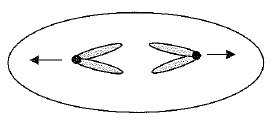
Q12. What process is illustrated in this cell, for a species where 2n=2 and all chromosomes are telocentric?
Background
Topic: Cell Division and Chromosome Structure
This question tests your ability to identify stages of mitosis and meiosis based on chromosome behavior.
Key Terms:
Telocentric chromosome: Centromere at the end.
Anaphase: Chromosomes move to opposite poles.
Step-by-Step Guidance
Examine the diagram for chromosome movement and structure.
Recall the characteristics of anaphase in mitosis and meiosis.
Determine which process matches the diagram.
Try solving on your own before revealing the answer!
Final Answer: Anaphase II of meiosis
The diagram shows anaphase II of meiosis, where sister chromatids are separated.
