 Back
BackStep-by-Step Study Guide for Photosynthesis and Cellular Respiration
Study Guide - Smart Notes
 Tailored notes based on your materials, expanded with key definitions, examples, and context.
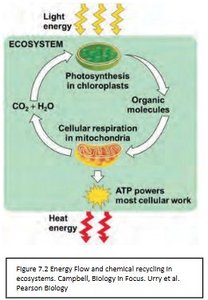
Q1. Below is the equation for photosynthesis. Describe the role of each reactant and product in the equation. Which molecules are oxidized and reduced?
Background
Topic: Photosynthesis Chemical Equation & Redox Reactions
This question tests your understanding of the photosynthesis equation, the function of each reactant and product, and the identification of oxidation and reduction processes.
Key Terms and Formula:
Photosynthesis equation:
Oxidation: Loss of electrons
Reduction: Gain of electrons
Step-by-Step Guidance
Identify the reactants (, ) and products (, ) in the equation.
Consider the source of electrons: Water () is split during the light reactions, releasing electrons.
Determine which molecule is oxidized: The molecule that loses electrons (typically ).
Determine which molecule is reduced: The molecule that gains electrons (typically ).
Explain the role of each reactant and product in the context of energy transformation and cellular processes.
Try solving on your own before revealing the answer!
Final Answer:
In photosynthesis, water () is oxidized to oxygen (), and carbon dioxide () is reduced to glucose (). Water provides electrons, which are transferred to $CO_2$ to form sugar, while oxygen is released as a byproduct.
Q2. How does photosynthesis relate and depend on cellular respiration?
Background
Topic: Interdependence of Photosynthesis and Cellular Respiration
This question explores the relationship between photosynthesis and cellular respiration, focusing on how their products and reactants are interconnected.
Key Terms:
Photosynthesis: Converts light energy to chemical energy (glucose)
Cellular respiration: Breaks down glucose to produce ATP
ATP: Energy currency of the cell
Step-by-Step Guidance
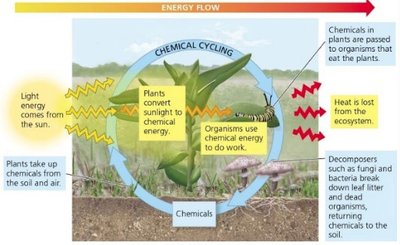
Recall the products of photosynthesis: glucose and oxygen.
Recall the reactants of cellular respiration: glucose and oxygen.
Explain how cellular respiration uses these products to generate ATP.
Describe how the carbon dioxide and water produced by respiration are used as reactants in photosynthesis.
Try solving on your own before revealing the answer!
Final Answer:
Photosynthesis produces glucose and oxygen, which are used in cellular respiration to generate ATP. Cellular respiration releases carbon dioxide and water, which are then used as reactants in photosynthesis, creating a cycle of energy and matter.
Q3. Describe the general structure of a plant cell and chloroplast. Describe the role of the following structures: Stomata, Stroma, Thylakoid/membrane.
Background
Topic: Plant Cell and Chloroplast Structure
This question tests your knowledge of plant cell anatomy and the specific structures involved in photosynthesis.
Key Terms:
Stomata: Pores for gas exchange
Stroma: Fluid-filled space in chloroplast
Thylakoid/membrane: Site of light reactions
Step-by-Step Guidance
Describe the basic structure of a plant cell, including cell wall, membrane, and organelles.
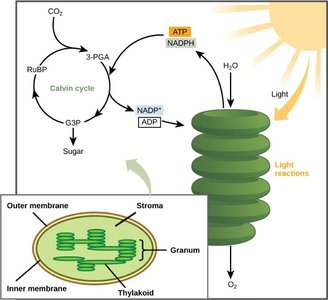
Identify the chloroplast and its main components: outer membrane, inner membrane, stroma, thylakoids, and grana.
Explain the function of stomata in gas exchange (CO₂ in, O₂ out).
Describe the stroma as the site of the Calvin cycle and other metabolic processes.
Discuss the thylakoid membrane as the location of the light-dependent reactions.
Try solving on your own before revealing the answer!
Final Answer:
Stomata allow gas exchange, stroma is the site of the Calvin cycle, and thylakoid membranes host the light reactions. The chloroplast's structure is specialized for efficient photosynthesis.
Q6. What is the primary purpose of the light reactions in photosynthesis? List the major steps of the light reactions in chronological order and the roles of the following components: Chlorophyll a, Photosystem II, Electron transport chain, ATP synthase, NADP⁺ reductase.
Background
Topic: Light Reactions of Photosynthesis
This question focuses on the sequence and function of the light-dependent reactions in photosynthesis.
Key Terms:
Chlorophyll a: Primary pigment for light absorption
Photosystem II: Initiates electron transport
Electron transport chain: Transfers electrons, creates proton gradient
ATP synthase: Produces ATP
NADP⁺ reductase: Forms NADPH
Step-by-Step Guidance
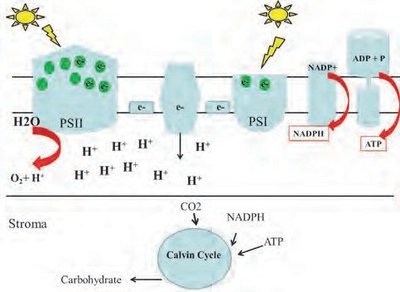
Light is absorbed by chlorophyll a in Photosystem II, exciting electrons.
Electrons are transferred through the electron transport chain, generating a proton gradient across the thylakoid membrane.
ATP synthase uses the proton gradient to synthesize ATP from ADP and inorganic phosphate.
NADP⁺ reductase catalyzes the reduction of NADP⁺ to NADPH using electrons from Photosystem I.
Try solving on your own before revealing the answer!
Final Answer:
The light reactions convert solar energy into chemical energy by producing ATP and NADPH. Chlorophyll a absorbs light, Photosystem II initiates electron flow, the electron transport chain creates a proton gradient, ATP synthase produces ATP, and NADP⁺ reductase forms NADPH.
Q13. How might increasing light intensity affect the rate of the light reactions up to a certain point?
Background
Topic: Light Intensity and Photosynthesis Rate
This question examines how environmental factors, specifically light intensity, influence the rate of photosynthesis.
Key Terms:
Light intensity: Amount of light energy per unit area
Photosynthesis rate: Speed at which photosynthesis occurs
Limiting factors: Factors that restrict the rate of a process
Step-by-Step Guidance
Understand that increasing light intensity increases the energy available for the light reactions.
Recognize that more light allows more electrons to be excited and transferred, increasing ATP and NADPH production.
Identify the point at which other factors (such as CO₂ concentration or temperature) become limiting, causing the rate to plateau.
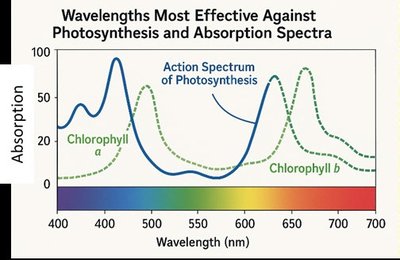
Analyze how the action spectrum of photosynthesis relates to light intensity and wavelength.
Try solving on your own before revealing the answer!
Final Answer:
Increasing light intensity boosts the rate of light reactions up to a saturation point, after which other factors limit further increases. The action spectrum shows which wavelengths are most effective for photosynthesis.
