 Back
BackStep-by-Step Study Guide: Photosynthesis & Cellular Respiration
Study Guide - Smart Notes
 Tailored notes based on your materials, expanded with key definitions, examples, and context.
Q1. Below is the equation for photosynthesis. Describe the role of each reactant and product in the equation. Which molecules are oxidized and reduced?
Background
Topic: Photosynthesis Chemical Equation & Redox Reactions
This question tests your understanding of the photosynthesis equation, the function of each molecule involved, and the concept of oxidation and reduction in biological systems.
Key Terms and Formulas:
Photosynthesis equation:
Oxidation: Loss of electrons
Reduction: Gain of electrons
Step-by-Step Guidance
Identify the reactants (, , light energy) and products (, ) in the equation.
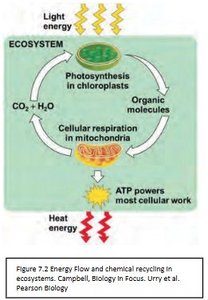
Describe the role of each reactant: provides carbon for sugar, supplies electrons and hydrogen, light energy powers the reaction.
Describe the role of each product: is the energy-rich sugar, is released as a byproduct.
Determine which molecules are oxidized and which are reduced by tracking electron movement: is oxidized to , is reduced to .
Try solving on your own before revealing the answer!
Final Answer:
is reduced to (gains electrons), is oxidized to (loses electrons). Each reactant and product plays a specific role in the transformation of light energy to chemical energy.
Q2. How does photosynthesis relate and depend on cellular respiration?
Background
Topic: Interdependence of Photosynthesis and Cellular Respiration
This question explores the relationship between the two processes and how they cycle energy and matter in living systems.
Key Terms:
Photosynthesis: Converts light energy to chemical energy (glucose)
Cellular respiration: Breaks down glucose to release energy (ATP)
ATP: Main energy currency of the cell
Step-by-Step Guidance
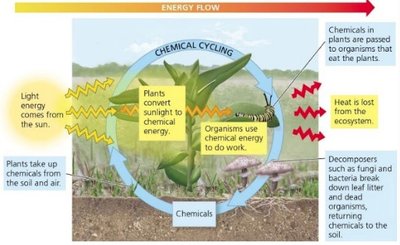
Recall that photosynthesis produces glucose and oxygen, which are used in cellular respiration.
Cellular respiration breaks down glucose, releasing energy as ATP and producing and as byproducts.
Explain how the products of one process are the reactants for the other, forming a cycle.
Discuss how energy flows from sunlight to ATP, and how matter cycles between , , and organic molecules.
Try solving on your own before revealing the answer!
Final Answer:
Photosynthesis and cellular respiration are interdependent: photosynthesis provides the glucose and oxygen needed for cellular respiration, while cellular respiration returns and to the environment for photosynthesis. This forms a cycle of energy and matter in ecosystems.
Q6. What is the primary purpose of the light reactions in photosynthesis? List the major steps of the light reactions in chronological order and the roles of the following components: a. Chlorophyll a b. Photosystem II c. Electron transport chain d. ATP synthase e. NADP⁺ reductase
Background
Topic: Light Reactions of Photosynthesis
This question tests your knowledge of the light-dependent reactions, their purpose, and the function of key components in the process.
Key Terms and Formulas:
Light reactions: Convert solar energy to chemical energy (ATP, NADPH)
Chlorophyll a: Main pigment absorbing light
Photosystem II (PSII): Initiates electron transport
Electron transport chain (ETC): Transfers electrons, pumps protons
ATP synthase: Produces ATP from ADP and
NADP⁺ reductase: Reduces NADP⁺ to NADPH
Step-by-Step Guidance
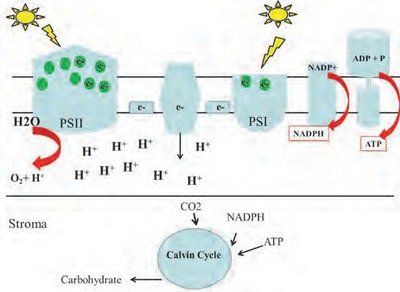
Light is absorbed by chlorophyll a in Photosystem II, exciting electrons.
Electrons are transferred from PSII to the electron transport chain, creating a proton gradient across the thylakoid membrane.
ATP synthase uses the proton gradient to synthesize ATP from ADP and .
NADP⁺ reductase receives electrons at the end of the chain and reduces NADP⁺ to NADPH.
Try solving on your own before revealing the answer!
Final Answer:
The light reactions produce ATP and NADPH, which are used in the Calvin cycle. The steps involve light absorption, electron transport, ATP synthesis, and NADPH formation.
Q13. How might increasing light intensity affect the rate of the light reactions up to a certain point?
Background
Topic: Factors Affecting Photosynthesis
This question examines how environmental factors, specifically light intensity, influence the rate of the light-dependent reactions.
Key Terms:
Light intensity: Amount of light energy available
Rate of light reactions: Speed at which ATP and NADPH are produced
Saturation point: Maximum rate beyond which increases in light do not increase reaction rate
Step-by-Step Guidance
Consider how increasing light intensity provides more energy for chlorophyll to absorb, boosting electron excitation.
As light intensity rises, the rate of ATP and NADPH production increases, up to a certain limit.
At high light intensities, other factors (such as enzyme activity or CO₂ availability) may become limiting, causing the rate to plateau.
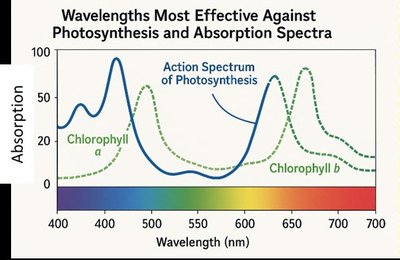
Analyze the action spectrum of photosynthesis to see which wavelengths are most effective for increasing the rate.
Try solving on your own before revealing the answer!
Final Answer:
Increasing light intensity increases the rate of light reactions until a saturation point is reached, after which the rate levels off due to other limiting factors.
Q21. What is the primary purpose of the Calvin cycle in photosynthesis?
Background
Topic: Calvin Cycle (Light-Independent Reactions)
This question focuses on the role of the Calvin cycle in converting chemical energy into organic molecules.
Key Terms:
Calvin cycle: Series of reactions that fix carbon dioxide into sugar
ATP and NADPH: Energy carriers produced in light reactions
CO₂ fixation: Incorporation of carbon dioxide into organic molecules
Step-by-Step Guidance
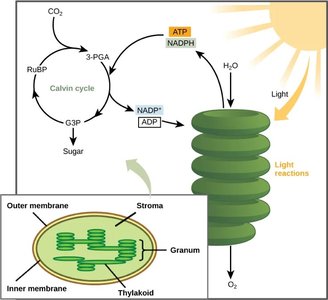
Recall that the Calvin cycle uses ATP and NADPH from the light reactions to drive the synthesis of glucose from CO₂.
Describe how CO₂ is fixed by the enzyme RuBisCO and incorporated into 3-PGA.
Explain how ATP and NADPH are used to convert 3-PGA into G3P, a precursor to glucose.
Discuss the regeneration of RuBP to allow the cycle to continue.
Try solving on your own before revealing the answer!
Final Answer:
The Calvin cycle's primary purpose is to fix carbon dioxide and produce sugar using ATP and NADPH from the light reactions.
