 Back
Structure and Function of Large Biological Molecules
Study Guide - Smart Notes
 Tailored notes based on your materials, expanded with key definitions, examples, and context.
Chapter 5: Structure & Function of Large Biological Molecules
5.1: Macromolecules and Polymers
Large biological molecules, or macromolecules, are essential for life and include carbohydrates, proteins, and nucleic acids. These macromolecules are polymers, which are long chains made from repeating units called monomers. Lipids, while biologically important, are not true polymers due to their smaller size and non-repetitive structure.
Polymer: A long molecule consisting of many similar or identical building blocks (monomers) linked by covalent bonds.
Monomer: The repeating unit that serves as the building block of a polymer.
Enzymes: Specialized macromolecules that speed up chemical reactions, including those that build or break down polymers.
Synthesis and Breakdown of Polymers
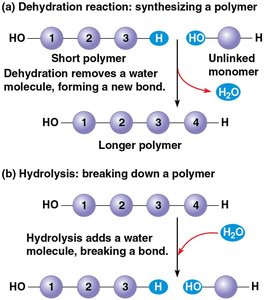
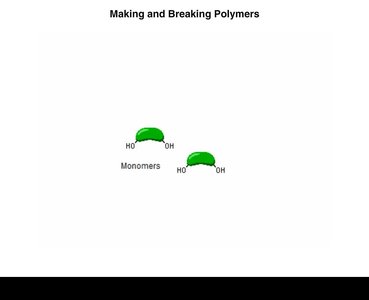
Dehydration Reaction: Two monomers are covalently bonded to each other with the removal of a water molecule, forming a polymer.
Hydrolysis: Polymers are disassembled into monomers by the addition of a water molecule, breaking the bond.
5.2: Carbohydrates
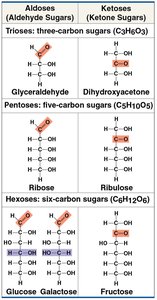
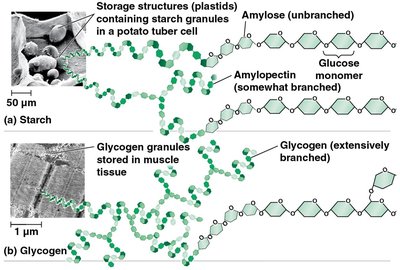
Carbohydrates are sugars and polymers of sugars. They serve as fuel and building material for cells. The simplest carbohydrates are monosaccharides (simple sugars), while carbohydrate macromolecules are polysaccharides (polymers of sugars).
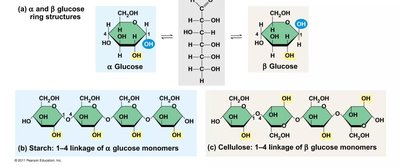
Monosaccharides: Simple sugars (e.g., glucose, fructose) that are the monomers of carbohydrates.
Disaccharides: Consist of two monosaccharides joined by a glycosidic linkage (e.g., sucrose).
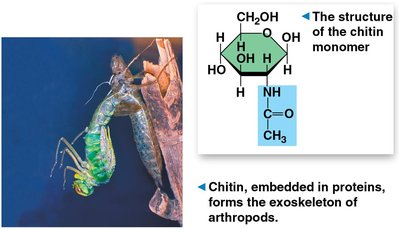
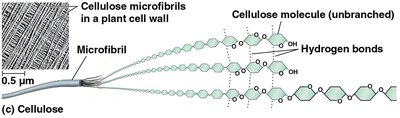
Polysaccharides: Polymers composed of many sugar building blocks (e.g., starch, glycogen, cellulose, chitin).
Major Polysaccharides and Their Functions
Polymer Name | Type | Examples | Functions |
|---|---|---|---|
Monosaccharide | Simple sugar | Glucose | Energy source |
Polysaccharide | Storage | Glycogen (animals), Starch (plants) | Storage of glucose |
Polysaccharide | Structural | Cellulose (plants), Chitin (arthropods) | Structural support |
5.3: Lipids
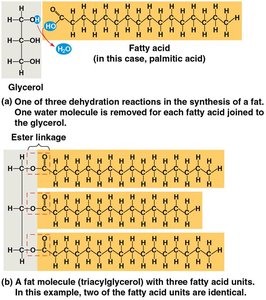
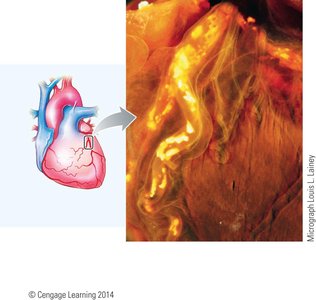
Lipids are a diverse group of hydrophobic molecules that include fats, phospholipids, and steroids. They are not true polymers but are crucial for energy storage, membrane structure, and signaling.
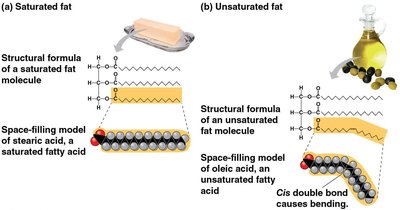
Fats: Constructed from glycerol and fatty acids. Used for long-term energy storage.
Saturated Fatty Acids: No double bonds; solid at room temperature (e.g., butter).
Unsaturated Fatty Acids: One or more double bonds; liquid at room temperature (e.g., oils).
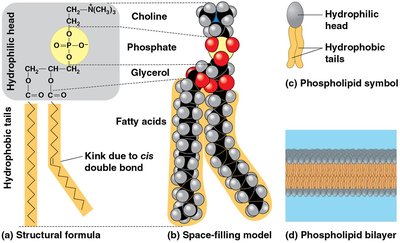
Phospholipids: Major component of cell membranes, with hydrophilic heads and hydrophobic tails.
Steroids: Lipids with a carbon skeleton consisting of four fused rings (e.g., cholesterol).

5.4: Proteins
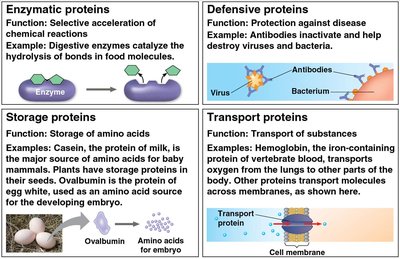
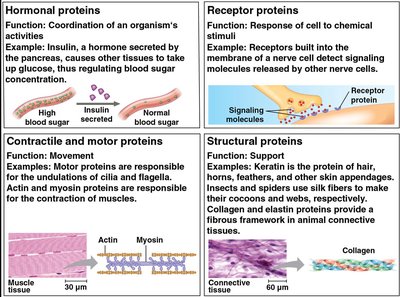
Proteins are polymers of amino acids and account for more than 50% of the dry mass of most cells. They perform a vast array of functions, including catalysis, defense, storage, transport, communication, movement, and structural support.
Monomer: Amino acid
Polymer: Polypeptide (protein)
Peptide Bond: Covalent bond linking amino acids in a protein
Protein Type | Examples | Functions |
|---|---|---|
Enzymes | Digestive enzymes | Catalyze chemical reactions |
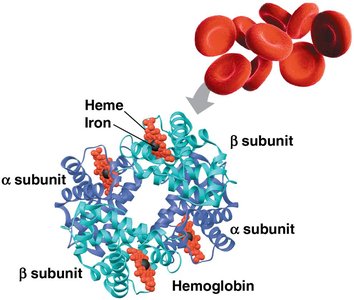
Transport | Hemoglobin | Transport substances |
Receptors | Cell surface receptors | Relay signals |
Motor proteins | Actin, myosin | Movement |
Structural proteins | Collagen, keratin | Support |
Levels of Protein Structure
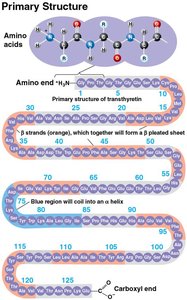
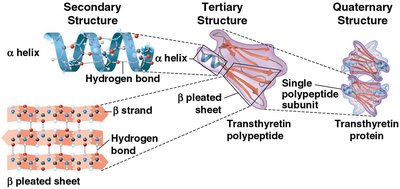
Primary Structure: Unique sequence of amino acids in a protein.
Secondary Structure: Coils and folds (α-helix, β-pleated sheet) due to hydrogen bonding.
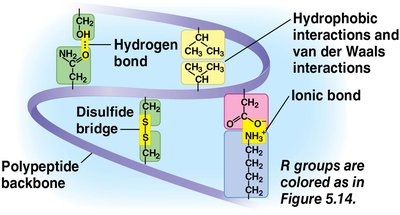
Tertiary Structure: Overall 3D shape due to interactions among R groups.
Quaternary Structure: Association of multiple polypeptide chains.

Sickle-Cell Disease: A Change in Primary Structure
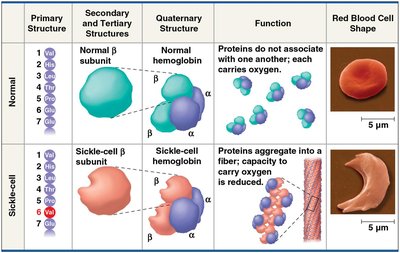
A single amino acid substitution in the protein hemoglobin leads to sickle-cell disease, an inherited blood disorder. This change alters the protein's structure and function, causing red blood cells to deform and aggregate.
5.5: Nucleic Acids
Nucleic acids store, transmit, and help express hereditary information. The two types are DNA (deoxyribonucleic acid) and RNA (ribonucleic acid). Genes, made of DNA, program the amino acid sequence of polypeptides.
Monomer: Nucleotide (composed of a sugar, phosphate group, and nitrogenous base)
DNA: Stores hereditary information
RNA: Functions in gene expression and protein synthesis
Polymer Name | Monomer | Examples | Functions |
|---|---|---|---|
DNA | Nucleotides (A, T, C, G) | Genomic DNA | Store hereditary info |
RNA | Nucleotides (A, U, C, G) | mRNA, tRNA, rRNA | Gene expression, protein synthesis |
