 Back
Structure and Function of Large Biological Molecules
Study Guide - Smart Notes
 Tailored notes based on your materials, expanded with key definitions, examples, and context.
Structure and Function of Large Biological Molecules
Introduction to Biological Macromolecules
Biological macromolecules are large, complex molecules essential for life. Their diversity and function arise from the unique properties of carbon, which forms the backbone of these molecules. The four major classes of macromolecules are carbohydrates, proteins, nucleic acids, and lipids. Each class plays a distinct role in cellular structure and function.
Molecular Diversity Due to Carbon
Properties of Carbon
Carbon atoms can form four covalent bonds, allowing for a variety of stable structures, including chains and rings. This versatility enables the formation of large and complex molecules, known as macromolecules. Along with carbon, nitrogen is crucial for building proteins and nucleic acids, while phosphorus is important for nucleic acids and some lipids.
Classes of Macromolecules
Carbohydrates
Proteins
Nucleic acids
Lipids (do not form true polymers and are hydrophobic)
Formation and Breakdown of Macromolecules
Polymers and Monomers
Polymers are long chains of repeating units called monomers, covalently bonded together. The formation of polymers occurs through dehydration reactions, where a water molecule is removed as two monomers join. Conversely, hydrolysis reactions break polymers into monomers by adding water.
Dehydration reaction:
Hydrolysis reaction:
Carbohydrates
Structure and Types
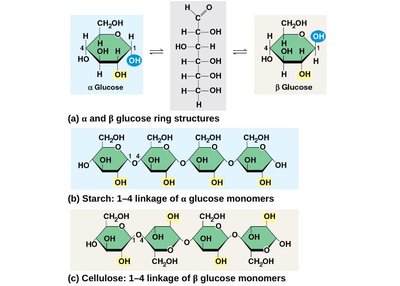
Carbohydrates include sugars and their polymers. They contain a carbonyl group and multiple hydroxyl groups, and are composed of carbon, hydrogen, and oxygen (C, H, O). The simplest carbohydrates are monosaccharides (simple sugars), with the general formula .
Monosaccharides: Serve as nutrients and building blocks for other molecules. Example: glucose.
Disaccharides: Two monosaccharides joined by a glycosidic linkage. Example: sucrose (glucose + fructose).
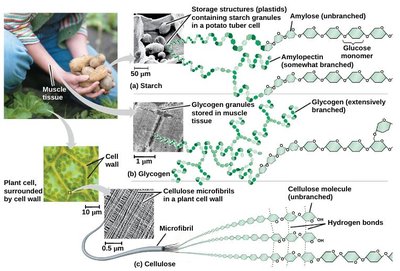
Polysaccharides: Polymers of many sugars joined by dehydration reactions. They serve as storage (starch in plants, glycogen in animals) or structural components (cellulose in plants, chitin in arthropods).
Examples and Applications
Starch: Storage form of glucose in plants.
Glycogen: Storage form of glucose in animals (liver and muscle cells).
Cellulose: Structural component of plant cell walls.
Chitin: Structural component in arthropod exoskeletons.
Proteins
Structure and Function
Proteins are polymers of amino acids, folded into specific three-dimensional shapes that determine their function. They are composed of carbon, hydrogen, oxygen, nitrogen, and sometimes sulfur. Proteins perform a wide range of functions, including catalysis (enzymes), structure, transport, signaling, and defense.
Amino Acids and Peptide Bonds
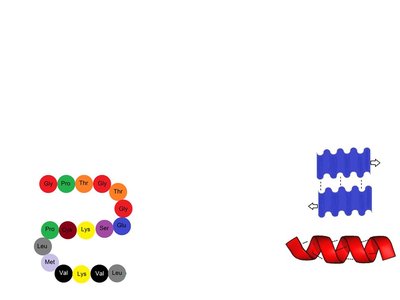
Amino acids have a central carbon atom bonded to an amino group, a carboxyl group, a hydrogen atom, and a variable side chain (R group). There are 20 different amino acids, classified by the properties of their side chains (nonpolar, polar, or charged). Peptide bonds form between the carboxyl group of one amino acid and the amino group of another via a dehydration reaction, creating a polypeptide chain.
Levels of Protein Structure
Primary structure: Linear sequence of amino acids, determined by genes.
Secondary structure: Coils and folds (alpha helix, beta pleated sheet) due to hydrogen bonding.
Tertiary structure: 3D folding due to interactions between side chains (hydrophobic interactions, disulfide bridges).
Quaternary structure: Association of two or more polypeptides (only in some proteins).
Note: The unique sequence of amino acids (primary structure) determines the higher levels of structure and ultimately the protein's function.
Functions of Proteins
Antibodies: Protect the body from disease.
Enzymes: Catalyze chemical reactions.
Messengers: Transmit signals (e.g., hormones).
Structural proteins: Provide support and shape.
Transport/storage proteins: Carry molecules throughout the body.
Nucleic Acids
Structure and Function
Nucleic acids are polymers of nucleotide monomers. They store, transmit, and express hereditary information. The two main types are deoxyribonucleic acid (DNA) and ribonucleic acid (RNA).
Nucleotide Structure
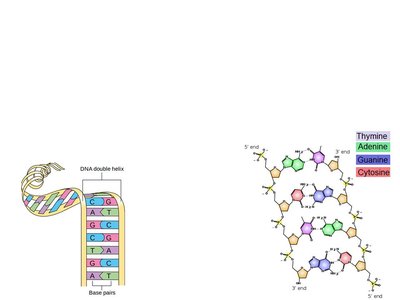
Nitrogenous base: Pyrimidines (cytosine, thymine, uracil) and purines (adenine, guanine).
Five-carbon sugar: Deoxyribose in DNA, ribose in RNA.
Phosphate group: Attached to the 5' carbon of the sugar.
Polynucleotides and DNA Structure
Nucleotides are joined by phosphodiester linkages, forming a sugar-phosphate backbone with directionality (5' to 3'). DNA consists of two antiparallel polynucleotide strands forming a double helix, held together by hydrogen bonds between complementary bases (A-T, C-G). RNA is typically single-stranded and can fold into various shapes due to internal base pairing.
Lipids
Structure and Types
Lipids are a diverse group of hydrophobic molecules that do not form true polymers. They are generally small and include fats, phospholipids, and steroids. Lipids are composed mainly of carbon, hydrogen, and oxygen (with phosphorus in phospholipids).
Fats
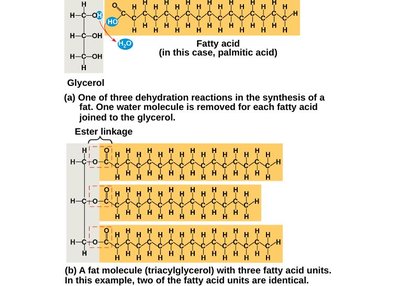
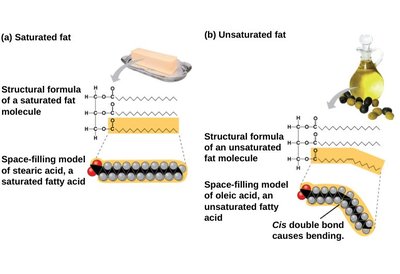
Fats are constructed from glycerol (an alcohol) and fatty acids (long hydrocarbon chains with a carboxyl group). Three fatty acids join to glycerol via ester linkages, forming a triglyceride. Fats are classified as:
Saturated fatty acids: No double bonds; solid at room temperature.
Unsaturated fatty acids: One or more double bonds; liquid at room temperature.
Phospholipids
Phospholipids consist of two fatty acids and a phosphate group attached to glycerol. They are major components of cell membranes, forming bilayers with hydrophobic tails and hydrophilic heads.
Steroids
Steroids are lipids with four fused rings. Different functional groups attached to the rings determine the type of steroid (e.g., cholesterol, testosterone).
Summary Table: Biological Macromolecules
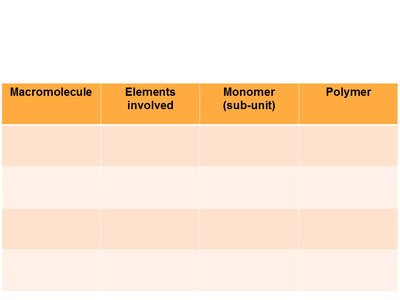
Macromolecule | Elements involved | Monomer (sub-unit) | Polymer |
|---|---|---|---|
Carbohydrates | Carbon, hydrogen, oxygen | Monosaccharide | Polysaccharide |
Proteins | Carbon, hydrogen, oxygen, nitrogen, sulfur | Amino acids | Polypeptides |
Lipids | Carbon, hydrogen, oxygen (phosphorus for phospholipids) | Glycerol and fatty acids | Does not contain true polymers |
Nucleic Acids | Carbon, hydrogen, oxygen, nitrogen, phosphorus | Nucleotides | DNA, RNA |
Additional info: This guide covers the core concepts from Chapter 5: The Structure and Function of Large Biological Molecules, including the chemical properties of carbon, the formation and breakdown of macromolecules, and the structure and function of carbohydrates, proteins, nucleic acids, and lipids. The included images reinforce key structural and functional aspects of these macromolecules.
