Back
Structure and Function of Large Biological Molecules
Study Guide - Smart Notes
 Tailored notes based on your materials, expanded with key definitions, examples, and context.
Structure and Function of Large Biological Molecules
Introduction to Biological Macromolecules
Biological macromolecules are large, complex molecules essential for life. They include carbohydrates, proteins, nucleic acids, and lipids. These molecules are primarily composed of carbon, hydrogen, oxygen, nitrogen, phosphorus, and sulfur, and their diverse structures allow for a wide range of biological functions.
Molecular Diversity Due to Carbon
Properties of Carbon
Carbon is a unique element that forms the backbone of biological macromolecules due to its ability to form four covalent bonds, allowing for a variety of stable structures such as chains, rings, and branches. This versatility leads to molecular diversity in living organisms.
Macromolecules: Large molecules made from smaller subunits.
Four main classes: Carbohydrates, Proteins, Nucleic Acids, Lipids.
Nitrogen is essential for proteins and nucleic acids; phosphorus is important for nucleic acids and some lipids.
Formation and Breakdown of Macromolecules
Polymers and Monomers
Most macromolecules (except lipids) are polymers, which are long chains of repeating units called monomers. The formation and breakdown of these polymers involve specific chemical reactions:
Dehydration Reaction: Joins two monomers by removing a water molecule ().
Hydrolysis Reaction: Breaks a polymer into monomers by adding water.
Carbohydrates
Structure and Types
Carbohydrates are sugars and polymers of sugars, containing carbon, hydrogen, and oxygen. They serve as energy sources and structural materials in cells.
Monosaccharides: Simple sugars (e.g., glucose, C6H12O6), basic energy source for cells.
Disaccharides: Two monosaccharides joined by a glycosidic linkage (e.g., sucrose = glucose + fructose).
Polysaccharides: Long chains of monosaccharides; can be storage (starch in plants, glycogen in animals) or structural (cellulose in plants, chitin in arthropods).
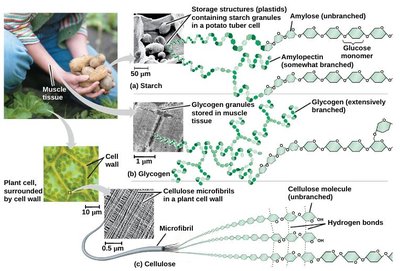
Example: Starch and glycogen are both polymers of glucose but differ in branching and storage location. Cellulose provides structural support in plant cell walls.
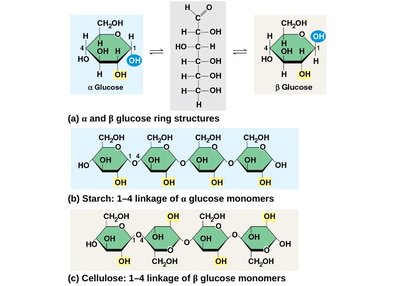
Additional info: The difference between alpha and beta glucose leads to different polysaccharide structures and functions.
Proteins
Structure and Function
Proteins are polymers of amino acids, folded into specific three-dimensional shapes that determine their function. They are composed of carbon, hydrogen, oxygen, nitrogen, and sometimes sulfur.
Amino Acids: 20 different types, each with a unique side chain (R group) that determines its properties (nonpolar, polar, or charged).
Peptide Bonds: Link amino acids via dehydration reactions, forming polypeptides.
Polypeptides: Chains of amino acids with directionality (N-terminus and C-terminus).
Protein Function: Includes enzymes, antibodies, messengers (hormones), structural support, and transport/storage.
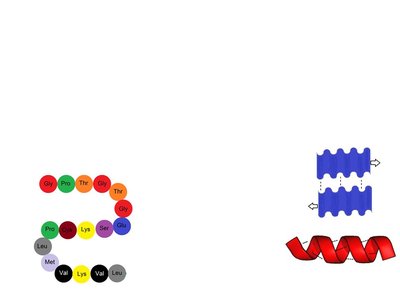
Levels of Protein Structure:
Primary: Sequence of amino acids.
Secondary: Coils and folds (alpha helix, beta sheet) due to hydrogen bonding.
Tertiary: 3D folding from side chain interactions (hydrophobic interactions, disulfide bridges).
Quaternary: Association of multiple polypeptides (only in some proteins).
Example: The deletion of nucleotides in the CFTR gene alters the primary structure of the protein, leading to cystic fibrosis due to improper folding and function.
Nucleic Acids
Structure and Function
Nucleic acids are polymers of nucleotides and are responsible for storing, transmitting, and expressing hereditary information. The two main types are DNA and RNA.
Nucleotide Structure: Each nucleotide consists of a nitrogenous base (purine or pyrimidine), a five-carbon sugar (deoxyribose in DNA, ribose in RNA), and a phosphate group.
Polynucleotides: Nucleotides are linked by phosphodiester bonds, forming a sugar-phosphate backbone with directionality (5' to 3').
DNA: Double-stranded helix, antiparallel strands, base pairing (A-T, C-G).
RNA: Single-stranded, variable shapes, base pairing (A-U, C-G).
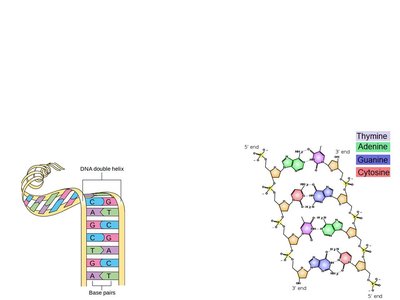
Example: The sequence of bases in DNA determines the sequence of amino acids in proteins, which in turn determines protein structure and function.
Lipids
Structure and Types
Lipids are a diverse group of hydrophobic molecules that do not form true polymers. They are generally small and include fats, phospholipids, and steroids.
Fats: Composed of glycerol and three fatty acids joined by ester linkages. Can be saturated (no double bonds, solid at room temperature) or unsaturated (one or more double bonds, liquid at room temperature).
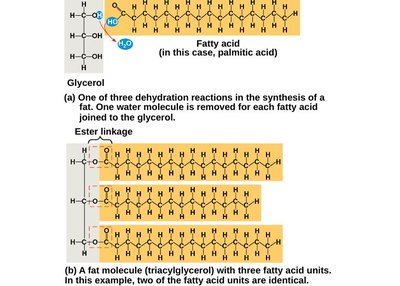
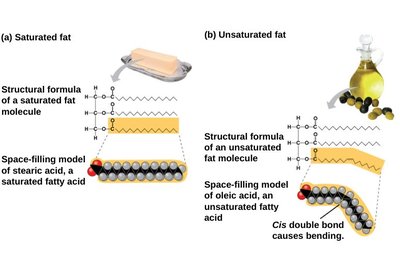
Phospholipids: Two fatty acids and a phosphate group attached to glycerol; major component of cell membranes, forming bilayers with hydrophobic tails and hydrophilic heads.
Steroids: Lipids with four fused rings; different functional groups attached to the rings determine the type of steroid (e.g., cholesterol, testosterone).
Summary Table: Biological Macromolecules
Macromolecule | Elements involved | Monomer (sub-unit) | Polymer |
|---|---|---|---|
Carbohydrates | Carbon, hydrogen, oxygen | Monosaccharide | Polysaccharide |
Proteins | Carbon, hydrogen, oxygen, nitrogen, sulfur | Amino acids | Polypeptides |
Lipids | Carbon, hydrogen, oxygen (phosphorus for phospholipids) | Glycerol and fatty acids | Does not contain true polymers |
Nucleic Acids | Carbon, hydrogen, oxygen, nitrogen, phosphorus | Nucleotides | DNA, RNA |