 Back
Structure and Function of Large Biological Molecules
Study Guide - Smart Notes
 Tailored notes based on your materials, expanded with key definitions, examples, and context.
Overview: The Molecules of Life
Macromolecules
Macromolecules are large, complex molecules essential for life, including carbohydrates, lipids, proteins, and nucleic acids. Their structure and function are determined by the unique bonds and arrangements of their monomeric units.
Carbohydrates: Serve as fuel and building material.
Lipids: Hydrophobic molecules important for energy storage and membrane structure.
Proteins: Diverse functions including catalysis, structure, transport, and signaling.
Nucleic Acids: Store and transmit genetic information.
Concept 5.1: Macromolecules are Polymers, Built from Monomers
Polymers and Monomers
Most macromolecules are polymers, long chains made from repeating monomers. Three of the four major macromolecules—carbohydrates, proteins, and nucleic acids—are polymers.
Polymer: Long molecule consisting of many similar or identical monomers.
Monomer: Small building block molecule.
Synthesis and Breakdown of Polymers
Polymers are assembled and disassembled by specific chemical reactions:
Dehydration Reaction: Joins two monomers by removing a water molecule, forming a new bond.
Hydrolysis: Breaks a bond in a polymer by adding a water molecule, releasing monomers.
Enzymes: Biological catalysts that speed up these reactions.
Concept 5.2: Carbohydrates Serve as Fuel and Building Material
Carbohydrate Structure
Carbohydrates are classified by their size and complexity:
Monosaccharides: Simple sugars (e.g., glucose, C6H12O6), molecular formula is a multiple of CH2O.
Disaccharides: Two monosaccharides joined by a glycosidic linkage (e.g., lactose, maltose, sucrose).
Polysaccharides: Long chains of monosaccharides (e.g., starch, glycogen, cellulose, chitin).
Monosaccharide Function
Fuel: Primary energy source for cells.
Building Block: Used to construct more complex carbohydrates.
Ring Formation: Monosaccharides often form rings in aqueous solutions.
Disaccharides: Structure and Function
Structure: Two monosaccharides joined by glycosidic linkage.
Function: Serve as fuel and building blocks for larger molecules.
Polysaccharides
Starch: Storage polysaccharide in plants, composed of α glucose monomers.
Glycogen: Storage polysaccharide in animals, stored in liver and muscle cells.
Cellulose: Structural polysaccharide in plant cell walls, composed of β glucose monomers.
Chitin: Structural polysaccharide in arthropod exoskeletons and fungal cell walls.
Alpha and Beta Glucose
Polymers with α glucose are helical (e.g., starch).
Polymers with β glucose are straight and form hydrogen bonds (e.g., cellulose).
Digestion of Starch and Cellulose
Animals can digest starch (enzymes hydrolyze α linkages).
Animals cannot digest cellulose (lack enzymes for β linkages); cellulose acts as insoluble fiber.
Some microbes can digest cellulose.
Concept 5.3: Lipids are a Diverse Group of Hydrophobic Molecules
Lipid Structure and Types
Lipids are hydrophobic molecules that do not form polymers. They consist mostly of hydrocarbons and are important for energy storage and membrane structure.
Fats: Composed of glycerol and three fatty acids, joined by ester linkages (triacylglycerol).
Phospholipids: Glycerol, two fatty acids, and a phosphate group; form bilayers in cell membranes.
Steroids: Four fused rings; include cholesterol and hormones.
Saturated vs. Unsaturated Fatty Acids
Saturated Fatty Acids: No double bonds, solid at room temperature, found in animal fats.
Unsaturated Fatty Acids: One or more double bonds (cis), liquid at room temperature, found in plant and fish fats.
Trans Fats: Created by hydrogenation, contain trans double bonds.
Essential Fatty Acids: Not synthesized by the body, must be obtained from diet (e.g., omega-3 fatty acids).
Functions of Lipids
Energy Storage: Fats store energy efficiently.
Insulation and Cushioning: Protect organs and maintain body temperature.
Cell Membranes: Phospholipids form the structural basis of membranes.
Hormones: Steroids act as signaling molecules.
Concept 5.4: Proteins Include a Diversity of Structures, Resulting in a Wide Range of Functions
Protein Functions
Proteins are the most versatile macromolecules, performing a wide range of functions:
Enzymatic: Catalyze biochemical reactions.
Defense: Immune response.
Storage: Store amino acids.
Transport: Move substances across membranes.
Hormonal: Coordinate activities.
Receptor: Respond to signals.
Contractile: Movement.
Structural: Support and shape cells and tissues.
Protein Structure Vocabulary
Protein: Functional molecule made of one or more polypeptides.
Polypeptide: Polymer of amino acids.
Amino Acid: Organic molecule with carboxyl and amino groups, plus a unique R group.
Amino Acid Structure
20 different amino acids, each with a unique R group.
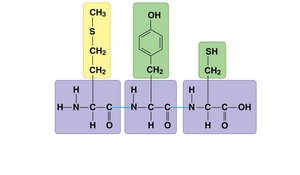
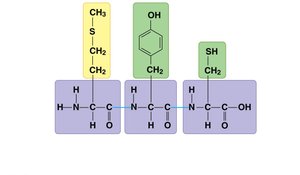
Amino acids are linked by peptide bonds between carboxyl and amino termini.
Levels of Protein Structure
Primary Structure: Unique sequence of amino acids, determined by genetic information.
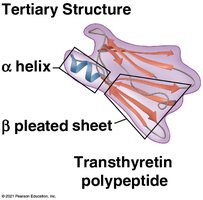
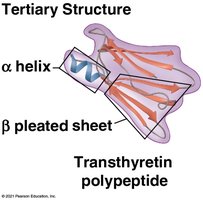
Secondary Structure: Coiling (α helix) or folding (β pleated sheet) due to hydrogen bonds in the backbone.
Tertiary Structure: Overall 3D shape, determined by interactions among R groups (hydrogen bonds, ionic bonds, hydrophobic interactions, van der Waals forces, disulfide bridges).
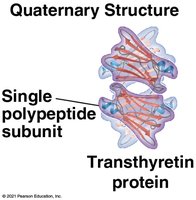
Quaternary Structure: Association of multiple polypeptide chains into a functional protein.

Sickle-Cell Disease: A Change in Primary Structure
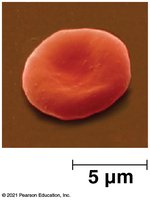
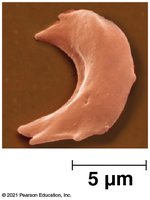
A single amino acid change in the primary structure of hemoglobin leads to sickle-cell disease, altering the protein's function and shape.
Factors Affecting Protein Structure
Environmental Factors: pH, salt concentration, temperature can cause denaturation (loss of native structure and function).
Concept 5.5: Nucleic Acids Store, Transmit, and Help Express Hereditary Information
The Roles of Nucleic Acids
DNA (Deoxyribonucleic Acid): Stores genetic information, directs its own replication, and guides synthesis of messenger RNA (mRNA).
RNA (Ribonucleic Acid): Controls protein synthesis, forms part of ribosomes.
Structure of Nucleic Acids
Nucleotide: Monomer consisting of a nitrogenous base, pentose sugar, and one or more phosphate groups.
Phosphodiester Bond: Links nucleotides into a chain.
Base Pairing: Specific hydrogen bonding between bases.
Nitrogenous Bases and Sugars
Pyrimidines: Cytosine, Thymine (DNA), Uracil (RNA).
Purines: Adenine, Guanine.
Sugar: DNA contains deoxyribose; RNA contains ribose.
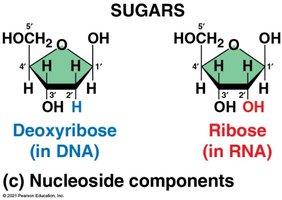
Nucleotide Polymers
Nucleotides are linked by phosphodiester bonds, forming a sugar-phosphate backbone with nitrogenous base appendages.
Structures of DNA and RNA Molecules
RNA: Usually single-stranded.
DNA: Double-stranded, forms a double helix, strands are antiparallel.
One DNA molecule contains many genes.
Base Pairing Rules
In DNA: Adenine (A) pairs with Thymine (T); Guanine (G) pairs with Cytosine (C).
In RNA: Adenine (A) pairs with Uracil (U).
Concept 5.6: Genomics and Proteomics Have Transformed Biological Inquiry and Applications
Genomics and Proteomics
Genomics: Study and analysis of large sets of genes or entire genomes.
Proteomics: Study and analysis of large sets of proteins.
Bioinformatics: Computer-aided analysis of biological data.
DNA and Proteins as Tape Measures of Evolution
DNA and protein sequences document hereditary relationships and evolutionary history.
Example: DNA sequencing techniques have enabled the reconstruction of ancestral genetic codes and the study of evolutionary relationships.
