 Back
Structure and Function of Macromolecules: General Biology Study Notes
Study Guide - Smart Notes
 Tailored notes based on your materials, expanded with key definitions, examples, and context.
Structure and Function of Macromolecules
Introduction to Macromolecules
Macromolecules are large, complex molecules essential for life, composed of smaller subunits called monomers. The four main categories of organic macromolecules are carbohydrates, lipids, proteins, and nucleic acids. These molecules are fundamental to cellular structure and function.
Polymer: A molecule made of many identical subunits (monomers) linked together.
Monomer: The individual subunit that makes up a polymer.
Examples: DNA, RNA, proteins, sugars, fats.
Polymer Formation and Breakdown
Polymers are synthesized and broken down by specific chemical reactions.
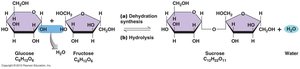
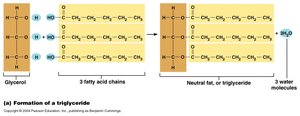
Condensation (Dehydration Synthesis): Monomers are joined together, releasing water. Requires energy and enzymes.
Hydrolysis: Polymers are broken down into monomers by adding water. This process is essential for digestion.
Carbohydrates
Structure and Function
Carbohydrates serve as energy sources and structural materials. They are classified based on the number of sugar units.
Monosaccharides: Simple sugars (e.g., glucose), usually form ring structures in nature.
Disaccharides: Two monosaccharides joined by condensation (e.g., sucrose).
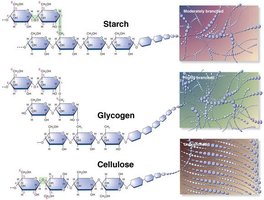
Polysaccharides: Long chains of monosaccharides, used for energy storage and structural support.
Polysaccharides: Storage and Structure
Polysaccharides are specialized for either storage or structural functions.
Starch: Glucose polymer in plants, stored in grains and potatoes.
Glycogen: Glucose polymer in animals, highly branched, stored in muscle and liver.
Cellulose: Structural component of plant cell walls; most animals cannot digest it.
Chitin: Structural component in exoskeletons of arthropods and cell walls of fungi.
Lipids
Types and Functions
Lipids are hydrophobic molecules that include fats, phospholipids, steroids, and waxes. They are insoluble in water and serve as energy storage, insulation, and structural components.
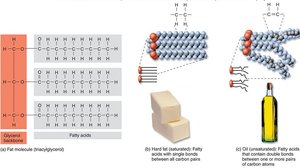
Fats (Triglycerides): Composed of glycerol and three fatty acids. Provide long-term energy storage, cushion organs, and insulate against heat loss.
Saturated and Unsaturated Fats
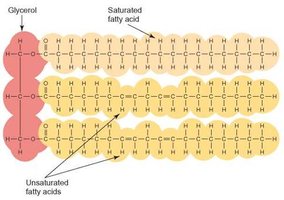
The physical properties of fats depend on the presence of double bonds in their fatty acid tails.
Saturated Fats: No double bonds; solid at room temperature; most animal fats.
Unsaturated Fats: One or more double bonds; liquid at room temperature; plant oils.
Phospholipids
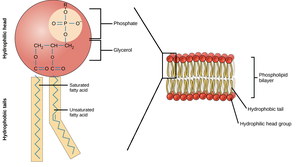
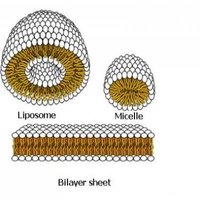
Phospholipids are major components of cell membranes. Their amphipathic nature allows them to form bilayers in aqueous environments.
Structure: Glycerol backbone, two fatty acid tails (hydrophobic), and a phosphate group (hydrophilic).
Function: Form micelles and bilayers, crucial for membrane structure.
Steroids
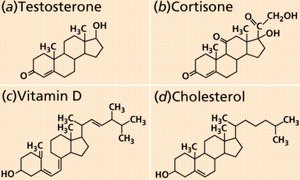
Steroids are lipids characterized by four fused rings.
Cholesterol: Found in animal cell membranes; precursor to sex steroids and other hormones.
Proteins
Structure and Function
Proteins are polymers of amino acids, folded into specific shapes for diverse functions.
Polypeptide: A polymer of amino acids.
Protein: One or more polypeptide chains folded into a specific conformation.
Functions: Structural support, transport, signaling, receptors, enzymes, movement, immunity.
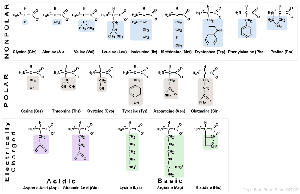
Protein Structure Levels
Protein structure is organized into four hierarchical levels:
Primary Structure: Linear sequence of amino acids, determined by DNA. Mutations can affect conformation.
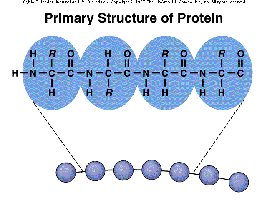
Secondary Structure: Coiling or folding of the polypeptide chain (e.g., alpha helix, beta sheet).
Tertiary Structure: Three-dimensional shape due to R group interactions, stabilized by ionic, hydrogen, hydrophobic, and covalent (disulfide) bonds.
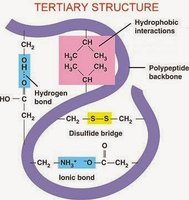
Quaternary Structure: Interactions between multiple polypeptide chains.
Protein Denaturation and Renaturation
Proteins can lose their functional shape (denature) if exposed to extreme temperature or pH.
Denaturation: Disruption of tertiary and secondary structure; reversible unless peptide bonds are broken.
Renaturation: Restoration of normal conditions can allow proteins to regain their shape.
Nucleic Acids
Structure and Types
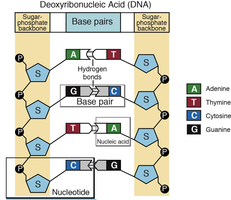
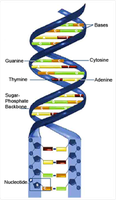
Nucleic acids are polymers of nucleotides, essential for genetic information storage and transfer.
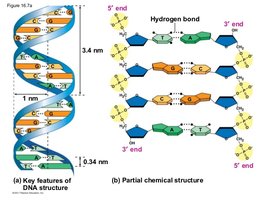
DNA (Deoxyribonucleic Acid): Contains deoxyribose sugar; double-stranded; bases are G, C, A, T.
RNA (Ribonucleic Acid): Contains ribose sugar; single-stranded; bases are G, C, A, U.
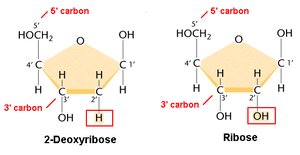
Nitrogenous Bases
Nitrogenous bases are classified as pyrimidines (single ring) or purines (two rings).
Pyrimidines: Cytosine (C), Thymine (T, only in DNA), Uracil (U, only in RNA).
Purines: Adenine (A), Guanine (G).
Base Pairing: Bases are held together by hydrogen bonds.
Comparing DNA and RNA
DNA and RNA differ in structure and function.
Feature | DNA | RNA |
|---|---|---|
Strands | Double | Single |
Sugar | Deoxyribose | Ribose |
Bases | G, C, A, T | G, C, A, U |
Summary Table: Macromolecule Comparison
Macromolecule | Monomer | Main Function | Example |
|---|---|---|---|
Carbohydrate | Monosaccharide | Energy, structure | Glucose, starch, cellulose |
Lipid | Fatty acid, glycerol | Energy storage, membranes | Triglyceride, phospholipid, steroid |
Protein | Amino acid | Enzymes, structure, transport | Hemoglobin, collagen |
Nucleic Acid | Nucleotide | Genetic information | DNA, RNA |
Key Equations
Dehydration Synthesis:
Hydrolysis:
