 Back
Study Guidance: Amino Acids, Protein Structure, and Properties (Chapter 3)
Study Guide - Smart Notes
 Tailored notes based on your materials, expanded with key definitions, examples, and context.
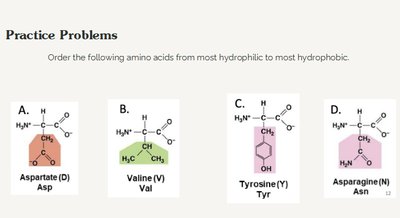
Q1. Order the following amino acids from most hydrophilic to most hydrophobic: Aspartate (D), Valine (V), Tyrosine (Y), Asparagine (N)
Background
Topic: Amino Acid Properties and Protein Structure
This question tests your understanding of how the chemical properties of amino acid side chains (R-groups) affect their solubility and interaction with water. Hydrophilic amino acids interact well with water, while hydrophobic amino acids avoid water.
Key Terms:
Hydrophilic: "Water-loving"; amino acids with polar or charged side chains.
Hydrophobic: "Water-fearing"; amino acids with nonpolar side chains.
R-group: The side chain that determines the properties of each amino acid.
Step-by-Step Guidance
Examine the structure of each amino acid's R-group to determine if it is charged, polar, or nonpolar.
Recall that charged side chains (like Aspartate) are usually the most hydrophilic, followed by uncharged polar side chains (like Asparagine), then polar aromatic side chains (like Tyrosine), and finally nonpolar side chains (like Valine).
Arrange the amino acids based on their side chain properties, starting with the most hydrophilic (charged) and ending with the most hydrophobic (nonpolar).
Review the molecular structures to confirm your order, considering the presence of functional groups such as carboxyl, amine, hydroxyl, and aromatic rings.
Try solving on your own before revealing the answer!
Final Answer:
The correct order from most hydrophilic to most hydrophobic is:
Aspartate (D) → Asparagine (N) → Tyrosine (Y) → Valine (V)
Aspartate is fully charged and interacts strongly with water, Asparagine is polar but uncharged, Tyrosine has a polar OH group but a large hydrophobic ring, and Valine is nonpolar and most hydrophobic.
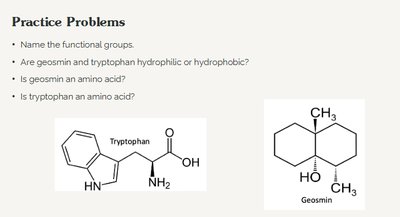
Q2. Name the functional groups present in tryptophan and geosmin. Are geosmin and tryptophan hydrophilic or hydrophobic? Is geosmin an amino acid? Is tryptophan an amino acid?
Background
Topic: Functional Groups and Amino Acid Classification
This question tests your ability to identify functional groups in organic molecules and distinguish between amino acids and other compounds. It also asks you to assess the hydrophilic or hydrophobic nature of these molecules based on their structure.
Key Terms:
Functional group: Specific group of atoms within a molecule that determines its chemical properties.
Amino acid: Organic molecule with an amine (NH2) and carboxyl (COOH) group.
Hydrophilic/Hydrophobic: Based on the presence of polar or nonpolar groups.
Step-by-Step Guidance
Identify the functional groups in tryptophan: Look for amine (NH2), carboxyl (COOH), aromatic ring (indole), and any alkyl chains.
Identify the functional groups in geosmin: Look for alcohol (OH), alkyl groups (CH3), and bicyclic ring structures.
Assess whether each molecule is hydrophilic or hydrophobic by considering the number and type of polar/nonpolar groups present.
Determine if geosmin and tryptophan are amino acids by checking for the presence of both amine and carboxyl groups attached to a central carbon.
Try solving on your own before revealing the answer!
Final Answer:
Tryptophan: Amine (NH2), carboxyl (COOH), aromatic ring (indole), alkyl chain. Mostly hydrophobic, but slightly hydrophilic due to amine and carboxyl groups. It is an amino acid.
Geosmin: Alcohol (OH), multiple alkyl groups (CH3), bicyclic ring. Hydrophobic (big nonpolar ring, only one OH). It is not an amino acid.
Tryptophan is one of the 20 standard amino acids, while geosmin is not.
