 Back
Study Guide: Bond Types, Electronegativity, and Effects of pH in General Biology
Study Guide - Smart Notes
 Tailored notes based on your materials, expanded with key definitions, examples, and context.
Q1. What atoms are involved in the bond by arrow? What is the electronegativity difference between these atoms? Show your work. What type of bond is this?
Background
Topic: Chemical Bonds and Electronegativity
This question tests your understanding of how to determine the type of bond between two atoms based on their electronegativity values. It also asks you to identify the atoms involved and calculate the difference in electronegativity to classify the bond as non-polar covalent, polar covalent, or ionic.
Key Terms and Formulas
Electronegativity: A measure of an atom's ability to attract electrons in a bond.
Bond Types:
Non-polar covalent: Electronegativity difference < 0.5
Polar covalent: Electronegativity difference between 0.5 and 1.7
Ionic: Electronegativity difference > 1.7
Electronegativity values (from worksheet): C = 2.5, N = 3.04, O = 3.44, H = 2.1, P = 2.19
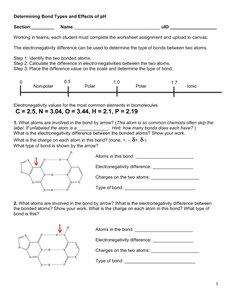
Step-by-Step Guidance
Identify the two atoms involved in the bond indicated by the arrow in the diagram.
Write down the electronegativity values for each atom using the provided table.
Calculate the difference in electronegativity between the two atoms:
Compare the calculated difference to the bond type ranges above to determine the type of bond.
Try solving on your own before revealing the answer!
Final Answer:
Atoms in the bond: C and N
Electronegativity difference:
Type of bond: Polar covalent
The difference falls within the polar covalent range, so the bond is polar covalent.
Q2. What atoms are involved in the bond by arrow? What is the electronegativity difference between these atoms? Show your work. What type of bond is this?
Background
Topic: Chemical Bonds and Electronegativity
This question is similar to Q1, but involves a different pair of atoms. You are asked to identify the atoms, calculate the electronegativity difference, and classify the bond type.
Key Terms and Formulas
Electronegativity values (from worksheet): C = 2.5, N = 3.04, O = 3.44, H = 2.1, P = 2.19
Bond Types:
Non-polar covalent: Electronegativity difference < 0.5
Polar covalent: Electronegativity difference between 0.5 and 1.7
Ionic: Electronegativity difference > 1.7
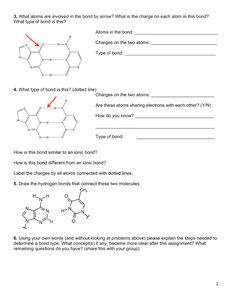
Step-by-Step Guidance
Identify the two atoms involved in the bond indicated by the arrow in the diagram.
Write down the electronegativity values for each atom using the provided table.
Calculate the difference in electronegativity between the two atoms:
Compare the calculated difference to the bond type ranges above to determine the type of bond.
Try solving on your own before revealing the answer!
Final Answer:
Atoms in the bond: C and O
Electronegativity difference:
Type of bond: Polar covalent
The difference falls within the polar covalent range, so the bond is polar covalent.
Q3. What atoms are involved in the bond by arrow? What is the charge on each atom in this bond? What type of bond is this?
Background
Topic: Bond Polarity and Partial Charges
This question tests your ability to identify the atoms in a bond, determine the partial charges based on electronegativity, and classify the bond type.
Key Terms and Formulas
Partial charge: The more electronegative atom will have a partial negative charge (), and the less electronegative atom will have a partial positive charge ().
Bond Types: Non-polar covalent, polar covalent, ionic (see previous definitions).
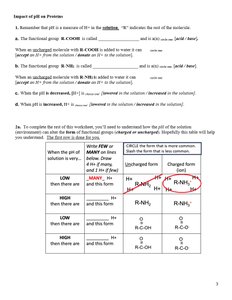
Step-by-Step Guidance
Identify the atoms involved in the bond indicated by the arrow.
Determine which atom is more electronegative using the provided values.
Assign partial charges: to the more electronegative atom, to the less electronegative atom.
Classify the bond type based on the electronegativity difference.
Try solving on your own before revealing the answer!
Final Answer:
Atoms in the bond: N and H
Charges: N (), H ()
Type of bond: Polar covalent
N is more electronegative than H, so it has a partial negative charge.
Q4. What type of bond is this? (dotted line) Are these atoms sharing electrons with each other? How do you know? Type of bond:
Background
Topic: Hydrogen Bonds
This question tests your understanding of hydrogen bonds, which are a type of non-covalent interaction. You are asked to identify whether electrons are shared and to classify the bond.
Key Terms and Formulas
Hydrogen bond: A weak interaction between a hydrogen atom (attached to a highly electronegative atom) and another electronegative atom.
Electrons are not shared in hydrogen bonds; they are based on attraction between partial charges.
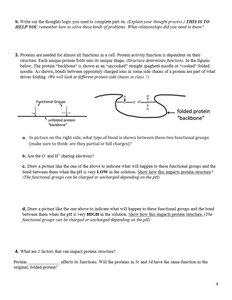
Step-by-Step Guidance
Identify the atoms involved in the dotted line bond.
Determine if electrons are shared between these atoms.
Classify the bond as hydrogen bond or another type based on the interaction.
Try solving on your own before revealing the answer!
Final Answer:
Type of bond: Hydrogen bond
No, electrons are not shared. The bond is formed by attraction between partial charges.
Hydrogen bonds are important for the structure of biological molecules.
Q5. How is this bond similar to an ionic bond? How is this bond different from an ionic bond? Label the charges by all atoms connected with dotted lines. Draw the hydrogen bonds that connect these two molecules.
Background
Topic: Hydrogen Bonds vs. Ionic Bonds
This question asks you to compare hydrogen bonds and ionic bonds, label partial charges, and illustrate hydrogen bonding between molecules.
Key Terms and Formulas
Hydrogen bond: Attraction between partial charges, not full charges.
Ionic bond: Attraction between full positive and negative charges.
Partial charge: and
Step-by-Step Guidance
Identify the atoms involved in hydrogen bonding between the two molecules.
Label partial charges ( and ) on the relevant atoms.
Compare hydrogen bonds to ionic bonds: both involve attraction, but hydrogen bonds are between partial charges, ionic bonds are between full charges.
Draw the hydrogen bonds as dotted lines connecting the molecules.
Try solving on your own before revealing the answer!
Final Answer:
Hydrogen bonds are similar to ionic bonds because both involve electrostatic attraction, but hydrogen bonds are between partial charges ( and ), while ionic bonds are between full charges.
Hydrogen bonds are drawn as dotted lines between the molecules, connecting the partial charges.
Q6. Using your own words (not without looking at problems above) please explain the steps needed to determine bond type. What questions do you need to ask? Did you feel more clear after this assignment? What remaining questions do you still have?
Background
Topic: Bond Type Determination and Reflection
This question asks you to reflect on the process of determining bond types and your understanding after completing the assignment.
Key Terms and Formulas
Electronegativity difference
Bond types: non-polar covalent, polar covalent, ionic, hydrogen bond
Step-by-Step Guidance
List the steps you would take to determine the type of bond between two atoms (e.g., identify atoms, find electronegativity values, calculate difference, compare to bond type ranges).
Consider what questions you need to ask at each step (e.g., "What are the electronegativity values?", "Is the difference large or small?").
Reflect on your understanding and any remaining questions you have.
Try solving on your own before revealing the answer!
Final Answer:
To determine bond type, you need to: 1) identify the atoms involved, 2) find their electronegativity values, 3) calculate the difference, and 4) compare to bond type ranges. Ask questions like "What are the electronegativity values?" and "Is the difference large enough for an ionic bond?" Reflection: This assignment clarifies the process, but you may still have questions about exceptions or more complex molecules.
Q7. Impact of pH on Proteins: What happens to the functional group R-NH2 when pH is low? What happens when pH is high?
Background
Topic: pH Effects on Functional Groups
This question tests your understanding of how pH affects the charge and structure of amino groups in proteins.
Key Terms and Formulas
pH: Measure of hydrogen ion concentration
Functional group: R-NH2 (amino group)
At low pH: more H+ ions, amino group gains a proton ()
At high pH: fewer H+ ions, amino group loses a proton ()
Step-by-Step Guidance
Recall that low pH means high concentration of H+ ions.
Consider how the amino group (R-NH2) interacts with H+ ions at low pH.
Consider what happens to the amino group at high pH (fewer H+ ions).
Write the chemical forms for each pH condition.
Try solving on your own before revealing the answer!
Final Answer:
At low pH, the amino group (R-NH2) gains a proton and becomes R-NH3+ (positively charged). At high pH, it loses a proton and remains as R-NH2 (uncharged).
This change affects protein structure and function.
Q8. What are 2 factors that can impact protein structure?
Background
Topic: Protein Structure and Stability
This question tests your understanding of factors that influence protein folding and stability.
Key Terms and Formulas
Protein structure: Primary, secondary, tertiary, quaternary
Factors: pH, temperature, ionic strength, presence of cofactors
Step-by-Step Guidance
Think about environmental conditions that can affect protein structure (e.g., pH, temperature).
Consider how changes in these factors can lead to denaturation or altered function.
Try solving on your own before revealing the answer!
Final Answer:
Two factors that impact protein structure are pH and temperature. Changes in either can cause proteins to unfold or lose function.
