 Back
Study Guide: Carbon Compounds and Biological Molecules – Step-by-Step Guidance
Study Guide - Smart Notes
 Tailored notes based on your materials, expanded with key definitions, examples, and context.
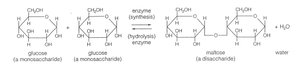
Q1. Describe the condensation reaction that occurs between two monosaccharides to form a disaccharide.
Background
Topic: Carbohydrates & Dehydration Synthesis
This question tests your understanding of how monosaccharides (simple sugars) combine to form disaccharides through a condensation (dehydration) reaction, which is a fundamental process in biochemistry.
Key Terms and Formulas:
Monosaccharide: A single sugar molecule (e.g., glucose).
Disaccharide: Two monosaccharides joined together (e.g., maltose).
Condensation (Dehydration) Reaction: A chemical reaction where two molecules are joined by removing a water molecule.
Glycosidic Bond: The covalent bond formed between two monosaccharides.
Step-by-Step Guidance
Identify the two monosaccharides involved in the reaction (e.g., two glucose molecules).
Locate the hydroxyl group () on one glucose and the hydrogen () on the other glucose that will participate in the reaction.
Understand that these groups combine to form a water molecule (), which is released during the reaction.
The remaining atoms from each glucose are joined by a glycosidic bond, forming a disaccharide (e.g., maltose).
Set up the equation for the reaction:
Try solving on your own before revealing the answer!
Final Answer:
During the condensation reaction, the hydroxyl group from one glucose and the hydrogen from another glucose combine to form water (), and the remaining glucose molecules are joined by a glycosidic bond to form maltose (a disaccharide).
This process is catalyzed by enzymes and is essential for forming larger carbohydrate molecules in living organisms.
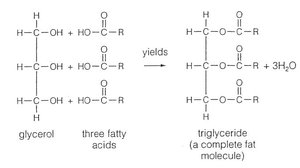
Q2. Describe the formation of a triglyceride from glycerol and three fatty acids.
Background
Topic: Lipids & Dehydration Synthesis
This question tests your understanding of how triglycerides (fats) are formed from glycerol and fatty acids through a condensation (dehydration) reaction, which is important for energy storage in cells.
Key Terms and Formulas:
Glycerol: A three-carbon molecule with hydroxyl groups.
Fatty Acid: Long hydrocarbon chain with a carboxyl group.
Triglyceride: A fat molecule formed from glycerol and three fatty acids.
Condensation (Dehydration) Reaction: Joins molecules by removing water.
Ester Bond: The covalent bond formed between glycerol and fatty acids.
Step-by-Step Guidance
Identify the glycerol molecule and three fatty acid molecules as reactants.
Locate the hydroxyl groups () on glycerol and the carboxyl groups () on each fatty acid.
Each fatty acid reacts with a hydroxyl group on glycerol, releasing a water molecule () for each bond formed.
The remaining atoms are joined by ester bonds, resulting in a triglyceride molecule.
Set up the equation for the reaction:
Try solving on your own before revealing the answer!
Final Answer:
Three fatty acids each react with a hydroxyl group on glycerol, releasing three water molecules () and forming ester bonds. The result is a triglyceride, which is a major form of energy storage in cells.
This process is essential for the synthesis of fats in biological systems.
