 Back
BackStudy Guide: Cellular Respiration, Photosynthesis, and Bioenergetics
Study Guide - Smart Notes
 Tailored notes based on your materials, expanded with key definitions, examples, and context.
Q1. When an enzyme catalyzes a reaction, what does it do?
Background
Topic: Enzyme Function
This question tests your understanding of how enzymes affect chemical reactions in biological systems.
Key Terms and Concepts:
Enzyme: A biological catalyst that speeds up chemical reactions without being consumed.
Activation Energy: The minimum energy required for a reaction to proceed.
Step-by-Step Guidance
Recall that enzymes are proteins that facilitate biochemical reactions by interacting with substrates.
Think about what happens to the activation energy of a reaction when an enzyme is present.
Consider whether enzymes are used up in the reaction or can be reused.
Try solving on your own before revealing the answer!
Final Answer: It lowers the activation energy of the reaction.
Enzymes work by lowering the activation energy barrier, making it easier for reactions to occur at cellular temperatures.
Q2. Oxidation is the ______, and reduction is the ______.
Background
Topic: Redox Reactions
This question tests your knowledge of oxidation-reduction (redox) reactions, which are fundamental to cellular respiration and photosynthesis.
Key Terms and Concepts:
Oxidation: The loss of electrons from a molecule, atom, or ion.
Reduction: The gain of electrons by a molecule, atom, or ion.
Step-by-Step Guidance
Remember the mnemonic "OIL RIG": Oxidation Is Loss, Reduction Is Gain (of electrons).
Apply this to the blanks in the question: oxidation involves losing electrons, reduction involves gaining electrons.
Try solving on your own before revealing the answer!
Final Answer: loss of electrons; gain of electrons
Oxidation and reduction always occur together in redox reactions.
Q3. Which statements about cellular respiration and photosynthesis are true?
Background
Topic: Cellular Respiration and Photosynthesis
This question asks you to identify correct statements about the redox changes and energy flow in cellular respiration and photosynthesis.
Key Terms and Concepts:
Oxidation: Loss of electrons.
Reduction: Gain of electrons.
Endergonic Reaction: Requires energy input.
Exergonic Reaction: Releases energy.
Step-by-Step Guidance
Recall that in aerobic cellular respiration, glucose is oxidized and oxygen is reduced.
Remember that photosynthesis is an endergonic process (requires energy input from sunlight).
Consider which statements accurately describe the redox changes in both processes.
Try solving on your own before revealing the answer!
Final Answer: The reactant carbon is oxidized in aerobic cellular respiration; Photosynthesis is an endergonic process (overall endothermic reaction).
These statements correctly describe the redox and energy changes in these processes.
Q4. The breakdown of which reactant is used to produce energy for the cell and begins with glycolysis?
Background
Topic: Cellular Respiration
This question tests your understanding of the starting molecule for cellular respiration and glycolysis.
Key Terms and Concepts:
Glycolysis: The first step in cellular respiration, where glucose is broken down in the cytoplasm.
Glucose: A six-carbon sugar that is the main energy source for cells.
Step-by-Step Guidance
Recall the main substrate that enters glycolysis in cellular respiration.
Think about which molecule is broken down to release energy for the cell.
Try solving on your own before revealing the answer!
Final Answer: Glucose
Glycolysis is the breakdown of glucose to pyruvate, producing ATP and NADH.
Q5. Stages two and three of cellular respiration take place in which organelle?
Background
Topic: Cellular Respiration
This question tests your knowledge of the location of the citric acid cycle and oxidative phosphorylation in eukaryotic cells.
Key Terms and Concepts:
Mitochondria: The organelle where the citric acid cycle and oxidative phosphorylation occur.
Cytosol: The fluid part of the cytoplasm where glycolysis occurs.
Step-by-Step Guidance
Recall which organelle is known as the "powerhouse of the cell" and is responsible for most ATP production.
Think about where the citric acid cycle and electron transport chain are located within the cell.
Try solving on your own before revealing the answer!
Final Answer: Mitochondria
Both the citric acid cycle and oxidative phosphorylation occur in the mitochondria.
Q6. When a cell uses chemical energy to perform work, it couples which types of reactions?
Background
Topic: Bioenergetics
This question tests your understanding of how cells use energy from exergonic reactions to drive endergonic reactions.
Key Terms and Concepts:
Exergonic Reaction: Releases energy.
Endergonic Reaction: Requires energy input.
Step-by-Step Guidance
Recall that cells often use the energy released from ATP hydrolysis (an exergonic reaction) to power cellular processes that require energy (endergonic reactions).
Think about the direction of energy flow between these reactions.
Try solving on your own before revealing the answer!
Final Answer: Exergonic; endergonic
Cells couple exergonic reactions to endergonic reactions to drive processes that require energy input.
Q7. Which statement regarding the movement of electrons during cellular respiration is true?
Background
Topic: Cellular Respiration - Electron Transport
This question tests your understanding of how electrons are transferred during cellular respiration.
Key Terms and Concepts:
Oxidation: Loss of electrons (often from carbon in glucose).
Electron Transport Chain: Series of proteins that transfer electrons to oxygen, forming water.
Step-by-Step Guidance
Recall that during cellular respiration, carbon atoms in glucose are oxidized, and electrons are transferred to oxygen.
Think about what happens to carbon when it loses electrons and forms carbon dioxide.
Try solving on your own before revealing the answer!
Final Answer: Carbon is oxidized when it donates electrons to oxygen and forms carbon dioxide.
This describes the fate of carbon atoms during aerobic respiration.
Q8. In the exergonic reaction A + B → C + heat, what is true about the potential energy of the products?
Background
Topic: Exergonic Reactions
This question tests your understanding of energy changes in exergonic reactions.
Key Terms and Concepts:
Exergonic Reaction: A reaction that releases energy (often as heat).
Potential Energy: Stored energy in chemical bonds.
Step-by-Step Guidance
Recall that in exergonic reactions, energy is released, so the products have less potential energy than the reactants.
Think about the energy difference between reactants and products.
Try solving on your own before revealing the answer!
Final Answer: The potential energy of the products is less than that of the reactant.
Energy is released as heat, so products have lower energy.
Q9. Which statement regarding photosynthesis and cellular respiration is true?
Background
Topic: Photosynthesis vs. Cellular Respiration
This question tests your knowledge of where these processes occur in the cell.
Key Terms and Concepts:
Photosynthesis: Occurs in chloroplasts.
Cellular Respiration: Occurs in mitochondria.
Step-by-Step Guidance
Recall the organelles responsible for each process in plant cells.
Match the process to the correct organelle.
Try solving on your own before revealing the answer!
Final Answer: Photosynthesis occurs in chloroplasts, and cellular respiration occurs in mitochondria.
This is a fundamental distinction in plant cell biology.
Q10. Which of the following equations represent photosynthesis incorrectly?
Background
Topic: Photosynthesis Equation
This question tests your ability to recognize the correct chemical equation for photosynthesis.
Key Terms and Concepts:
Photosynthesis Equation:
Step-by-Step Guidance
Recall the balanced equation for photosynthesis.
Compare each option to the correct equation and identify any that are unbalanced or have incorrect reactants/products.
Try solving on your own before revealing the answer!
Final Answer: Any equation that does not match is incorrect.
Check for correct numbers of atoms and correct products.
Q11. During redox reactions, what happens to electrons?
Background
Topic: Redox Reactions
This question tests your understanding of electron transfer during oxidation and reduction.
Key Terms and Concepts:
Redox Reaction: Involves the transfer of electrons from one substance to another.
Step-by-Step Guidance
Recall that oxidation is the loss of electrons and reduction is the gain of electrons.
Think about how electrons move between molecules during these reactions.
Try solving on your own before revealing the answer!
Final Answer: Electrons are lost from one substance and added to another substance.
This is the essence of redox reactions.
Q12. In which stage is most of the ATP generated during aerobic cellular respiration?
Background
Topic: Cellular Respiration - ATP Production
This question tests your knowledge of where the majority of ATP is produced in aerobic respiration.
Key Terms and Concepts:
Glycolysis: Produces a small amount of ATP.
Citric Acid Cycle: Produces a small amount of ATP.
Oxidative Phosphorylation (Electron Transport Chain): Produces the majority of ATP.
Step-by-Step Guidance
Recall the three main stages of cellular respiration and the amount of ATP produced in each.
Identify which stage is responsible for the bulk of ATP synthesis.
Try solving on your own before revealing the answer!
Final Answer: During stage 3: oxidative phosphorylation (electron transport chain)
This stage uses the energy from electrons to produce ATP.
Q13. In this drawing, if structure C represents a thylakoid membrane and region A represents the stroma, what organelle is being depicted?
Background
Topic: Chloroplast Structure
This question tests your ability to identify organelles based on internal structures.
Key Terms and Concepts:
Thylakoid Membrane: Site of the light-dependent reactions of photosynthesis.
Stroma: Fluid-filled space surrounding thylakoids in chloroplasts.
Step-by-Step Guidance
Recall the internal structure of chloroplasts, including thylakoids and stroma.
Identify which organelle contains these structures.
Try solving on your own before revealing the answer!
Final Answer: Chloroplast
Chloroplasts contain thylakoid membranes and stroma, essential for photosynthesis.
Q14. What is the source of energy that provides the boost for electrons during photosynthesis?
Background
Topic: Photosynthesis - Light Reactions
This question tests your understanding of the energy source for the light-dependent reactions of photosynthesis.
Key Terms and Concepts:
Light Energy: Absorbed by chlorophyll to excite electrons.
Step-by-Step Guidance
Recall what powers the movement of electrons in the light reactions of photosynthesis.
Think about the role of sunlight in energizing electrons in chlorophyll.
Try solving on your own before revealing the answer!
Final Answer: Light
Light energy excites electrons, initiating the light-dependent reactions.
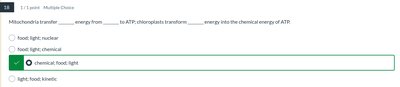
Q15. Mitochondria transfer ______ energy from ______ to ATP; chloroplasts transform ______ energy into the chemical energy of ATP.
Background
Topic: Energy Transformation in Organelles
This question tests your understanding of how mitochondria and chloroplasts convert energy.
Key Terms and Concepts:
Mitochondria: Convert chemical energy from food into ATP.
Chloroplasts: Convert light energy into chemical energy (ATP and NADPH).
Step-by-Step Guidance
Recall the source of energy for mitochondria (food) and for chloroplasts (light).
Think about the type of energy each organelle produces (chemical energy in ATP).
Try solving on your own before revealing the answer!
Final Answer: Mitochondria transfer chemical energy from food to ATP; chloroplasts transform light energy into the chemical energy of ATP.
This highlights the complementary roles of these organelles.
Q16. What is the basic difference between exergonic (exothermic) and endergonic (endothermic) reactions?
Background
Topic: Bioenergetics
This question tests your understanding of energy changes in chemical reactions.
Key Terms and Concepts:
Exergonic Reaction: Releases energy overall.
Endergonic Reaction: Absorbs energy overall.
Step-by-Step Guidance
Recall the direction of energy flow in each type of reaction.
Think about whether energy is released or absorbed overall.
Try solving on your own before revealing the answer!
Final Answer: Exergonic reactions release energy overall; endergonic reactions absorb energy overall.
This is the fundamental distinction between these reaction types.
Q17. What does the dashed line represent in the reaction energy diagram?
Background
Topic: Enzyme Catalysis
This question tests your ability to interpret reaction energy diagrams and understand the effect of enzymes.
Key Terms and Concepts:
Activation Energy: The energy barrier that must be overcome for a reaction to proceed.
Catalyzed Reaction: A reaction whose activation energy has been lowered by an enzyme.
Step-by-Step Guidance
Compare the solid and dashed lines in the diagram. Which one has a lower peak (activation energy)?
Recall that enzymes lower the activation energy, making reactions proceed faster.
Try solving on your own before revealing the answer!
Final Answer: The dashed line represents a reaction that has been catalyzed by an enzyme.
The lower peak shows reduced activation energy due to enzyme action.
Q18. Photosynthesis is able to convert water into oxygen during the Light Reaction phase of energy production in plants. This takes place in which organelle and structure?
Background
Topic: Photosynthesis - Light Reactions
This question tests your knowledge of where the light reactions of photosynthesis occur in plant cells.
Key Terms and Concepts:
Chloroplast: Organelle where photosynthesis occurs.
Thylakoid Membrane: Site of the light-dependent reactions.
Step-by-Step Guidance
Recall which organelle contains the thylakoid membranes.
Think about where the splitting of water and release of oxygen occurs during photosynthesis.
Try solving on your own before revealing the answer!
Final Answer: Photosynthesis, chloroplast, thylakoid (with chlorophyll)
The light reactions occur in the thylakoid membranes of chloroplasts.
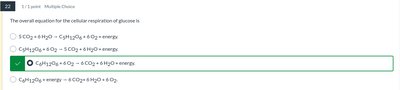
Q19. The overall equation for the cellular respiration of glucose is:
Background
Topic: Cellular Respiration Equation
This question tests your ability to recognize the correct chemical equation for cellular respiration.
Key Terms and Concepts:
Cellular Respiration Equation:
Step-by-Step Guidance
Recall the reactants and products of aerobic cellular respiration.
Check for the correct number of atoms on both sides of the equation.
Try solving on your own before revealing the answer!
Final Answer:
This is the balanced equation for aerobic respiration of glucose.
Q20. CO2 enters and O2 escapes from a leaf via which structures?
Background
Topic: Plant Gas Exchange
This question tests your knowledge of how gases move in and out of plant leaves.
Key Terms and Concepts:
Stomata (Stomatal Pores): Small openings on the underside of leaves that allow gas exchange.
Step-by-Step Guidance
Recall the structures responsible for gas exchange in plant leaves.
Think about how CO2 enters and O2 exits during photosynthesis.
Try solving on your own before revealing the answer!
Final Answer: Stomatal pores
Stomata regulate the exchange of gases in plant leaves.
Q21. Which process is endergonic (endothermic)?
Background
Topic: Photosynthesis vs. Cellular Respiration
This question tests your understanding of which biological processes require energy input.
Key Terms and Concepts:
Endergonic Process: Requires energy input (e.g., photosynthesis).
Exergonic Process: Releases energy (e.g., cellular respiration).
Step-by-Step Guidance
Recall which process builds glucose from CO2 and H2O, requiring energy from sunlight.
Think about whether the process absorbs or releases energy overall.
Try solving on your own before revealing the answer!
Final Answer: Photosynthesis (the synthesis of glucose from carbon dioxide and water)
Photosynthesis is an endergonic process because it requires energy input from sunlight.
Q22. The processes of photosynthesis and cellular respiration are complementary. During these energy conversions, especially during cellular respiration, some energy is ______.
Background
Topic: Energy Flow in Cells
This question tests your understanding of energy loss as heat during metabolic processes.
Key Terms and Concepts:
Heat Loss: Not all energy from glucose is converted to ATP; some is lost as heat.
Step-by-Step Guidance
Recall the second law of thermodynamics and how it applies to biological systems.
Think about what happens to energy that is not captured in ATP during cellular respiration.
Try solving on your own before revealing the answer!
Final Answer: Lost in the form of heat
Some energy is always lost as heat during energy conversions.
Q23. Why are most plants green?
Background
Topic: Plant Pigments
This question tests your understanding of why plants appear green to our eyes.
Key Terms and Concepts:
Chlorophyll: The main pigment in plants that reflects green light.
Step-by-Step Guidance
Recall what happens to light that is not absorbed by pigments in plant cells.
Think about which wavelengths of light are reflected by chlorophyll.
Try solving on your own before revealing the answer!
Final Answer: Many chlorophyll dyes reflect green light.
Chlorophyll absorbs red and blue light, reflecting green.
Q24. The full range of electromagnetic energy is called the ______ spectrum, and photosynthesis utilizes the ______ portion of the spectrum.
Background
Topic: Light and Photosynthesis
This question tests your knowledge of the electromagnetic spectrum and the light used in photosynthesis.
Key Terms and Concepts:
Electromagnetic Spectrum: The entire range of electromagnetic radiation.
Visible Light: The portion of the spectrum used in photosynthesis.
Step-by-Step Guidance
Recall the different types of electromagnetic radiation (gamma rays, X-rays, UV, visible, IR, microwaves, radio waves).
Think about which part of the spectrum is absorbed by chlorophyll for photosynthesis.
Try solving on your own before revealing the answer!
Final Answer: Electromagnetic; visible
Photosynthesis uses visible light from the electromagnetic spectrum.
Q25. Which statement concerning the role of oxidation-reduction reactions in photosynthesis and cellular respiration is true?
Background
Topic: Redox Reactions in Metabolism
This question tests your understanding of how redox reactions are involved in both photosynthesis and cellular respiration.
Key Terms and Concepts:
Oxidation: Loss of electrons.
Reduction: Gain of electrons.
Step-by-Step Guidance
Recall that in photosynthesis, carbon in CO2 is reduced to form glucose.
In respiration, carbon in glucose is oxidized to form CO2.
Try solving on your own before revealing the answer!
Final Answer: In photosynthesis, the carbon in carbon dioxide is reduced to form sugar; in respiration, the carbon in sugar is oxidized to form carbon dioxide.
This describes the complementary redox roles in these processes.
