 Back
Study Guide: Characteristics of Life in General Biology
Study Guide - Smart Notes
 Tailored notes based on your materials, expanded with key definitions, examples, and context.
Q1. Which of the following is NOT a characteristic of life?
Background
Topic: Characteristics of Life
This question tests your understanding of the fundamental traits that define living organisms and distinguish them from nonliving things.
Key Terms:
Organization: Living things are organized in a hierarchy (cells, tissues, organs, etc.).
Homeostasis: The ability to maintain stable internal conditions.
Energy Conversion: Living things can convert energy (e.g., photosynthesis).
Genetic Information: DNA stores hereditary information.
Step-by-Step Guidance
Review each answer choice and consider whether it describes a property shared by all living organisms.
Recall that living things must be able to maintain internal stability, reproduce, grow, respond to stimuli, and use energy.
Think about whether the structure of an organism, ability to regulate temperature, energy conversion, or DNA storage are universal characteristics.
Identify which option does not fit with the others as a core characteristic of life.
Try solving on your own before revealing the answer!
Final Answer: a) Structure of an organism based on a hierarchy of organization.
While organization is a feature of life, the specific structure hierarchy is not always considered a defining characteristic compared to the others listed.
Q2. All of the following are characteristics of life EXCEPT:
Background
Topic: Characteristics of Life
This question asks you to identify which trait is not universally considered a characteristic of living organisms.
Key Terms:
Evolution: Change in populations over time.
Multicellularity: Having more than one cell.
Homeostasis: Maintaining internal balance.
Reproduction: Ability to produce offspring.
Step-by-Step Guidance
Review each option and ask if it applies to all living things.
Remember that some organisms are unicellular, so multicellularity is not universal.
Consider whether evolution, homeostasis, and reproduction are required for life.
Identify the option that is not a characteristic shared by all living organisms.
Try solving on your own before revealing the answer!
Final Answer: b) Multicellularity.
Not all living organisms are multicellular; many are unicellular, so multicellularity is not a universal characteristic of life.
Q3. Salt concentration in blood remains relatively steady, regardless of a person’s diet. This best illustrates:
Background
Topic: Homeostasis
This question tests your understanding of how living organisms regulate their internal environment to maintain stable conditions.
Key Terms:
Homeostasis: The process of maintaining internal stability.
Organizational Hierarchy: Levels of biological organization.
Autotrophy: Ability to produce own food.
Evolution: Change over time.
Step-by-Step Guidance
Read the scenario and identify what is being described (steady salt concentration).
Recall the definition of homeostasis and how it applies to internal regulation.
Compare the other options to see if they fit the scenario.
Determine which term best describes the process of maintaining stable internal conditions.
Try solving on your own before revealing the answer!
Final Answer: a) Homeostasis.
Homeostasis is the process by which living organisms maintain stable internal conditions, such as salt concentration in blood.
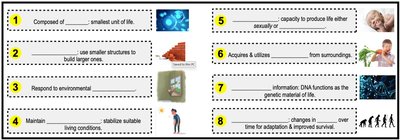
Q4. Fill in the blanks: Eight Characteristics of Life
Background
Topic: Characteristics of Life
This exercise helps you recall and understand the eight fundamental characteristics that define living organisms.
Key Terms:
Cell: Smallest unit of life.
Organization: Use of smaller structures to build larger ones.
Response: Reacting to environmental stimuli.
Homeostasis: Maintaining stable internal conditions.
Reproduction: Ability to produce offspring.
Energy: Acquiring and utilizing energy from surroundings.
Genetic Information: DNA as hereditary material.
Evolution: Changes over time for adaptation.
Step-by-Step Guidance
Review each numbered statement and the associated image for clues about the characteristic.
Recall the eight characteristics: cellular organization, organization, response to environment, homeostasis, reproduction, energy use, genetic information, and evolution.
Match each blank with the appropriate term based on the description and image.
Write the correct term in each blank, but stop before filling in the last two blanks.
Try solving on your own before revealing the answer!
Final Answer:
cells
organization
stimuli
homeostasis
reproduction
energy
genetic
evolution
These are the eight fundamental characteristics that define living organisms in biology.
