 Back
BackStudy Guide: Chromosome Structure, Dihybrid Crosses, and the Genetic Code
Study Guide - Smart Notes
 Tailored notes based on your materials, expanded with key definitions, examples, and context.
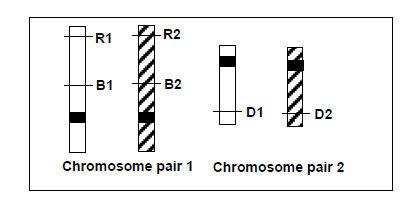
Q1. Examine the diagram of chromosome pairs. What do the labels R1, R2, B1, B2, D1, and D2 represent, and how do these relate to homologous chromosomes?
Background
Topic: Chromosome Structure and Homologous Chromosomes
This question is testing your understanding of how genes (loci) and alleles are organized on homologous chromosomes, and how to interpret chromosome diagrams in genetics.
Key Terms and Concepts:
Homologous Chromosomes: Chromosome pairs (one from each parent) that are similar in length, gene position, and centromere location.
Alleles: Different versions of a gene found at the same locus on homologous chromosomes.
Locus (plural: loci): The specific physical location of a gene on a chromosome.
Step-by-Step Guidance
Observe that each chromosome pair consists of two chromosomes: one inherited from the mother (open rectangle) and one from the father (hatched rectangle).
Notice that each chromosome has labeled regions (R1, R2, B1, B2, D1, D2). These labels represent specific gene loci and their alleles. For example, R1 and R2 are the same gene locus but different alleles (maternal and paternal).
Understand that homologous chromosomes have the same genes in the same order, but may have different alleles at those loci (e.g., R1 vs. R2).
Consider how these labeled loci would segregate during cell division, and how they contribute to genetic variation.
Try solving on your own before revealing the answer!
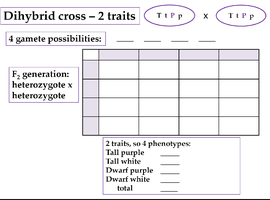
Q2. Complete the dihybrid cross Punnett square for two traits (TtPp x TtPp). List all possible gametes, fill in the Punnett square, and determine the phenotypic ratios for the F2 generation.
Background
Topic: Mendelian Genetics – Dihybrid Crosses
This question is testing your ability to set up and analyze a dihybrid cross, which involves two genes, each with two alleles. You will use a Punnett square to predict the genotypes and phenotypes of offspring.
Key Terms and Concepts:
Dihybrid Cross: A cross between individuals heterozygous for two traits (e.g., TtPp x TtPp).
Punnett Square: A grid used to predict the genotypes of offspring from parental gametes.
Phenotypic Ratio: The ratio of different observable traits in the offspring.
Step-by-Step Guidance
List all possible gametes each parent can produce. For TtPp, use the FOIL method to determine the combinations (e.g., TP, Tp, tP, tp).
Set up a 4x4 Punnett square, placing the gametes from one parent on the top and the other on the side.
Fill in each box by combining the alleles from the corresponding row and column to get the genotype of each possible offspring.
Count the number of each genotype and group them by phenotype (e.g., tall purple, tall white, dwarf purple, dwarf white).
Try solving on your own before revealing the answer!
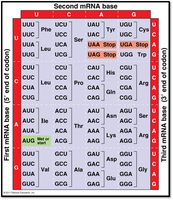
Q3. Use the genetic code chart to determine which amino acid is coded by the RNA codon UAG. What is the significance of this codon in translation?
Background
Topic: Gene Expression – The Genetic Code
This question is testing your ability to use a codon chart to translate mRNA codons into amino acids and to understand the role of stop codons in protein synthesis.
Key Terms and Concepts:
Codon: A sequence of three RNA nucleotides that codes for a specific amino acid or a stop signal during translation.
Translation: The process by which ribosomes synthesize proteins using mRNA as a template.
Stop Codon: A codon that signals the end of translation (e.g., UAG, UAA, UGA).
Step-by-Step Guidance
Locate the first base (U) on the left side of the chart, the second base (A) on the top, and the third base (G) on the right.
Find the intersection of these three bases to identify the amino acid or function coded by UAG.
Consider what happens during translation when a ribosome encounters this codon.
Try solving on your own before revealing the answer!
