 Back
Study Guide: Electronegativity, Bond Types, and Biological Relevance
Study Guide - Smart Notes
 Tailored notes based on your materials, expanded with key definitions, examples, and context.
Q1. Predict the Bond in Real Substances
Background
Topic: Electronegativity and Bond Types
This question tests your understanding of how to use electronegativity values to predict whether a bond is ionic, polar covalent, or nonpolar covalent.
Key Terms and Formulas
Electronegativity (EN): A measure of an atom's ability to attract electrons in a bond.
Bond Type: Determined by the difference in EN between two atoms.
Typical bond type cutoffs:
Nonpolar covalent: EN difference < 0.5
Polar covalent: EN difference between 0.5 and 1.7
Ionic: EN difference > 1.7
Step-by-Step Guidance
Identify the elements in each compound and find their electronegativity values using the reference table.
Calculate the EN difference for each pair of atoms.
Compare the EN difference to the cutoffs above to classify the bond type.
Record your classification for each compound.
Try solving on your own before revealing the answer!
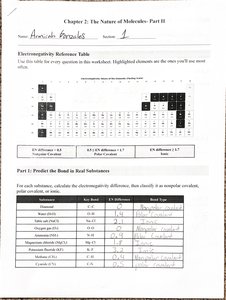
Final Answer:
The bond types for the compounds are:
NaCl: Ionic
MgCl2: Ionic
MgO: Ionic
HCl: Polar covalent
O2: Nonpolar covalent
These classifications are based on the EN differences calculated using the reference table.
Q2. Draw the Bond
Background
Topic: Lewis Dot Structures and Bond Polarity
This question tests your ability to draw Lewis dot structures for molecules and indicate bond polarity using partial charges and arrows.
Key Terms and Formulas
Lewis Dot Structure: Diagram showing valence electrons around atoms.
Bond Polarity: Indicated by partial charges (δ+ and δ-) and arrows pointing toward the more electronegative atom.
Step-by-Step Guidance
Draw the Lewis dot structure for each molecule, showing all valence electrons.
Identify the bond type (ionic, polar covalent, or nonpolar covalent) based on EN difference.
For polar bonds, indicate partial charges and draw an arrow toward the more electronegative atom.
Label the atoms and charges clearly.
Try solving on your own before revealing the answer!
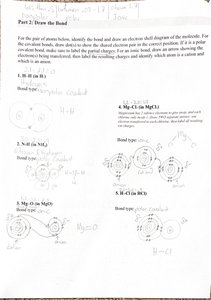
Final Answer:
Each molecule's Lewis dot structure should show valence electrons, bond type, partial charges, and arrows indicating bond polarity. For example, NaCl and MgCl2 are ionic, so electrons are transferred; HCl is polar covalent, so partial charges and arrows are shown.
Q3. Analyzing a Real Molecule: Ethanol
Background
Topic: Electronegativity Differences in Organic Molecules
This question tests your ability to analyze the bonds in ethanol (C2H5OH) by calculating EN differences and predicting bond polarity.
Key Terms and Formulas
Ethanol: An alcohol with the formula C2H5OH.
EN Difference: Used to predict bond polarity.
Step-by-Step Guidance
Identify each bond in the ethanol molecule (C-H, C-O, O-H).
Find the EN values for each atom using the reference table.
Calculate the EN difference for each bond.
Classify each bond as polar or nonpolar based on the EN difference.
Try solving on your own before revealing the answer!
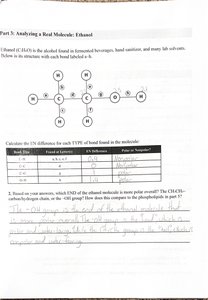
Final Answer:
The EN differences for ethanol's bonds are:
C-H: Nonpolar covalent
C-O: Polar covalent
O-H: Polar covalent
The O-H bond is the most polar, making the hydroxyl end of ethanol more polar than the hydrocarbon end.
Q4. Ranking Polarity
Background
Topic: Comparing Bond Polarity
This question tests your ability to rank bonds by their polarity based on EN differences.
Key Terms and Formulas
Bond Polarity: Determined by EN difference.
Ranking: From least to most polar.
Step-by-Step Guidance
List the bonds (C-F, C-Cl, C-Br, C-I).
Find EN values for C and each halogen.
Calculate EN differences for each bond.
Rank the bonds from least to most polar based on EN difference.
Try solving on your own before revealing the answer!
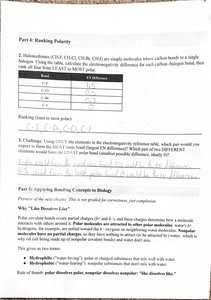
Final Answer:
Ranking from least to most polar: C-I < C-Br < C-Cl < C-F. The C-F bond is the most polar due to the largest EN difference.
Q5. Applying Bonding Concepts to Biology
Background
Topic: Biological Relevance of Bond Polarity
This question tests your ability to apply concepts of bond polarity to biological systems, such as water solubility, cell membranes, proteins, and ion transport.
Key Terms and Formulas
Polar vs. Nonpolar: Determines solubility and biological function.
Phospholipids: Have polar and nonpolar regions.
Proteins: Structure and function depend on polarity.
Ions: Na+, K+, Cl- are essential for cell signaling.
Step-by-Step Guidance
For each scenario, identify the relevant bond types and their polarity.
Explain how polarity affects solubility, membrane structure, or protein function.
Use EN differences to justify your predictions.
Relate the chemical concepts to biological outcomes.
Try solving on your own before revealing the answer!
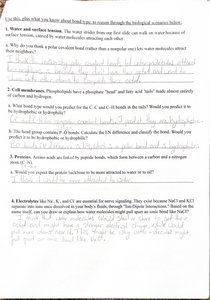
Final Answer:
Polar bonds increase solubility in water, affect membrane structure, and influence protein interactions. EN differences help predict which molecules are more likely to interact with water or other polar substances.
